Lorenzo Tugnoli's Projects

Tens of thousands of Yemenis have been scrambling from their villages as fighting closed in on the strategic port city of Hodeida, inflaming a humanitarian crisis already considered the most severe in the world. Refugee settlements have sprung up across southern Yemen, multiplying the pressure on Western aid agencies and hospitals struggling to cope with injuries, disease and hunger. About three-quarters of Yemen’s 30 million people are now in need of assistance, and nearly a third of those are on the brink of famine. The war has killed more than 10,000 civilians, thousands more have died of disease and more than 3 million people have been driven from their homes. At the end of May I travelled across southern Yemen on assignment for the Washington Post to report on the development of the crisis created by this new offensive. We visited IDP camps and hospitals as well as the frontline that at the time was located near the town of Khokha.

Since October 2015 Hebron (or Al Khalil in Arabic) was at the centre of a new wave of violence. In this city of southern West Bank settlers and Palestinians live in close proximity in the area around the Ibrahimi mosque, or the Cave of the Patriarchs, a site revered by both religions. Over the following months stabbing attacks and confrontations at Israeli army checkpoints occurred on a daily basis. On November 1st, 2015 part of the Old town was declared closed military zone and since then only residents are allowed inside. I spent the month of November documenting how the on-going tensions are affecting the life of residents. The recent unrest in the West Bank was triggered by disputes over the status of Al-Aqsa Mosque in East Jerusalem and resulted until now in over 140 Palestinians and 25 Israeli casualties. But Hebron has been for years the theatre of tensions between Palestinians and settlers. In 1997 the city has been divided into H1 area under Palestinian control and H2 under Israeli control. H2 is home to approximately 30,000 Palestinians and 500 Israeli settlers and around 2000 members of Israeli security forces. Following 1994 massacre of 29 Muslims praying at the Ibrahimi Mosque by Israeli-American doctor Baruch Goldstein, part of H2 have been closed to Palestinian vehicles and non-resident, and the holy site partitioned into Muslim and Jewish areas. The heavy militarization led to the large-scale abandonment of the area by Palestinian residents and to the paralysis of commercial life. Over 40 per cent of the area's Palestinian homes had been abandoned and three-quarters of commercial establishments had been shut down.
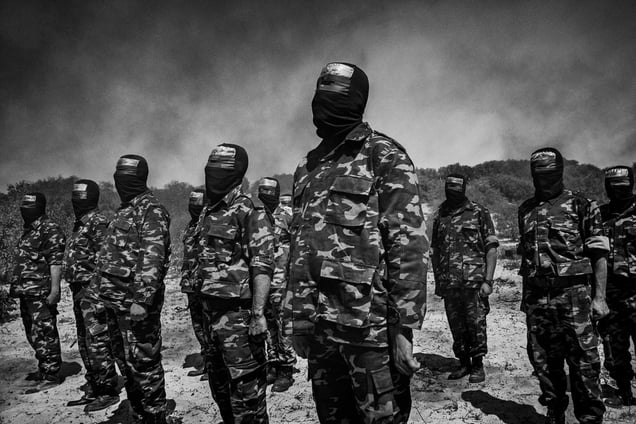
One generation of Palestinian fighters after the other take part in a struggle that seems to have no end. What brings these men to join? Since they are off limits in wartime and their secretive organizations provide only little access it is hard to give them a name and understand more about their background. The decision of becoming a militiaman slowly develops through personal experiences of conflicts and loss but it is also the result of social and cultural pressures, the need of a role in a society. The brigades in Gaza nurture a sense of belonging that since a young age can be found in the groups. They developed a way of representing themselves to young Palestinians and to the world and through this imagery they keep alive the memory of their heroes and their enemies. Many of these fighters have friends and family members who are in prison or died along their same path. But even the family of the “martyrs”, the ones who experienced the real consequences of the armed struggle often don’t show any regret, at least publicly. Some civilians in Gaza, still supports the militias, but there are also some who have no faith left in the divided Palestinian political landscape and bitterly disagree with armed groups’ policies. Especially the ones who are still living among the rubbles of their own house a year after the conflict. Then comes the real experience of war, the loss of friends and the close encounter with death. It is difficult to understand where propaganda and indoctrination ends and where their real feelings begin when fighters talk about death. They say they aren’t scared; they are committed to martyrdom, they will be happy to die. Some of them imagine at the same time a peaceful future with a wife and kids, a place in time where war will end and they will go back to a normal life. The older ones among them, however, seem overtly aware that they have taken a path with no return.
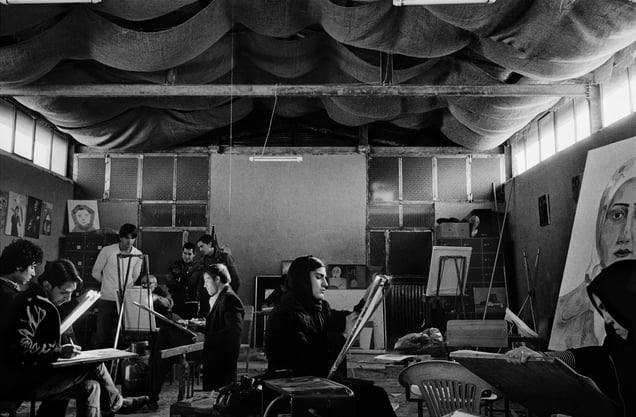
The Little Book of Kabul is an intimate portrait in words and photos of Kabul, Afghanistan, through the eyes, accents and activities of a number of creative people who live in the city. Francesca Recchia (independent researcher and writer) and Lorenzo Tugnoli (freelance photojournalist) have followed and lived in close proximity with several artists for over a year thus establishing an open and straightforward mutual relation of trust. Using an evocative visual and narrative language, The Little Book of Kabul takes the reader in a personal journey through the strive for artistic expression and the small, ordinary moments of life that escape the media representation of three decades of conflict in Afghanistan.

Underneath its meaning as a representation of the world, an image is a set of lines and shades; a bi-dimensional system of marks with its own expressive power. Playing with the shades and the lines of the rocky landscape of Afghanistan I produced this series of photographs originating from a simple act of enjoinment: the interaction between the landscapes and my frame. I discovered these images at the beginning or at the end of few photographic stories. They were taken before or after being in a place to photograph and they were destined to be set aside since they are not directly part the story. But I became fond of these visions and I start growing the idea of collecting them and their meaning grew on me. In some way they hold a sense of an untold story, a depiction of the moment before the action starts. Afghanistan appears like a living being, an old rugged-skin elephant. It looks mysterious, obscure and dangerous but if we go closer nothing is there other than dust, stones and some far away mud-houses. Since my entire research as a photographer revolves around the representation of humanity, it was a significant decision to choose a set of images devoid of human figures. It was a search for purity and simplicity, an exploration of other layers of meaning, but also a statement about the difficulties of telling the story of this country and this war. Afghanistan is often present in the media but its story and its geopolitical position is still resilient to be told in all its complexities. Even after working in the country for many years there is sometimes the impression that what we can see is only the surface of the whole story, that the country is slowly becoming an abstraction in our imaginations and the landscape is dissolving in a set of shades.