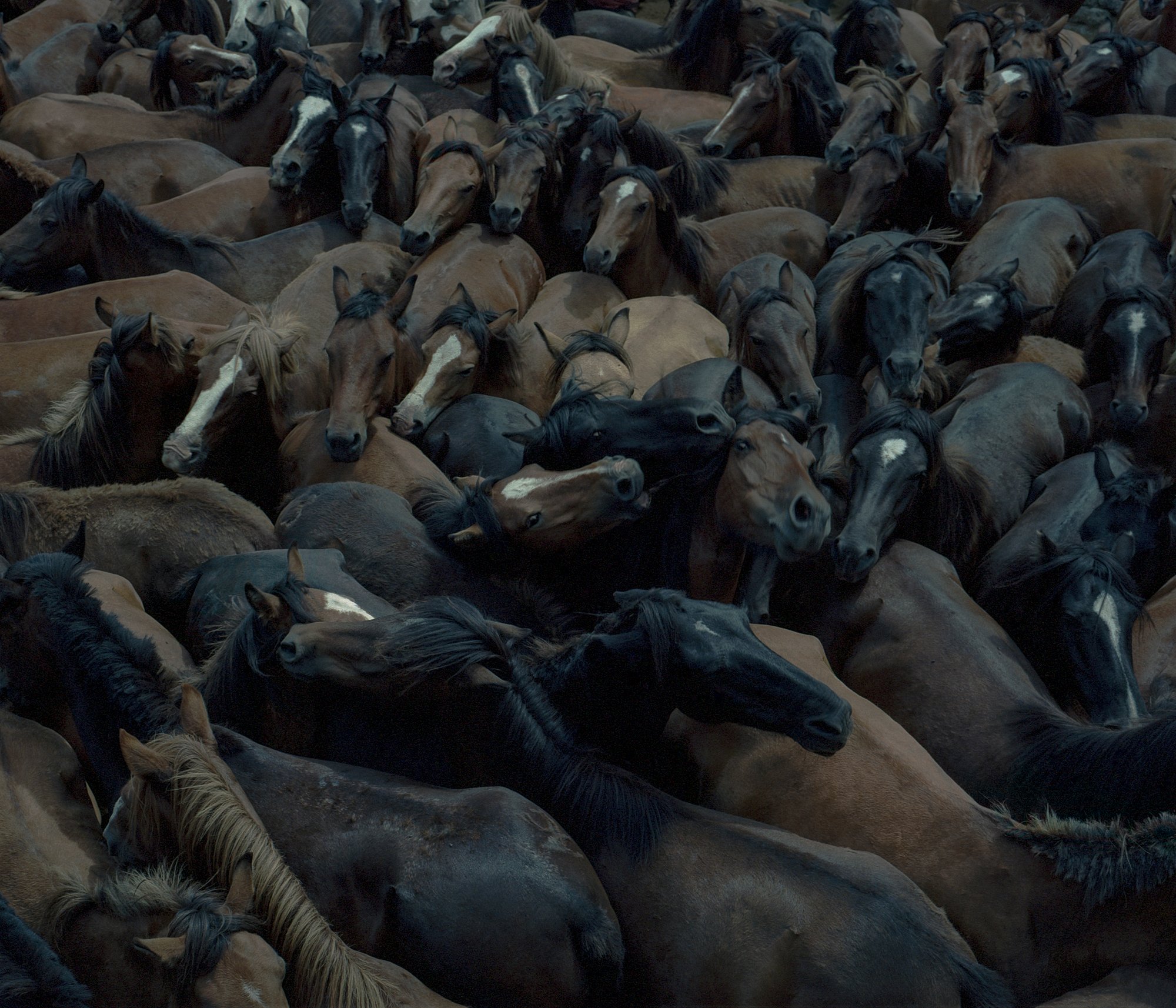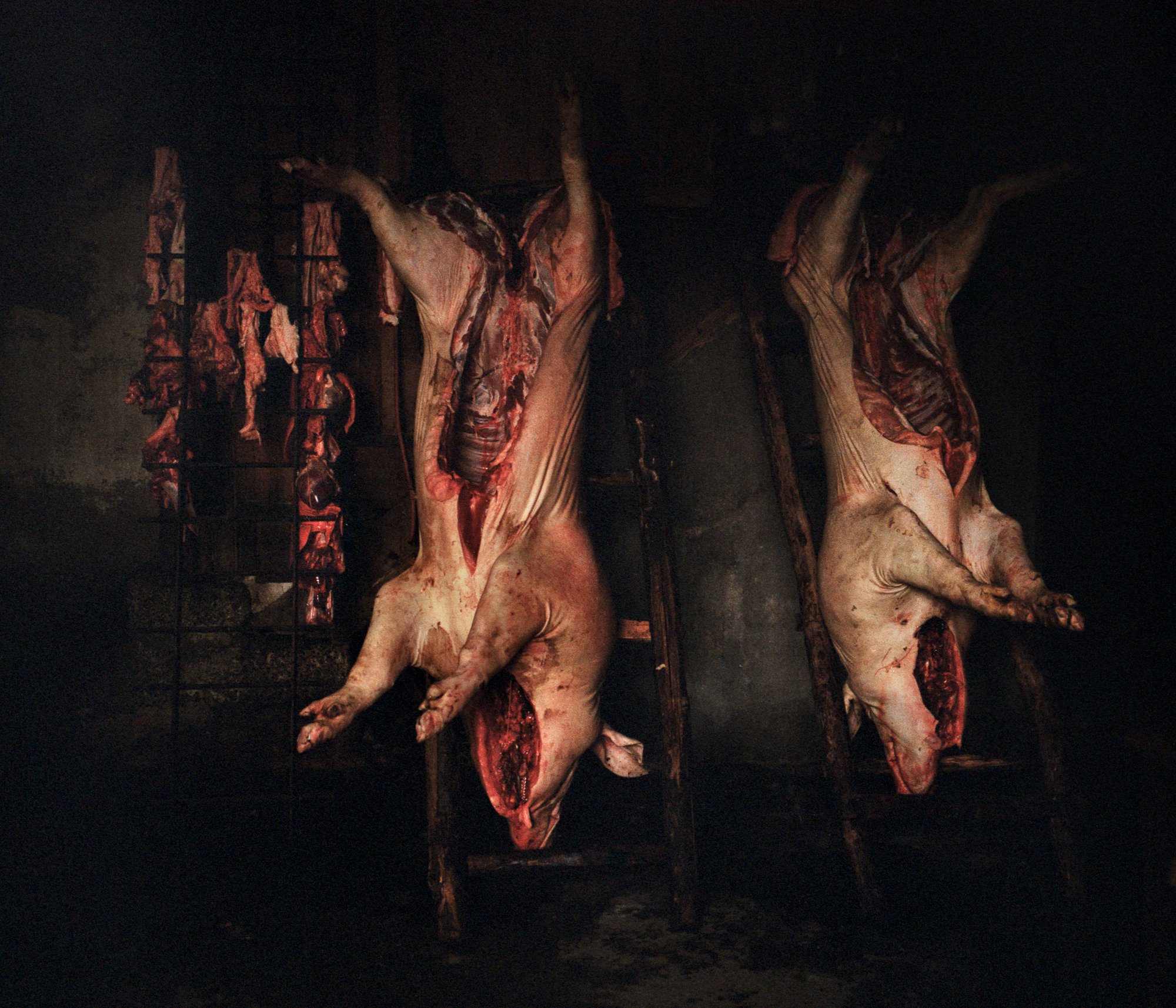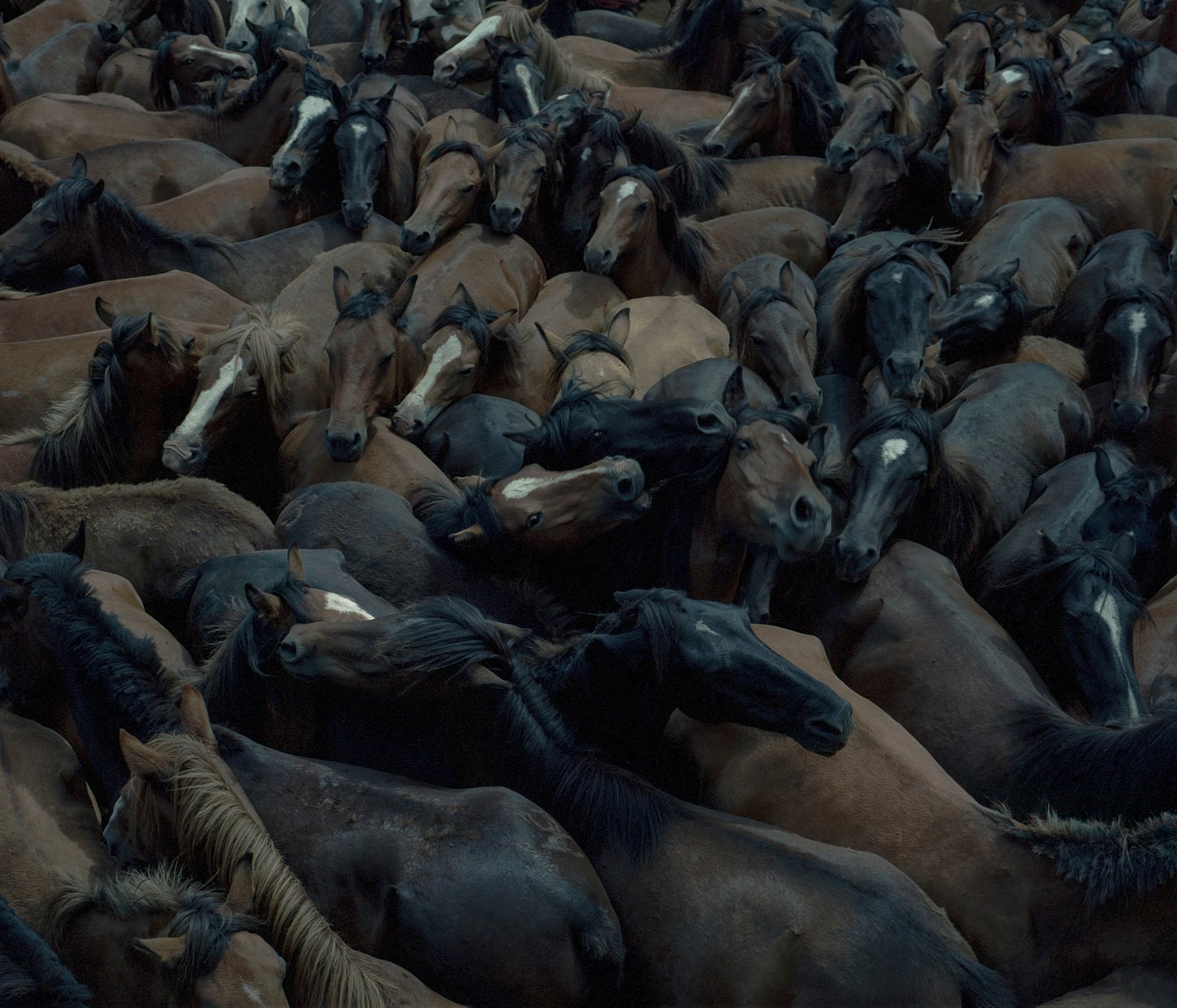
“We are the result of our past,” declares Carlos Folgoso Sueiro. The past haunts the Spanish photographer’s project Beyond the Lake. It emerges alongside the remnants of a flooded village and from the dim light of an at-home abattoir. It inhabits the traditional dress of a woman standing pensively in a forest clearing and the frightening costume of a festival-goer. But the present is equally alive, hinted at in the fire-scorched forests and references to hydroelectric dams.
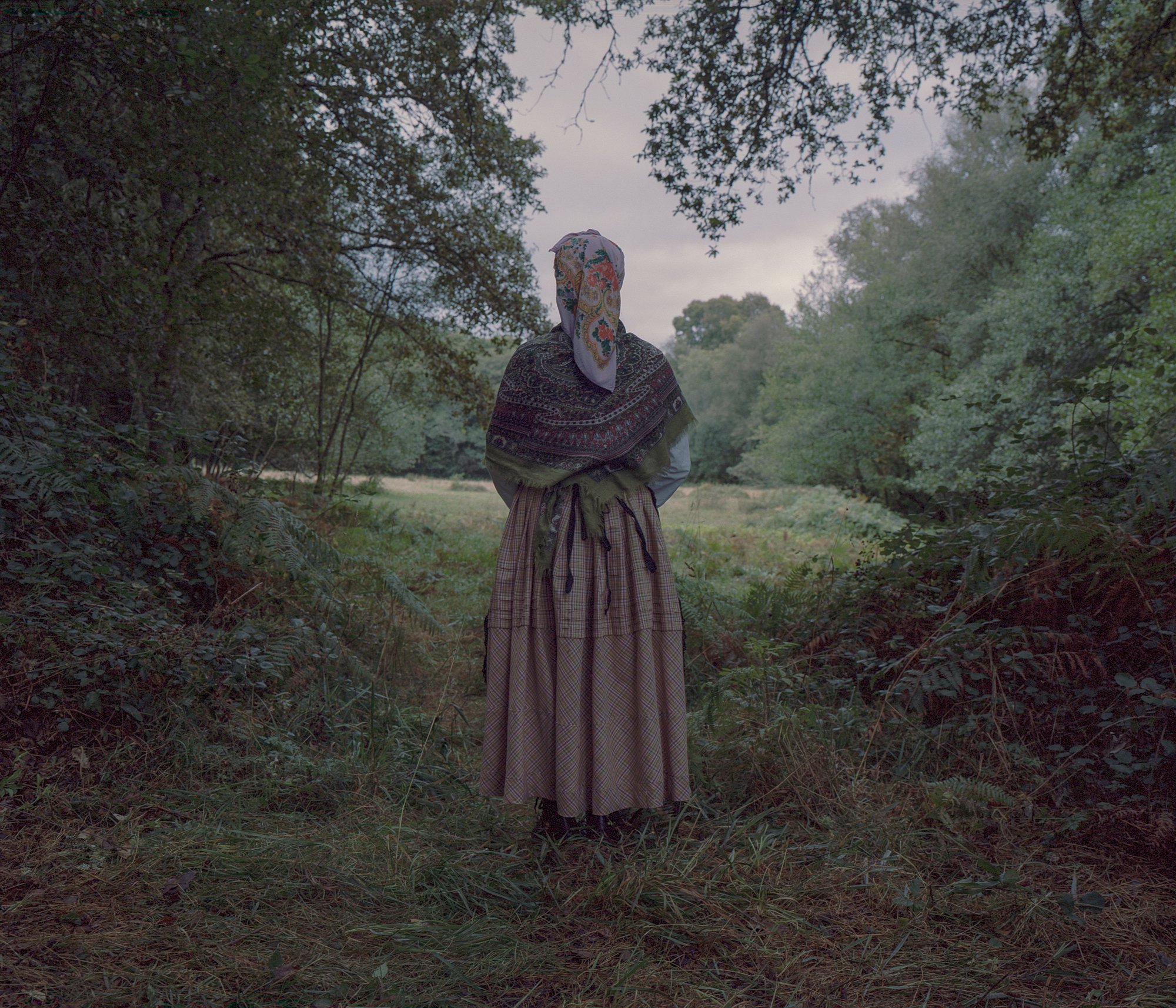
Son d'aldea. Nestled in the lush landscapes of Galicia, a woman dressed in traditional Galician attire poses before a meadow at the edge of a wooded enclave. The vegetation, a testament to Galicia’s historical abundance of rainfall, unfolds before her. The essence of Galicia’s enduring green legacy, shaped by the perennial rains that have blessed the region, is embodied in the silhouette of this woman, in a connection with nature that characterizes the people of Galicia. © Carlos Folgoso Sueiro
Son d’aldea. Nestled in the lush landscapes of Galicia, a woman dressed in traditional Galician attire poses before a meadow at the edge of a wooded enclave. The vegetation, a testament to Galicia’s historical abundance of rainfall, unfolds before her. The essence of Galicia’s enduring green legacy, shaped by the perennial rains that have blessed the region, is embodied in the silhouette of this woman, in a connection with nature that characterizes the people of Galicia. © Carlos Folgoso Sueiro

In a bid to reignite his creativity, Folgoso Sueiro casts a cinematic lens on his native Galicia—a corner of northwestern Spain that is at war with rural depopulation, climate crisis, reindustrialization, and the long shadow of emigration. In his mysterious images, one finds tales of struggle and melancholy but also resilience. Rather than bleak documents of the hardships of life in this embattled region, his photographs are imbued with a painterly, allegorical glow. In Beyond the Lake, he weaves an emotional, atmospheric sense of place—and himself within it.
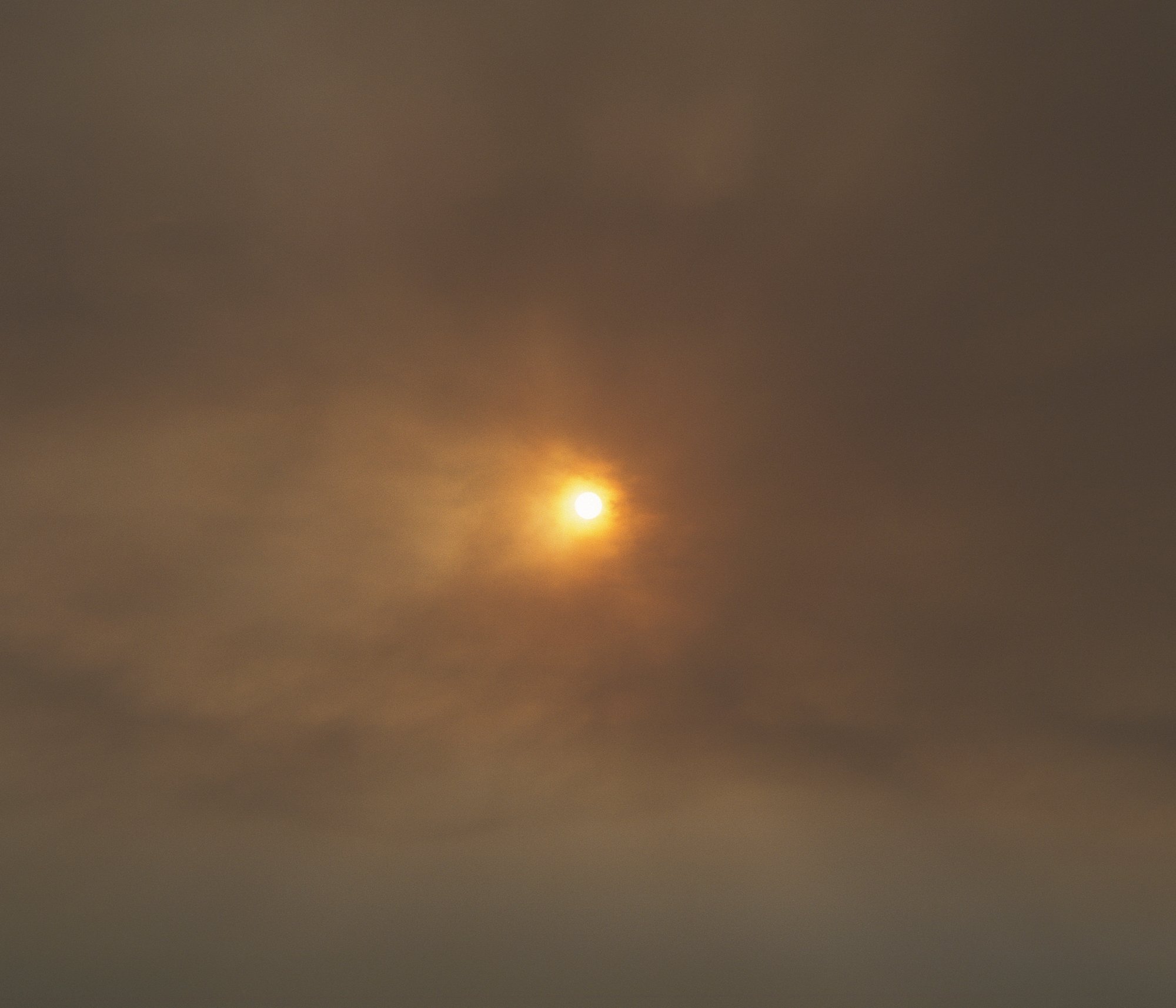
The sun. Sun obscured by a cloud of smoke from a forest fire. The region of Galicia experiences a devastating number of wildfires, contributing to 80% of forest fires in Spain. 2021 set a record with over 9,000 registered fires, consuming more than 35,000 hectares of land. These disasters not only wreak havoc on biodiversity but also have adverse consequences on air quality and the health of local communities. © Carlos Folgoso Sueiro

After more than a decade in Italy working as a photojournalist, Folgoso Sueiro returned to Galicia a few years ago. He had come back to help care for an aging grandparent and find balance after the demands of his work covering international news had worn him down. The shift was a struggle; a debilitating back injury combined with a personal loss contributed to a far-reaching mood of melancholy. After having photographed nonstop for work, he slowly made his way back to a more personal relationship with the camera, consuming books and immersing himself in paintings and films along the way.
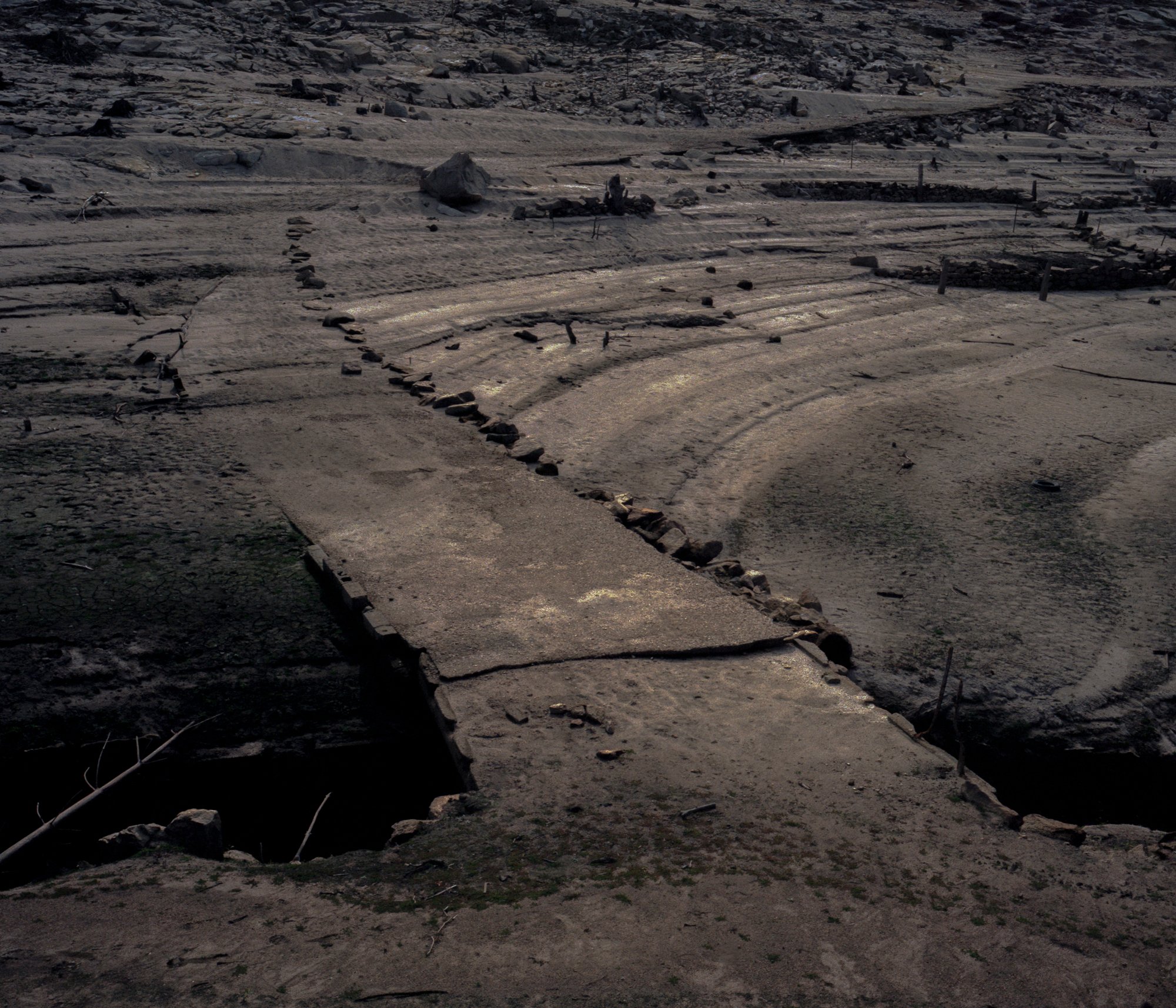
Bridge to hell. The remains of an almost wrecked bridge remind the Christian idea of the “Bridge to Hell.” In the Christian tradition, it is known as the “Bridge to Hell,” a metaphorical bridge that separates the world of the living from the world of the dead. All souls must cross the bridge after death. It is not a real physical construction, but a rhetorical figure that evokes the idea of a path or a decision that leads to negative or disastrous consequences. It is an expression used to illustrate the seriousness of a situation or the harmful potential of certain actions. Galicia, known for its deeply rooted beliefs and rich folklore, has long been a land steeped in mysticism. Legends of witches, spirits, and sacred rituals have shaped its cultural identity, blending pagan traditions with Christian spirituality. This intersection of the mystical and the religious is palpable in Galicia's population on both spiritual symbolism and the weight of Galicia’s ancestral narratives. © Carlos Folgoso Sueiro
Bridge to hell. The remains of an almost wrecked bridge remind the Christian idea of the “Bridge to Hell.” In the Christian tradition, it is known as the “Bridge to Hell,” a metaphorical bridge that separates the world of the living from the world of the dead. All souls must cross the bridge after death. It is not a real physical construction, but a rhetorical figure that evokes the idea of a path or a decision that leads to negative or disastrous consequences. It is an expression used to illustrate the seriousness of a situation or the harmful potential of certain actions. Galicia, known for its deeply rooted beliefs and rich folklore, has long been a land steeped in mysticism. Legends of witches, spirits, and sacred rituals have shaped its cultural identity, blending pagan traditions with Christian spirituality. This intersection of the mystical and the religious is palpable in Galicia’s population on both spiritual symbolism and the weight of Galicia’s ancestral narratives. © Carlos Folgoso Sueiro

The first images he took, before any concept of a project emerged, reflected his mood back to him. “I understood that I was shooting my own melancholy,” he explains. The sun is nearly smudged out of the sky, and raindrops disrupt the glassy surface of a river. Throughout his images, one can see references to the worldbuilding of Russian director Andrei Tarkovsky and the dramatic paintings of Rembrandt and Francis Bacon. As he reacquainted himself with his homeland and cultivated a sense of routine, he began to see the possibility of a new project.
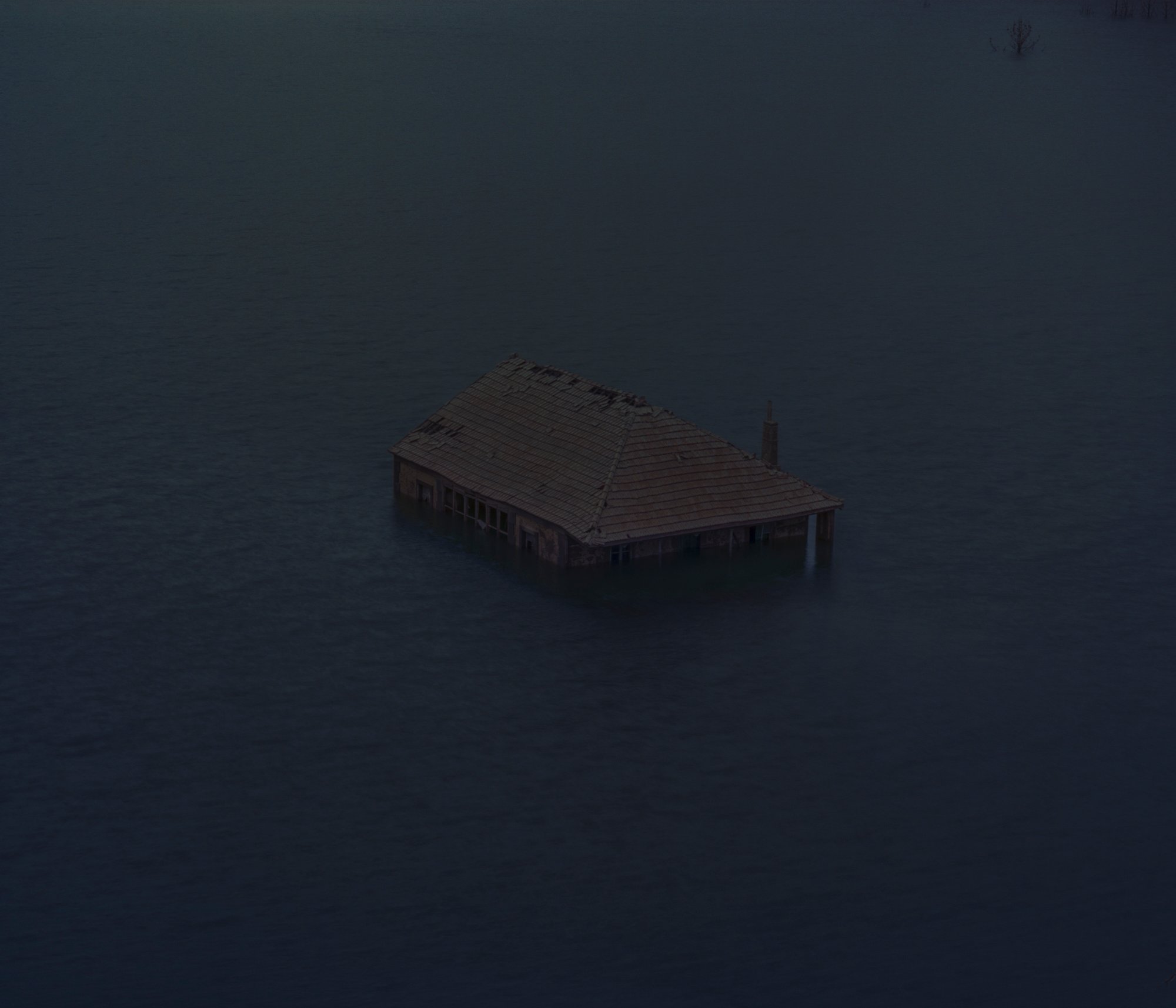
Ranger's home. In the 1970s, in the village of O Bao, located on the border between Galicia and Portugal, a house was built for the forest ranger to live in. His task was to safeguard the area’s forests, particularly to prevent wildfires. After the construction of the Limia River dam in the 1990s, the village of O Bao was completely submerged, including the forest ranger’s house, which resurfaced 30 years later due to the drought that had nearly emptied the reservoir. The house, seemingly floating on the water, appears like a ghost of the life that once thrived there. According to Francisco Gallato, a former resident of O Bao: “Perhaps the passage of time will one day heal all the pain caused by the abandonments brought about by the emigrations of the past.” © Carlos Folgoso Sueiro
Ranger’s home. In the 1970s, in the village of O Bao, located on the border between Galicia and Portugal, a house was built for the forest ranger to live in. His task was to safeguard the area’s forests, particularly to prevent wildfires. After the construction of the Limia River dam in the 1990s, the village of O Bao was completely submerged, including the forest ranger’s house, which resurfaced 30 years later due to the drought that had nearly emptied the reservoir. The house, seemingly floating on the water, appears like a ghost of the life that once thrived there. According to Francisco Gallato, a former resident of O Bao: “Perhaps the passage of time will one day heal all the pain caused by the abandonments brought about by the emigrations of the past.” © Carlos Folgoso Sueiro

A turning point in his process came when he heard news that a village, flooded for the construction of a dam 30 years prior, would be visible for a short period of time. He rented a place nearby to avoid the long back-and-forth drives. As night rolled in, he roamed the abandoned village. “I connected to this place. I felt as if something was waiting for me there— that I needed to be there,” he says. The resulting images are eerie, as if taken in a war zone, and yet, there is something that endures within them; the structures that emerge bear witness to what once was and what is now. The dam had been opened to address widespread drought, one of the most pressing concerns in a warming world. Galicia has also been ravaged by forest fires, devouring acreage at a clip.
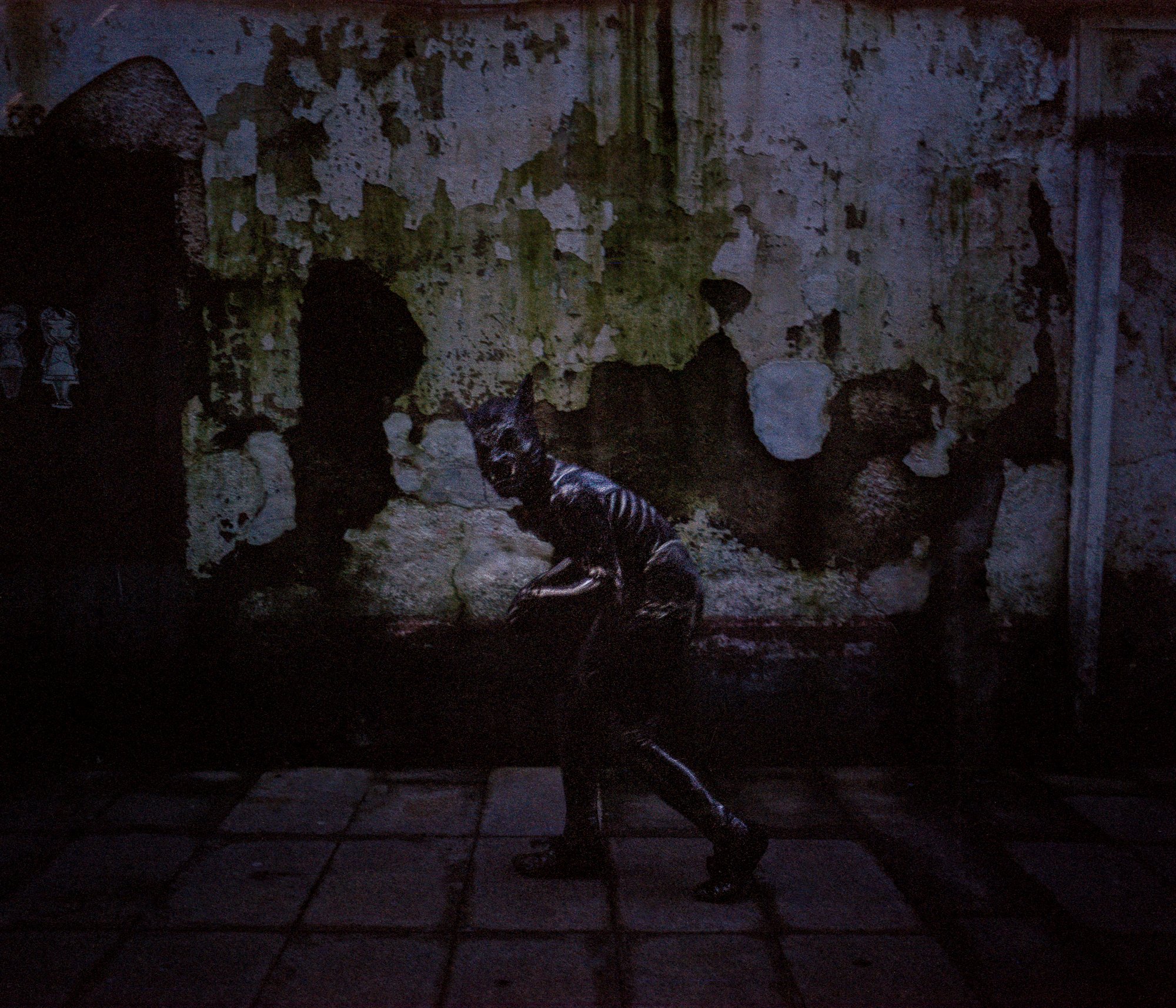
Sesta 13. Beliefs in the supernatural intertwine with the everyday reality of rural life on the border between Galicia and Portugal. The celebration of Montalegre's 'Sesta 13,' with its myths and legends, delves into the ancestral roots of witches and monsters in rural Galicia. This place is imbued with stories that weave into the rich Galician mythology, where witches conducted rituals and mysterious creatures were said to inhabit the shadows. The connection with concepts of life after death manifests in the atmosphere of this celebration, suggesting the idea of a threshold between the world of the living and the realm of the unknown. Rural Galicia, with its solitary landscapes and dense forests, becomes a fitting backdrop for these narratives that explore the boundaries between life and death. © Carlos Folgoso Sueiro
Sesta 13. Beliefs in the supernatural intertwine with the everyday reality of rural life on the border between Galicia and Portugal. The celebration of Montalegre’s ‘Sesta 13,’ with its myths and legends, delves into the ancestral roots of witches and monsters in rural Galicia. This place is imbued with stories that weave into the rich Galician mythology, where witches conducted rituals and mysterious creatures were said to inhabit the shadows. The connection with concepts of life after death manifests in the atmosphere of this celebration, suggesting the idea of a threshold between the world of the living and the realm of the unknown. Rural Galicia, with its solitary landscapes and dense forests, becomes a fitting backdrop for these narratives that explore the boundaries between life and death. © Carlos Folgoso Sueiro

By this point, Folgoso Sueiro knew he had a project—one that spoke to the past as much as to the future of Galicia, shaped by the rapidly increasing threats of climate change. He also knew that he could continue to photograph, to expand the work and its brief, drawing in universal themes of abandonment and nostalgia that he found across the region. His images of Galicia, he realized, were missing people, a choice that had corresponded to his own frame of mind. Recovering from a recent surgery and adjusting to the new parameters of his life, he set out to find people who reflected a part of himself; people who also kept to themselves or were somehow alone. “I was fascinated by these people who live alone in the forest, without electricity or water. I started to visit them—not to photograph them, but to speak with them.”
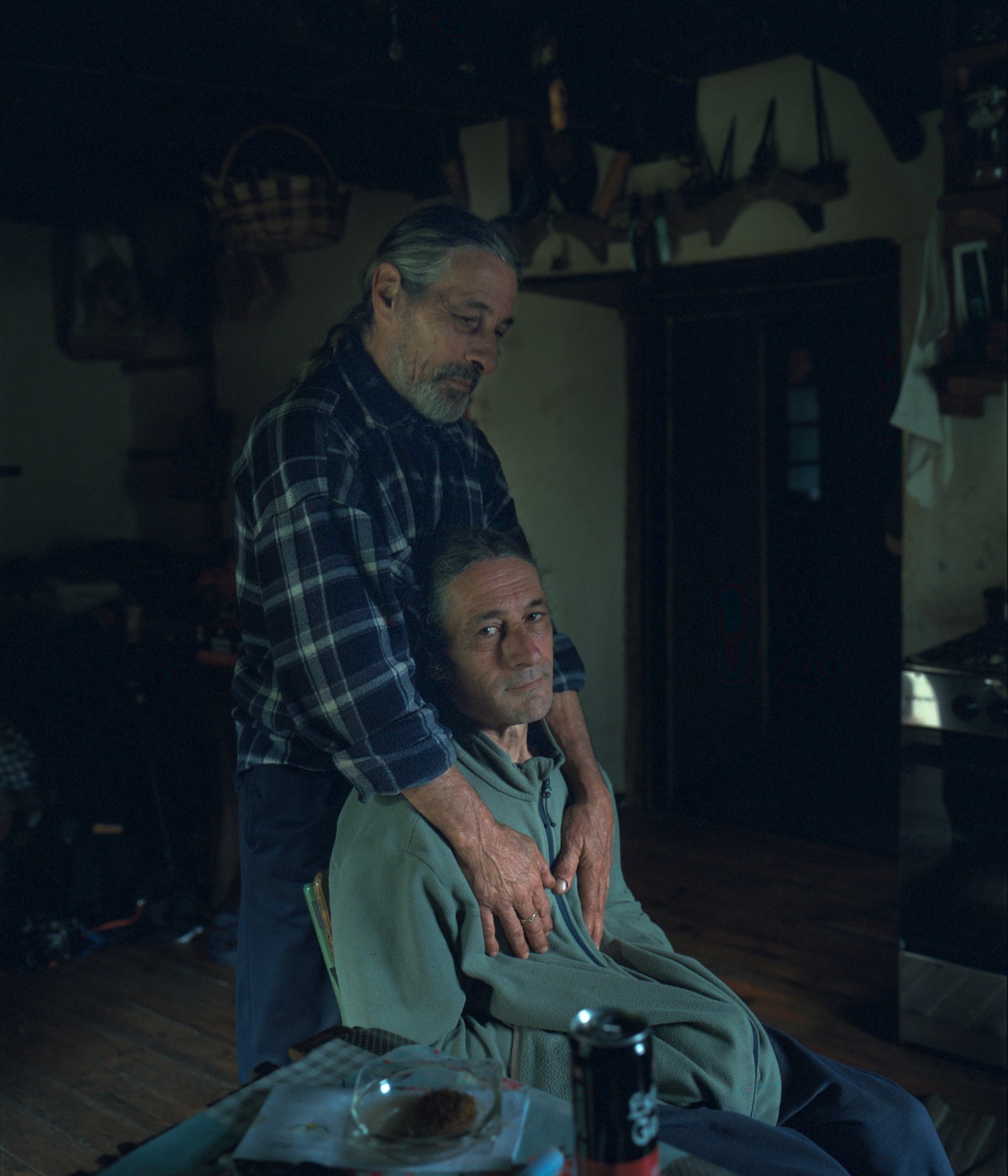
Adolf & Raul. Adolf and Raul came from Barcelona to live in a house in Barcela, an abandoned village in the Galician forest, at the foot of the Grandas de Salime reservoir. Locals accused them of intending to live there to gain economic benefits from the communal land, sparking significant disputes between them and the neighbors. One night, some neighbors attempted to set fire to Adolfo and Raúl's house while they were inside. To this day, Adolfo and Raúl are marginalized from the rest of the village, and they have spent almost 5 years without practically leaving their home. © Carlos Folgoso Sueiro
Adolf & Raul. Adolf and Raul came from Barcelona to live in a house in Barcela, an abandoned village in the Galician forest, at the foot of the Grandas de Salime reservoir. Locals accused them of intending to live there to gain economic benefits from the communal land, sparking significant disputes between them and the neighbors. One night, some neighbors attempted to set fire to Adolfo and Raúl’s house while they were inside. To this day, Adolfo and Raúl are marginalized from the rest of the village, and they have spent almost 5 years without practically leaving their home. © Carlos Folgoso Sueiro

He returned multiple times before photographing anyone, listening to stories and sharing meals. After time and with great sensitivity, he photographed Adolfo and Raúl—a couple who had been marginalized by their neighbors. The decision to finally make a portrait was intuitive and arrived at slowly. This approach speaks to the project’s development, naturally in tune with the artist’s methodology; a slow unravelling of a deeper understanding of home. In photographing Galicia, he was also photographing himself. “To shoot from the inside, you must also shoot yourself, your house, your family. I photographed my cousin, my grandmother, my room, and so on. My family is Galicia. This flooded place is Galicia. This forest fire is Galicia,” he explains.
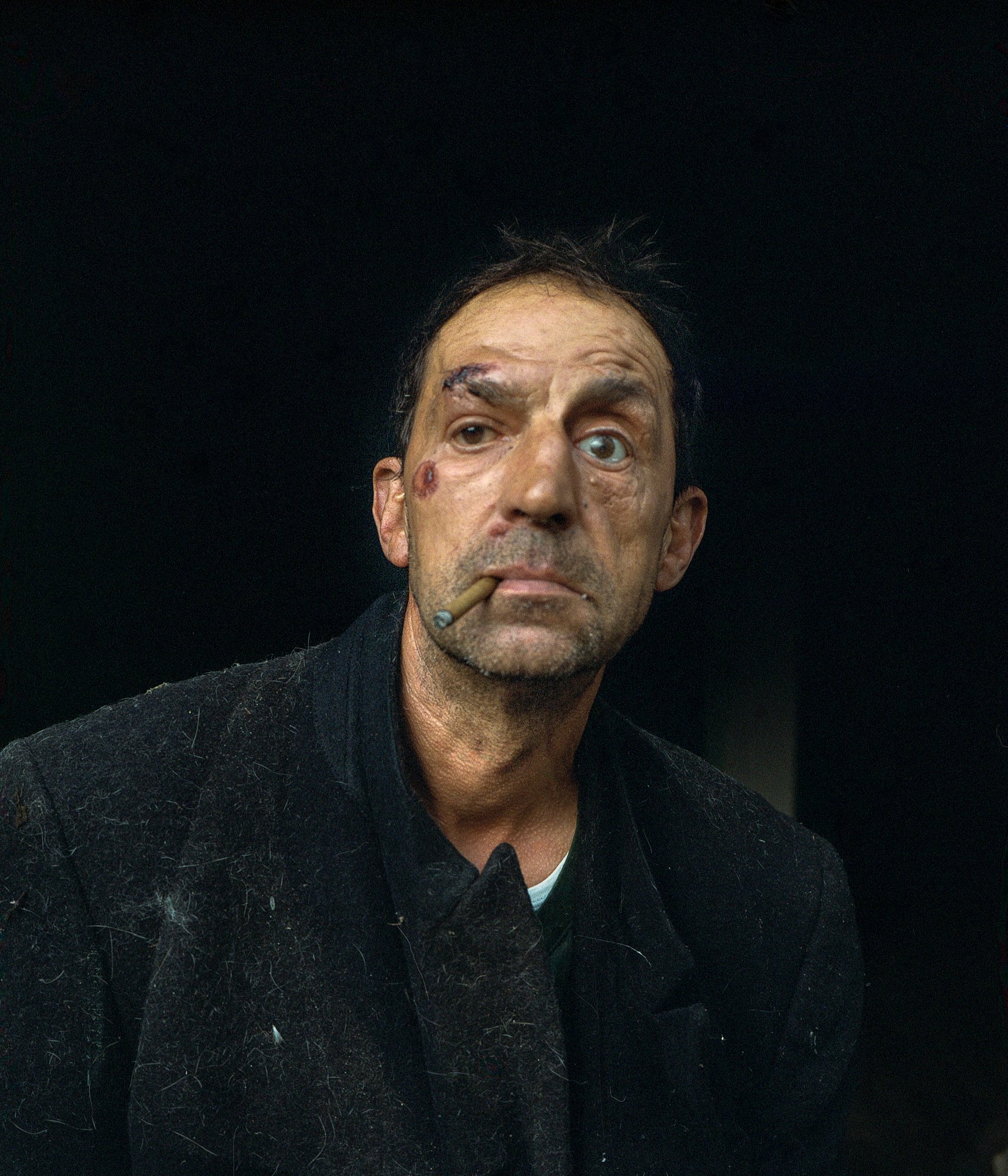
Tony. Tony used to arrive home with nuts, claiming that his girlfriend, Rosemary, had given them to him. However, Rosemary only existed in his mind. Tony resides in Atas, a small remote village on the border between Galicia and Portugal. He grew up with alcoholic parents and, unfortunately, became an alcoholic himself. Tony says, "I remember that when I was a child my father would put a glass of wine on the table for me and tell me 'Drink! A little bit won't hurt you". When Tony drinks alcohol he quickly loses control over himself to the point of losing an eye due to a car accident while driving drunk. He currently lost his job due to his alcoholism and lives on state aid and his family's charity. The depression in the area, the lack of job opportunities, and the communication difficulties made it even more challenging for him to overcome his alcoholism. © Carlos Folgoso Sueiro
Tony. Tony used to arrive home with nuts, claiming that his girlfriend, Rosemary, had given them to him. However, Rosemary only existed in his mind. Tony resides in Atas, a small remote village on the border between Galicia and Portugal. He grew up with alcoholic parents and, unfortunately, became an alcoholic himself. Tony says, “I remember that when I was a child my father would put a glass of wine on the table for me and tell me ‘Drink! A little bit won’t hurt you”. When Tony drinks alcohol he quickly loses control over himself to the point of losing an eye due to a car accident while driving drunk. He currently lost his job due to his alcoholism and lives on state aid and his family’s charity. The depression in the area, the lack of job opportunities, and the communication difficulties made it even more challenging for him to overcome his alcoholism. © Carlos Folgoso Sueiro

The difficulties of life, and how the past continues to influence the present, are never far from view. Folgoso Sueiro addresses abandonment and alcoholism in his photographs and the role that earlier waves of emigration played on the descendants of the people who left. A portrait of his cousin, who battles with alcohol abuse, is both unflinching and beautiful. “Galicia, today, is not a poor area,” he explains, “but it was in the past. In the last century, there was a lot of emigration for work. My father was left behind as a child with another family. He was supported by his parents, but he grew up without love. There were many children abandoned like this; the fathers did what they thought was right. We have many good things in Galicia; it’s changing for the better, but we still have this heritage of emigration, sadness, and alcoholism. We still suffer from this.”
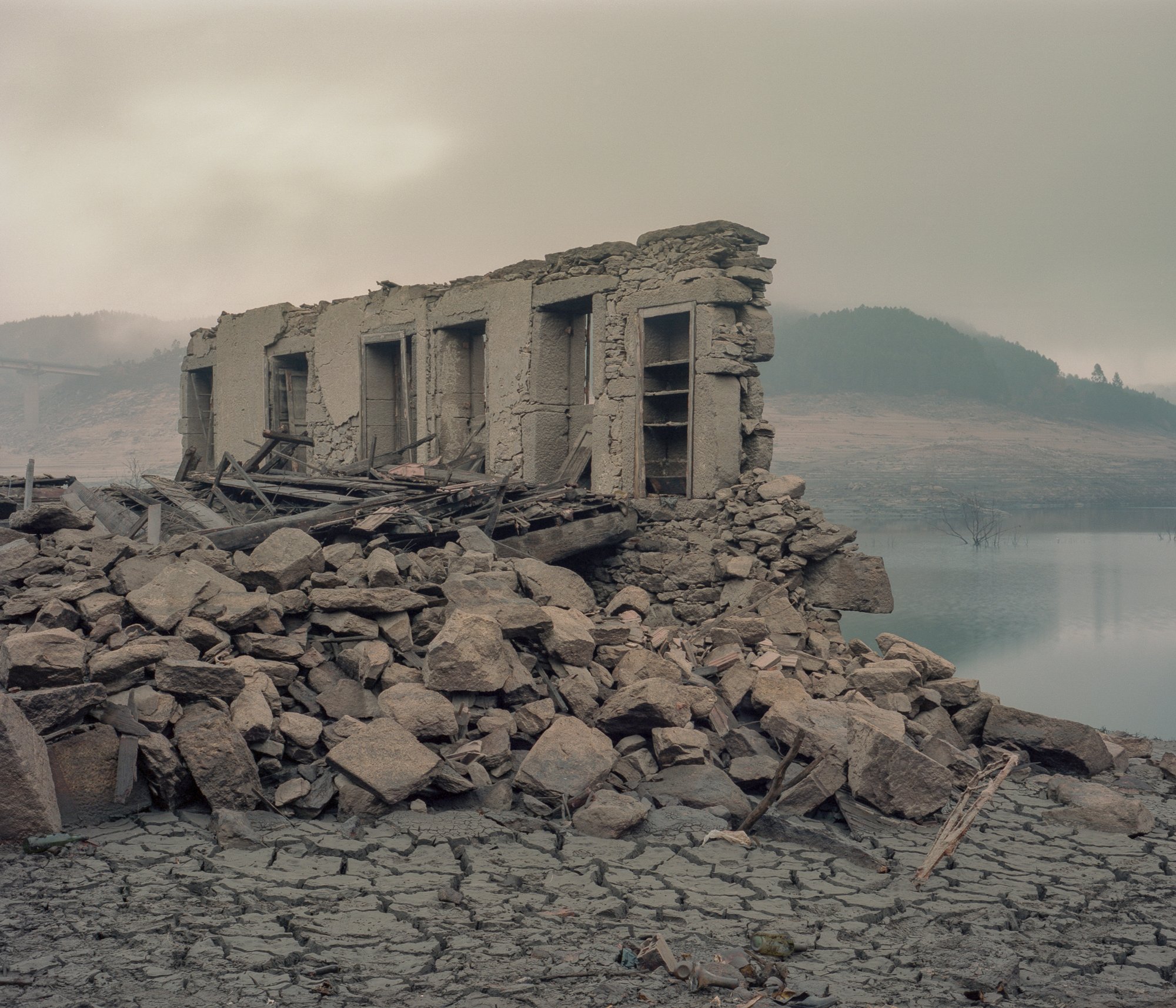
Aceredo. In January 1992, the Lindoso reservoir, managed by the Portuguese hydroelectric company EDP, submerged the towns of Aceredo, Buscacalque, O Bao, Lantemil, and A Reloeira, on the border between Galicia and Portugal. That fateful day froze those towns in time, marking the end of an era for its inhabitants. Three decades later, a severe drought has nearly drained the Lindoso Reservoir, exposing the remains of lives that once thrived there. In the picture, the remnants of a demolished house in one of these villages serve as a haunting reminder of the neglect that has befallen the entire region. © Carlos Folgoso Sueiro

Many of these stories unfold in a series of long-format captions, bolstering the images’ narrative flow as well as providing context. A sense of parallel and intersecting lives course through his images with an energy that churns below the surface. The series, much like a life, can be read multiple ways. In choosing to reference the works of earlier painters, Folgoso Sueiro opens a conversation across time, tying Galicia to the wider world whilst portraying it in a near-mythical light. Darkness is a metaphor, and sadness rings throughout, but if you look a second time, there is also connection—a gaze met, an embrace given, something that holds the eye and doesn’t let go. Entwining internal worlds and reality, Folgoso Sueiro has found a deeper understanding of his homeland and its people, buffeted by changing winds and difficulties, yet still holding on—still full of the power to enchant.


This project was one of the top winners of the LensCulture Critics’ Choice Awards 2025. Discover all of the winners – lots of great inspiration!