Charak Puja, Bhimshi Bhonubhir, Srimangal, Bangladesh A boys face is painted as he prepares to enact the part of Parvati, the wife of Shiva, at the festival of Charak Puja in Bhimshi Bhonubhir, Sylhet. © Claudio Cambon
Janmasthami, Dhaka, Bangladesh The ceremonial elephant is washed for Janmasthami, Krishnas birthday, at Dhakeshwari Temple in Dhaka before being paraded through the capital citys streets. © Claudio Cambon
Bon Bibi is a deity worshipped in a small string of villages at the edge of the Sundarbans in southwestern Bangladesh and just across the border in India. She protects people who work in the forest (fishermen, loggers, honey hunters) from Dakshin Ray, a man-eating Brahmin priest who transforms himself into a tiger to attack his prey. Women such as this devotee come to pray for the safety of their fathers, brothers, husbands, and sons.
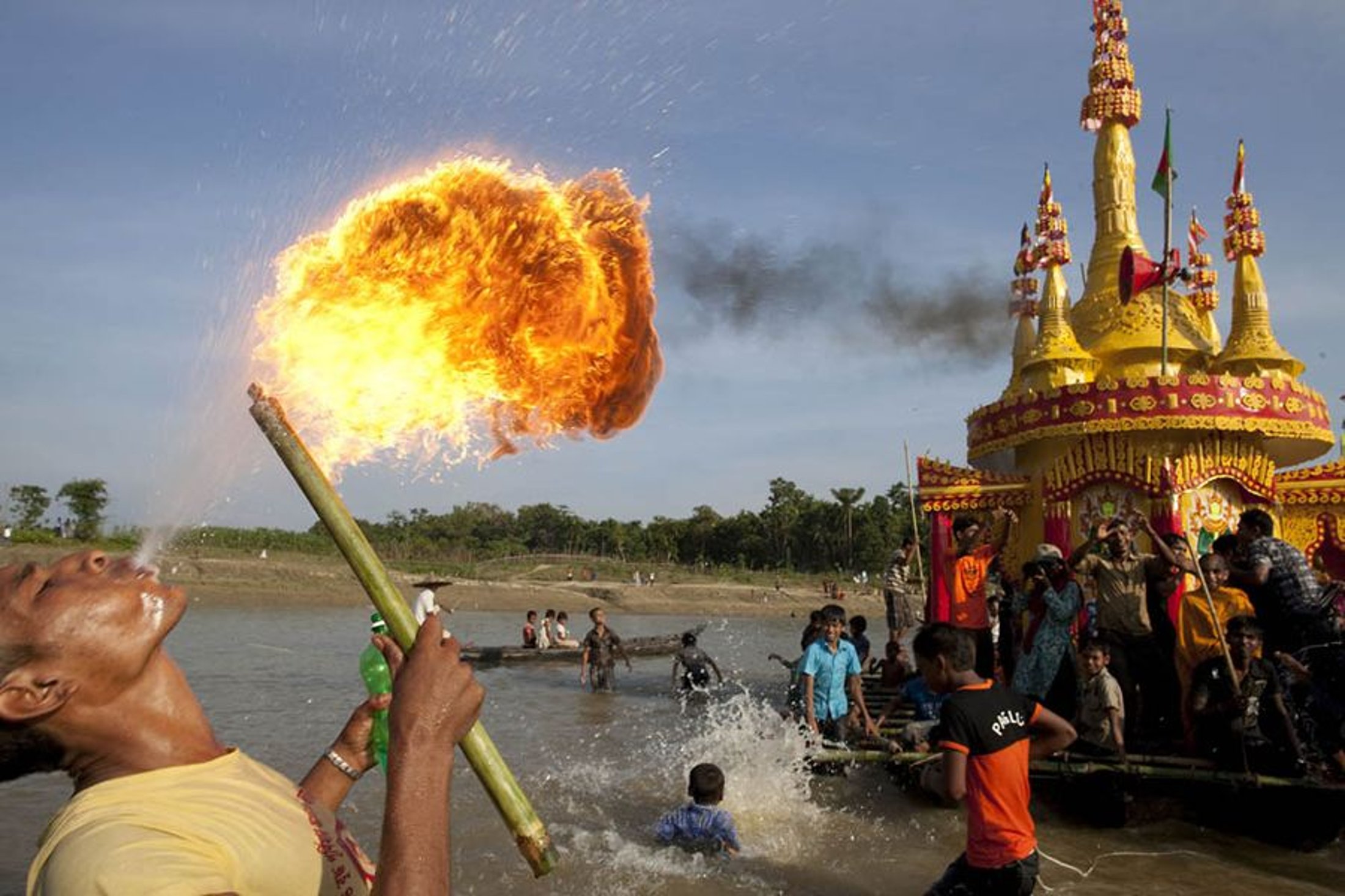
Prabaranna: Pagoda-like structures of bamboo and colored paper are lashed atop boats to make floating temples. Buddhist monks sit inside chanting sutras as the boats are pulled up and down the shallow river before thousands of onlookers. But the event is hardly solemn. The monks’ chant is distorted over blaring loudspeakers, boatmen shout, and people splash in elated, sometimes drunken abandon.
Hindus celebrate Charak Puja. They offer devotion to Shiva, some of which involve degrees of self-mutilation, either to ask for a wish to be granted in the coming year or to give thanks for those fulfilled in the one ending. Once celebrated widely across all of Bengal, it is now seems to be disappearing, as more people take distance from what they claim is low-caste barbarism. © Claudio Cambon
Amidst fishermen unloading their catch, these women perform a puja to Ganga Devi, goddess of the river. I felt out of time, joined to the elements through their devotion. I had the distinct sense that, older than the words to the song was the song itself which solemnly dreamed the goddess into being, a melody that seemed as old as the goddess herself, as the water and the sky that surrounded us.
New statues for Saraswati, goddess of arts and learning, are fashioned from river clay applied to a wood and straw frame, then painted and decorated with elaborate, colorful fabrics. At the end of the festival, when the goddess is believed to depart this world, students bring her statues to the water's edge, where they joyously immerse and abandon them. The unfired mud quickly dissolves. © Claudio
On the last day of Durga Puja, this woman dispenses advice to other worshippers. She sat in the priest's place, barking orders at everyone, even the Brahmins, who seemed to obey her without question. Her eyes were wide open, showing white all the way around her pupils; the furiousness of her trance-like stare was heightened by the somber, deep tone of her voice. Some brought children in need of healing, whom she would grab with her thick, strong arms and rock violently back and forth. © Claudio Cambon
The festival of Charak Puja culminates with young male devotees piercing their backs with hooks from which they will be hoisted onto a pole called the Charak Tree in honor of the god who ferries souls into the afterlife around which they will be swung seven times at sunset. I had expected them to be in some sort of trance or inebriated state, but they seemed very much within their bodies, not elsewhere, and after they were lowered, their elation was uncontainable. © Claudio Cambon
Funeral, Thakurgao, Bangladesh This woman mourns the death of her 1-year old son, who drowned in a shallow pond next to the house, just barely out of sight and earshot. Although she is Muslim, she follows a very rhetorical and performative process of mourning that is Hindu in its form. Her grief was almost entirely sublimated to an elegant recitation. © Claudio Cambon
Gaye Holud, Dhaka, Bangladesh On the Gaye Holud, the bride-to-be is traditionally smeared with turmeric by family and close friends to wish her a long life. Once separate events for bride and groom, a sort of bachelor or bachelorette party, they are more and more often celebrated together. © Claudio Cambon
The death anniversaries of many saints, known as Orosh, are often celebrated on a massive scale. Each year, hundreds of thousands attend the Orosh for Malek Shah, who died only a decade ago. Mass prayers are held and everyone is fed. It is an impressive spiritual gathering, logistical feat, and business model of tourism and consulting. Devotees clap their hands and repeat the God’s name, pushing themselves towards a greater union with the divine. © Claudio Cambon
The funeral for the Bhomong Raja, King of the indigenous Marma people in the Chittagong Hill Tracts, was a 2-day affair. The festivities culminated the transportation of his body in a decorated chariot through the streets of the town of Bandarban as people in the procession sang to celebrate his life. At the cemetery, his body was placed in an ornately decorated pyre and cremated before thousands who prayed and looked on. © Claudio Cambon
Fatima Rani Thirthok, Boromari, Sherpur, Bangladesh This procession in honor of Our Lady of Fatima is a new celebration; it is only about five years old, but it already draws almost 10,000 pilgrims, most of them from the Garo indigenous tribe, half of whom were converted to Catholicism in the 19th century. The festivals newness and the recent history of this peoples evangelization do not seem to take away from the fervor with which they venerated, one which to me seemed rooted in a more remote past. © Claudio Cambon