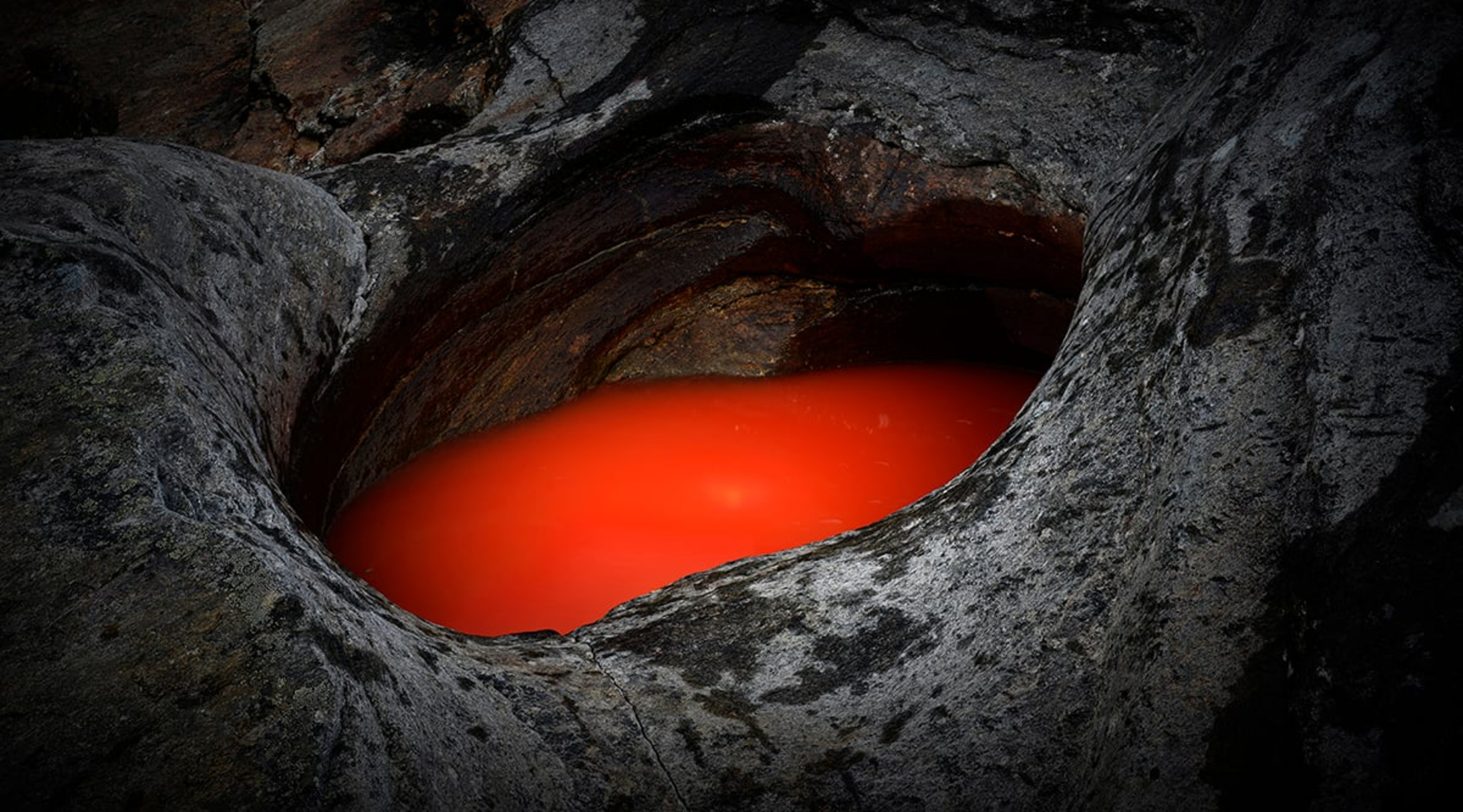
Light—both natural and artificial—is a key ingredient in Gjert Rognli’s mysterious photographs of the landscapes of Arctic Northern Norway. The artist’s images hold both darkness and lightness in one frame, illuminating the magic of our surroundings as well as the threat of its disappearance as the climate crisis encroaches. However, Rognli’s approach is not to provoke despair, but rather to nurture our connection to nature.
Drawing on his triple minority identity as Sami, Kven and queer, Rognli has mined his roots for different perspectives. His latest project What Nature Knows is steeped in animist knowledge passed down from his Grandfather, the invisible information of the locations his camera focuses on channeled and revitalised through the medium of photography. Through his practice, the artist builds a bridge between ancient knowledge and contemporary visual language that reaffirms nature as a “helper and healer.”
In this interview for LensCulture, Rognli speaks to Sophie Wright about the intersecting cultural touchpoints that form his artistic foundations, the challenges of working with the elements and what he hopes his audience will take away from encountering his images.

SW: What would you say has most shaped your photographic voice?
GR: I have had the opportunity to work at some of Norway’s most important cultural institutions such as the National Theatre and the Norwegian National Broadcasting Corporation at a young age as a set design assistant. My voice was shaped by the intertwining life experiences and lived life—and the ‘gift’ I received by having a triple minority background as Sami, Kven and queer.
These are qualities that have given me the opportunity to interpret and see life from many different perspectives, giving me an enormous drive to convey stories through photography, film, sculpture and performance. These are minorities who have been subjected to brutal oppression by the Norwegian state and other institutions of power. Today, Norway is a completely different country to live in with all the minorities you own—a country that leads the way in giving freedom to everyone who is ‘different.’
SW: ‘Biophilia’—the theory that humans have an instinctive affinity with nature—underpins your latest work What Nature Knows. How would you describe the key interests that have steered this project?
GR: When you see the light from a star in the sky, it may come from a star that died millions of years ago. But that light has traveled through space and time in order to be observed by your eyes. What will our descendants see after we have gone? Many people alive today are out of touch with environmental problems. Political decisions are made that only benefit political self-interest and not the citizens of the country or the global community. Everything is in contact with each other; the world is a whole and unity, full of people, animals, organisms, the sun and a long list of other important life cycles.
But we live in a system where the rich only get richer, and the poor only get poorer. It is unfair and unsustainable when we think about giving a good future to our children and all other life on the planet. With this as a backdrop and focus, I have tried and conveyed a message where the light leads the way to something positive, with a hope for a greater understanding and respect for nature. Paradoxically, we must include the darkness in order to understand the light.
SW: Your work is deeply rooted in your own surroundings—the textures, the seasons and the darkness of Arctic Northern Norway. Can you tell me a little about where you are from?
GR: I grew up in the village of Manndalen in the 60s and 70s, an area where three tribes met (and settled): the Kvens, Sámi and Norwegians. It was a village that had been through a brutal Norwegianization—an official policy carried out by the Norwegian government directed at the Sámi people and later the Kven people of northern Norway, in which the goal was to assimilate non-Norwegian-speaking native populations into an ethnically and culturally uniform population. The traces of the Sámi culture were wiped out.
‘Laestadianism,’ a pietistic Lutheran revival movement characterized by piety, austerity, and strict moral conduct with an emphasis on individual repentance as well as a condemnation of sin and worldly lifestyles, had a great influence on the population, with many prohibitions and orders on how life should be lived. It was a different and exciting place to grow up in, and I got to experience the conflict between the remains of an old natural religion and Laestadianism. The two were mixed as there were some who would not participate in wiping out the last vestige of the old doctrine of nature and its healing power. It was fascinating to experience helpers and shamans using nature for healing, such as taking a spoonful of water from a stream and performing healing rituals. Seeing this as a child gave me the opportunity to learn about reality in several different ways.

SW: What was your personal connection to these traditions and how has it shaped your work?
GR: I myself had the opportunity to learn from the old animist religion from my grandfather. He taught me, among other things, how to ‘stop blood’—a well-known term in folk medicine. If a domestic animal injures itself and there is blood loss, religious prayers can be used to stop it, for example. This lesson was both fascinating and terrifying and it gave me the opportunity to see and experience my surroundings in a different way. Nature provided healing on many levels, and the animist rituals became part of how I understood myself, the people around me and my surroundings.
Manndalen was a village where identities and religions were juggled, where the Sámi mindset and way of life were kept hidden. They were forced into a colonial system, and some failed to wipe out the last vestiges of its foundational culture—one that is today recognized as part of our world heritage. Growing up in this relationship between the past, the future, and the conflicts that arise from the two meeting, has given me the opportunity to interpret and understand reality, nature, religions and the surroundings in many ways, and has been an important source of inspiration for this project.
These are experiences that have made me look at the nature and landscape around us in a different way. Nature is a helper, a healer, and it has been important for me to transform this message and knowledge from my ancestors into a different idiom that resonates with our own times.
SW: How did What Nature Knows develop as a project?
GR: As I have said earlier in this interview, I had the fantastic opportunity to work at some of Norway’s most important cultural institutions, and worked with the best. Working with some of Norway’s most important cultural institutions has given me the strength and focus to find myself.
In my previous photo projects, I staged stories and experiences that referred to my minority background. In these photographs, I was often naked, or in a surreal setting dressed in costume and surrounded by scenographic objects, or placed in other situations that included dead or living animals. It was a rebellion against society and the treatment of minorities that I have carried with me since I was born, and also to show how ‘skinless’ a person can be in the face of a social system that oppresses you.
Gradually this focus has become less important. The country of Norway has changed, and parts of the world did the same. I also changed, and new stories and messages became more important to tell.

SW: In your photographs we see a series of interventions into the landscape, from sculptural shapes to flushes of light. Tell me about what these forms represent for you and how you choose them.
GR: The invisible information in the landscapes gives meaning to the photographs and light installations placed within them. I am working with intangible Sami and Kven cultural heritages that I had the opportunity to learn about through my grandparents and parents—one that stretches back several thousand years. The light installations are a mix between scenographic solutions and design that is adapted to each location. Into these concepts I mix together what I have learned about different places in nature and natural phenomena.
If we look at the photograph Genesis, for example, you see a stream where white objects flow through a forest on their way to the sea. This stream comes from a water source in the mountain, and within Sami mythology and shamanism, healing can only happen when it comes from a source. For me it has been an exciting and unique learning experience, as I was lucky enough to experience the last remnants of these cultures.
SW: What kind of challenges do you face working outdoors, in what I imagine can often be quite harsh weather conditions?
GR: I have been working on building up the exhibition concept What Nature Knows over several years. At the beginning, I chose to work in a season of the year that did not create too many challenges in terms of weather. I worked mostly in the fall where the temperature was pleasant and the Arctic light in the evening was perfect to blend with the artificial light and the light installations.
I had about 25 minutes of shooting time per day as the light changes quickly, and during this time of year, the days quickly become shorter and darker when you are on the ‘other side’ of the Arctic Circle. The autumn days in the Arctic would lose 90% of the light in the run up to the part of the year where it is practically dark 24/7.
Gradually I wanted to challenge myself and work in late winter when the light had returned. Then the conditions were even more difficult—it has not been unusual for me to go to the same location between seven and eight times to be fully satisfied with the results. One of the most important tasks in this project has been not to give up; it was to come home after a long day out in the woods and fields—sometimes I would walk for many hours round trip to the location I had found in advance of the filming—and analyze what went right and what went wrong. The weather apps became my best friend for several years.

SW: Tell me about your work process.
GR: I will not reveal all the techniques and working processes I have developed through my long career as an artist. But light, both natural and artificial, and long shutter speeds are the main ingredients in this project. Since my partner is our planet and its cycles, I have followed the moon phase, its ebb and flow, sunrise and sunset, and whatever weather phenomena pass over the sky where I work on my projects. Be it photography or film shooting, it is important to have a good routine—something I had to learn the hard way. Forgetting your glasses when all other details are in place on location has taught me that everything is equally important in life.
SW: Although the photographs that make up What Nature Knows are dreamlike, they also somehow draw attention to the fragility of the environment. What feeling do you hope they inspire in the viewer?
GR: One thing among many is the way that people are forced into a world of environmental shame, with the intention to place and influence them to think: “I am a bad person.” That has really proven not to be the right way to reach us humans and the challenges we face as a global community. But I do not have the answer to these challenges; my approach has been to find the hope, the light, the subtle and the mythological. And in a way I try to elicit a curiosity in the viewer to see the magic that lies in the beautiful and ordinary landscapes around us. At the same time, I hope that the viewer can see our fragile contemporary world in the images, not as something negative, but as a positive source of inspiration.