
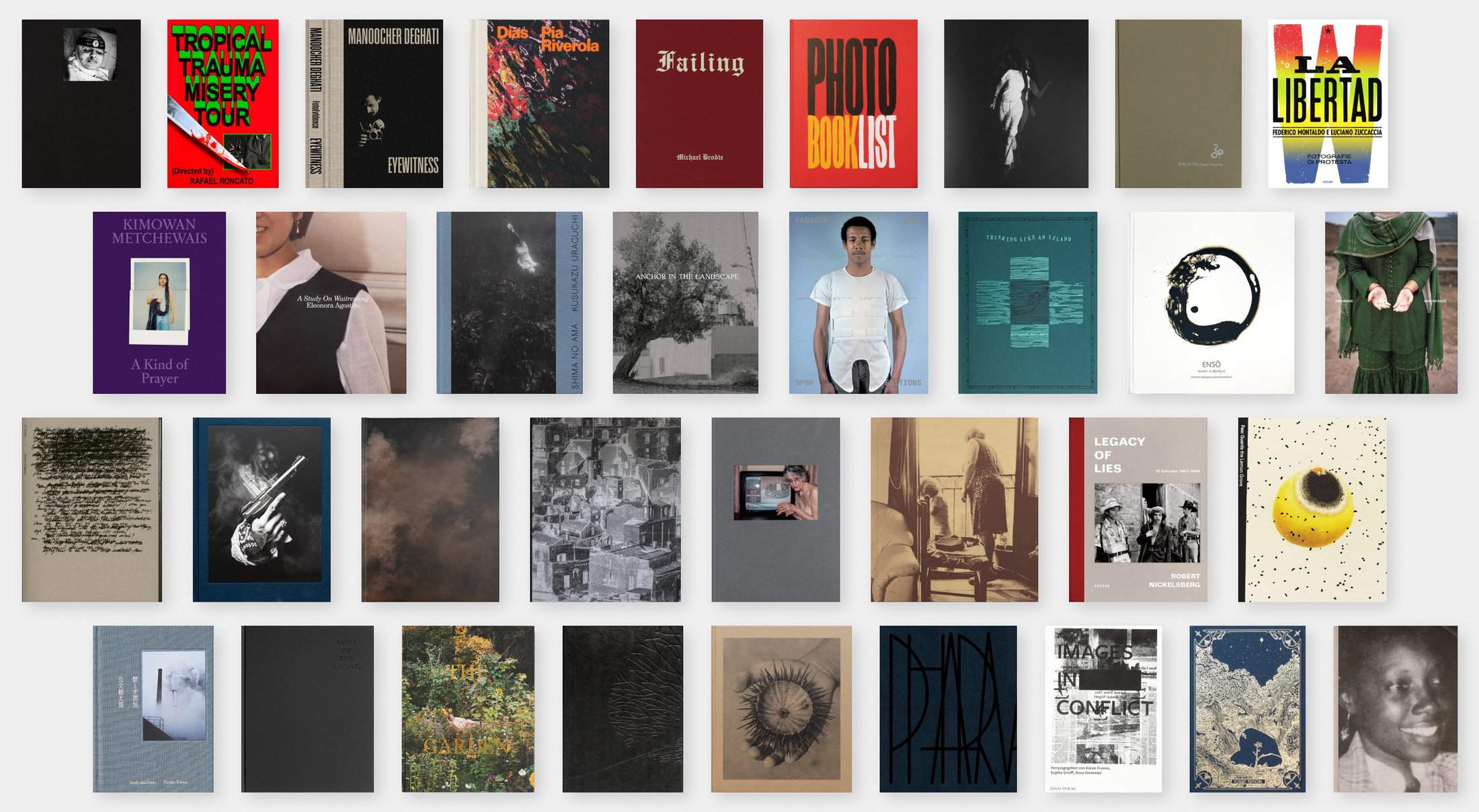
LensCulture celebrates great contemporary photography from all over the world, and we have a special place in our hearts for photobooks. We believe photography books offer some of the best ways to appreciate the visual language of photography. No matter what the subject matter is, no matter what creative approaches are used — books offer an intimate, in-depth, one-to-one conversation between an author and a reader.
We reached out to photography experts from around the globe, and we asked them to recommend books that are their personal favorites from 2024. This year’s list of favorites features 36 titles, and as you can imagine, the range of topics and styles is wide and varied.
Take a careful look here, and we hope you will discover some gems that you would like to get to know.

A Study on Waitressing stands somewhere between personal family research, a reflection on the theatricality of life, and a feminist study on the injunction made to women to “care for others.” The starting point for the book is an observation of the artist’s mother, specifically the career she held for over forty years as a professional waitress. It presents a motley crew of collected images: her mother as a young woman, a succession of grainy cropped closeups of her mother’s legs, her smile etc… Together with the beautifully staged full figure portraits of the mother assuming the positions of serving, the collection, careful sequencing and texts provides a tridimensional freeze-frame of the actions of “waiting for” and “waiting on”, as seen through the eyes of someone intensely familiar with this situation.
I loved the book precisely because of its multilayered construction: it ignites my questioning and focuses my attention in a both light and profound ways. I think this book is in conversation with Silvia Rosi’s Encounter, in which the artist dresses up as her mother and uses props against a classic west African colorful studio backdrop to evoke her mothers’s Togolese upbringing. It also reminds me of Dru Donovan’s Positions Taken where the photographer collaborated with a group of men to revisit their experiences of being stopped and frisked by the police. In all these cases, staging and reenacting are a way of making an issue, or person, hyper visible, rebuilding the topic from the ground up in a forensic and detached manner that ultimately — and counterintuitively — feels more universal than a documentary would be.
-Lucy Conticello, Director of Photography, Le Monde

It is not easy to work within the traditions of American desert road trip photography and not have your work sit in a dated, reminiscent-of-others-and-therefore-uninteresting space. Bryan has blown me away by navigating this dilemma and has produced a book that is confidently sad in the most beautiful way. It hints at a desperation and aloneness that all humans can recognize. Its despair is palpable, its modern poverty is “right now”. Its beauty is sad and overwhelming. A great accomplishment and a well-printed book.
-Nadav Kander, Photographer
This year was an exceptional year for photobooks—one of the best in recent memory—making my selection for book of the year incredibly challenging. Among the contenders were I Imagined It Empty by Ruth Lauer Manenti, Dogbreath by Matthew Genitempo, King, Queen, Knave by Gregory Halpern, Rotting from Within by Abdulhamid Kircher, Gong Co by Christian Patterson, and The Humanness of Our Lonely Selves by Awoiska van der Molen. These and many others inspired me deeply, renewing my belief in the power of the form.
Ultimately, Bryan Schutmaat’s Sons of the Living stood out because it was tender, poignant, and I could feel the soul of the work. Schutmaat masterfully intertwines the tattered western landscape with the intimate stories his subjects tell, creating images that feel both personal and deeply connected to the human condition. His photographs carry a quiet strength, each one revealing layers of emotion and meaning upon closer inspection. The sequencing is purposeful and lyrical, drawing the viewer into a contemplative cadence that mirrors the ebb and flow of life itself. The streaming lights of vehicles cutting through the landscape act as both a bassline and a chapter marker, grounding the work in a rhythm that echoes the pulse of life on the road. His portraits are gritty and tender, clearly reflecting the compassion and connection he shared with his sitters, elevating each subject to a place of dignity and humanity. Schutmaat’s approach radiates sincerity, revealing a deep respect for the lives he captures. Sons of the Living is a photobook that stays with you, not only for its visual impact but for the way it makes you feel.
-Christopher McCall, Director, Pier 24

Earlier this year, I devoured a book on the history of lemons in Italy. I took notes on plaster casts and marked a passage on scurvy, I underlined a section on lemon houses on Lake Garda. A few weeks later, I found Klaus Pichler’s Fear Guards the Lemon Grove. A dive into the origins of the Cosa Nostra alongside the boom in Sicilian lemon groves, Pichler’s images capture the beauty of sun-kissed landscapes and their violent history. Using photographs, documents, quotes, and prints, the connection between capitalism, agriculture, and corruption creates an atmosphere of tension. A quote in the book describes the interpretation of gestures and silences by the Cosa Nostra. In Pichler’s book, in which orange blossoms are so sharp one can smell them, where fruit rots in the field, surfaces are scarred by bullets, faces disfigured and shadows lurk, the link between resources and corruption is both a curse and a warning.
-Magali Duzant, Artist and Writer

Kentaro Kumon’s Smoke and Steam is a hardcover photobook in postcard size. At first glance, it might appear to be a photo collection composed of countless everyday scenes captured by the artist. However, reading the text that follows the photographs reveals that this work is about the relationship between the artist and his father. Revisiting the photobook after this realization brings forth an entirely new perspective. The hundreds of photographs evoke the time and distance that passed between them, while simultaneously reflecting how the artist himself has become a father, with the relationship between father and child continuing into the next generation. This beautiful book masterfully captures the fleeting nature of life, which feels as though it passes in an instant when we look back on it. Each copy of this photobook comes with a unique original print, making it even more one-of-a-kind.
-Ihiro Hayami, Founder, T3 Photo Festival Tokyo

Sandra Cattaneo Adorno has been a member of Women Street Photographers since its inception, and I’ve closely followed her inspiring journey over the years. Her photographic journey began in 2013, when she celebrated her 60th birthday by taking a photography workshop—a moment of discovery that transformed her life. Over the past decade, her camera has become a constant companion as she explores the interplay between reality and illusion across the globe.
To commemorate this ten-year milestone, Sandra published her fourth book, Ten Years, a remarkable monograph that transcends traditional photo books, reimagining the printed page as an objet d’art. I fell in love with the monograph earlier this year when I attended Sandra’s exhibition, organized by the European Cultural Center during the Venice Biennale, where Ten Years was presented as part of her installation in a stunning accordion format. She officially launched the book at Paris Photo.
Drawing inspiration from Carnival dancers in her native Rio de Janeiro, Sandra’s photographs are printed in gold metallic ink and unfold languorously in the book’s innovative accordion format. Some images are inverted to resemble photographic negatives, unveiling hidden dimensions and reinterpreting the world around us. This unique approach elevates street photography to the realm of fine art, making Ten Years a masterpiece that celebrates both a decade of discovery and the boundless possibilities of the photographic medium.
-Gulnara Lyabib Samoilova, Founder, Women Street Photographers

I love everything about the intelligent creativity of Tarrah Krajnak’s practice and her commitment to craft: from the research, to the shooting, to the magic she does in the darkroom. Building on earlier works, including Master Rituals, RePose contributes to Krajnak’s long-standing enquiry into the violence of archives over women’s bodies and, more particularly, the absences within them. For this book, Krajnak photographed herself in a temporary studio, where she choreographed a variety of poses that mirrored those of primarily white women depicted in vintage pornographic magazines, artists’ monographs, art history books, and more. Foregrounding the Indigenous body, these self-portraits form a new grammar of evocative ‘women’s poses’ that unapologetically dodge the conventions of women’s bodies representation. This work is simply exquisite.
-Raquel Villar Pérez, Curator and Writer

Transcending a selection of images, the book is an exploration into the art of ensō, offering a contemplative visual experience. Going through the pages I noticed my heart rate slowing down and a sudden mindfulness of breath. David Scheinbaum’s chemical calligraphy is a direct expression of the present moment captured without the camera. The work is described as “brushstrokes under a kind of starlight in a darkroom.” Ensō includes an insightful essay by a Zen monk and poet and an introduction by a Zen calligrapher to provide a deep context for appreciating the profound symbolism and the practice of ensō. The work exemplifies one of the great roles of artists, to move the invisible into the conscious, articulated world for us to behold.
-Laura Wzorek Pressley, Executive Director, CENTER

My absolute favorite photobook discovery of the year is the extraordinary monograph of Kimowan Metchewais, titled A Kind of Prayer. This Cree artist from Cold Lake First Nations left behind a wholly original and expansive body of photographic and mixed-media work, centered around a Polaroid archive. Through his innovative assemblages, Metchewais powerfully challenged harmful colonial narratives while asserting contemporary Indigenous visibility. His work stands as a testament to his unwavering commitment to showing Indigenous life and culture through an authentic, self-determined lens. The monograph preserves Metchewais’s artistic legacy following his untimely passing at just forty-seven. As someone who too often faced pressure to exhibit in natural history museums rather than art galleries (he once pointedly asked if Jackson Pollock or other white artists ever faced similar treatment), Metchewais insisted on being seen as a contemporary artist first and foremost. This stunning collection honors that wish.
-Sara Urbaez, Photo Editor

This book is a book of portraiture. Only the subjects depicted are not humans but trees. Very old trees that have been growing and witnessing life happening around them for centuries. Adam Broomberg and Rafael Gonzales sought to study some of the trees that somehow still manage to act as fixed points in the Palestinian landscape. Monumental, steady anchors in a changing landscape — a landscape that is both the subject of life and death, that is contested and loved, altered and cared for, destroyed and rebuilt. These portraits have been haunting me, yet I cannot stop looking at them looking at me.
-Elisa Medde, Curator, Editor & Writer

Emilia’s preciously designed book makes me want to go out at night and look up at the sky, in an attempt to actually capture that unique moment when a meteorite enters the Earth’s atmosphere; it triggers me to go to the beach and collect originally shaped stones like the young me would do; it even pushes me to go into the woods at sunset and look for those big rocks that seem placed there since ancient times.
From the delightfully engaging cover to the appealing, and playful design, I am taken in by Emilia’s imaginative celebration of stones as carriers of human stories, magical connections and wondrous imagery. Her book reminds us gently of the need to look further, listen carefully and remain observant of Nature’s tales.
-Arianna Rinaldo, Art director, Educator, Curator, PhEST

Italian duo Gabriele Chiapparini and Camilla Marrese invite us to look at an island as a complex geographical and sociological ecosystem. Their modern documentary approach comprises the use of archive, documents, text and lyrical images shot over a winter in the island of Alicudi in Italy. Yet the choice of this specific location is not as relevant as the opportunity to deconstruct preconceptions and dig deeper into how an island can shape the life and mind of its inhabitants. A conceptual journey that unfolds into infinite possibilities thanks to the sensible and bold book design of Tiffany Jones.
-Giuseppe Oliverio, Founder and Director, PhMuseum

These are Marcelo Montecino’s images taken in Chile during the years of the dictatorship, those by Kazuo Kitai during the 1968 protests in Japan, those by Robert Dunn, who covered the Occupy Wall street movement in New York, and many more: 22 stories of protest, known and lesser known, told through the images of 22 photographers who helped to give visibility to the transformative power of collective resistance movements. What’s really interesting about this book is that it doesn’t end with the last page. Behind it, there is the incredible work that curator, photographer and scholar Luciano Zuccaccia, does with protestinphotobook.com, a platform dedicated to photography books about protests around the world: a unique book collection, with reviews and interviews with photographers, curators and publishers.
-Elena Boille, Deputy Editor, Internazionale

In a time of global crisis, the publication Images of Conflict arrives at a pivotal moment. Authors Karen Fromm, Sophia Greiff and Anna Stemmler explore the urgent question of how conflict and crisis are perceived in an era dominated by the constant circulation of images. Through interviews, case studies, and essays conducted with various professionals such as visual artists, activists and picture editors, the book does not provide definitive answers. Rather, it offers multiple perspectives on and insights into this complex issue, encouraging readers to reflect on how images are disseminated and what the viewer’s role is in contemporary image consumption.
-Claartje van Dijk, Senior Curator, FOAM

i am (not) your mother is Hady Barry’s deeply personal reflection on her complex relationship with her mother. Including the artist’s photographs, diaristic writing, and rediscovered images from her family archive, the book is thoughtfully crafted as an intimate object. It carries the earthy scent of vegetable-based ink, which seems apt for work on the lingering imprint of memory. Its soft matte paper makes each page turn feel fleshy, while its slightly tacky surface leaves faint, tactile traces on fingers.
Printed and bound as an edition of 100 during her Penumbra Foundation Print and Publication Risograph Residency, Barry used black, red, and yellow inks to unify the images and text visually and emotionally. Reds and yellows overlay rediscovered family photos, adding an expressive layer that reinterprets the archival material with feeling. Handwritten red text of her mother’s words intersects with the artist’s black-and-white photographs, blending perspectives. Narrower pink pages, sewn into the centerfold, recount the trauma of adolescence disrupted by overwhelming responsibilities.
-Liz Sales, Art Writer and Educator

Eyewitness by Manoocher is a reminder of why he has been intertwined with the best of photojournalism for nearly 50 years of photojournalism. Beginning with his coverage of his native Iran, including a harrowing image from the infamous Evin prison, the book spans his exile and his impactful reporting from conflict zones in Latin America to Gaza and the West Bank. Manoocher’s photography embodies the relentless pursuit of storytelling, often undertaken at great personal risk—he was even wounded in the line of duty. This collection captures the immediacy of his experiences while ensuring the lasting impact of these moments, serving as a testament to the power of visual journalism to inform, educate, and inspire reflection.
-Ron Haviv, Co-Founder, The VII Foundation

I’m far from the only artist to be fascinated with photobooks. Long before he held the position of Director at Pier 24, curator Chris McCall wrote to Robert Adams to ask his 10 most influential photography books. What began with that simple question has culminated years later in this incredible collection of a visual list of 70 photobooks that were deeply influential to over 50 different photographers, including Laia Abril, Rahim Fortune, Deborah Willis, Graciela Iturbide…
Photo Book Photo List feels like a family album of influences, a secret peek into the libraries and minds of some of the most interesting photographers out there. It confirms classics, yet also introduces lesser-known or more recent treasures.
In an inspired collaboration, McCall decided that instead of simply photographing the books mentioned in the lists, he would present them as a collection of hand-painted and graphite drawn paper sculptures created by Libby Black, an artist long-known and celebrated for her recreations of everyday objects. Her representations of the familiar are faithful without being exact, accurate while having just the right amount of the irregularity found in hand-made craft. In this way, we get to see these influential publications not just as academic footnotes, but as beloved and personal objects.
-Todd Hido, Photographer

Legacy of Lies by Robert Nickelsberg is a vital visual document that offers an intimate, powerful lens into the complexities of U.S. foreign policy in Latin America during the 1980s. Through his striking photography, Nickelsberg captures the human cost of political intervention, shedding light on the covert war in El Salvador, the US government’s support for a murderous regime, and the suffering of civilians caught in the crossfire. The book is an essential companion for anyone seeking to understand the long-lasting repercussions of these policies—how they shaped the region’s instability and directly contributed to the current migrant crisis at the U.S. border. Its historical and emotional resonance makes it an indispensable resource for comprehending the profound and often hidden connections between past actions and present-day realities.
-Sam Barzilay, Creative Director & Co-Founder, Photoville

Teju Cole’s Pharmakon—which means both cure and poison—expands the hybrid photography book into new creative territory. The writer and photographer’s dozen dark fables are surrounded by a spare landscape of minimalistic photographs in a muted palette, reminiscent of the ruined terrain in Tarkovsky’s “Stalker”. Making my way through each unsettling tale of people in desperate situations—both political and ecological—I often felt emotionally adrift in the wasteland of images that followed. Yet, rereading this new language of words and images, I discovered that, taken together, they create “a music of pauses and entanglements that learned itself as it flowed forward,” to quote Cole.
-Rebecca Norris Webb, Photographer

In 2023, photographer Stefano De Luigi traveled the perimeter of Italy multiple times to see if the pastoral landscape of his memory had resisted modernity. Using an impressionistic technique which inverted blacks and whites, and silver inks evoking reflected light, De Luigi depicts a transformed terrain—now more built environment than Il Bel Paese of art history. This photobook invites a deeper journey: first questioning what we see, then taking us back in time, and forward again to marvel at its contemporary printing mastery. Hats off to the Gamberini’s of L’Artiere Edizioni for crafting a stunning, timeless publication that is one for the ages.
-Mary Virginia Swanson, Author, Educator, Advisor

Pia Riverola’ photographs are fragments of everyday life, capable of revealing the beauty hidden in the reality that surrounds us. The warm light and vibrant colours give life to abstract images in which emotion is the real protagonist. Flicking through her second book, Días, is like dipping into an album of memories and sensations that Riverola has experienced all over the world, from India to Mexico and Japan. The photographs blend harmoniously, creating unprecedented links between places far apart in time and space. It is reminiscent of Ettore Sottsass’s Photos from the Window, where photographs dialogue with spontaneous, touching and paradoxical reflections.
-Francesca Marani, Senior Photo Editor Vogue Italia

The Season is a wonderfully calm photobook in black and white by Italian photographer Giulia Vanelli. It was love at first sight: The simplicity of the photographed motifs, the slow rhythm of the book’s design, simply caught my eye and soul. Still lives and portraits that evolve around the theme of summer by the sea are presented with lots of white space, allowing each image to unfold its peaceful quality. It is a meditation about youth, the eternal presence of the ocean and the small everyday observations that make up our existence during summers.
-Alexa Becker, Independent Consultant, Photography Projects and Publishing

Challenging stereotypical narratives about migration across Mexico into the US, Cristina de Middel combines documentary and staged photography mixed with archival material in this presentation of beautifully sequenced images representing harsh realities filled with symbolism, and sometimes reminiscent of magical realism. The visually powerful pictures guide the reader through multiple double fold out pages intertwined with the stories of three migrants, a text by Pedro Anza, and an interview and notes by de Middel. With its title referencing the work of Jules Verne, this book — printed predominantly on mat paper — begins in Tapachula, Mexico along the border with Guatemala and ends in Felicity, California with a section of glossy full-bleed photographs and interview with the French legionnaire who officially named the small town, “The Center of the World.” De Middel spent multiple years on this project, traveling with migrants on parts of their journey, including on the train nicknamed “La Bestia” and has successfully - through her critical eye, sensitivity, and a touch of humor and irony - portrayed the migrant journey with compassion, respect, and amazement, a nuanced viewpoint much in need given today’s polarized discourse around migration.
-Kristen Gresh, Senior Curator of Photographs, Museum of Fine Arts, Boston

Hajime Kimura, a photographer who’s work pursues aspects of “memory,” recently photographed a historic community on Tebajima, a small Japanese island, disappearing due to a complex interplay of low birthrate, changing industrial structure, and climate change.
The distinctive silver ink-based printing is a reproduction of exhibition pieces transferred to metal plates Kimura created on the occasion of his show in Tokyo, expressing the sensation of floating memories in a state of flux.
Kimura documents the residents, their daily lives, traditional architecture, their memories of former prosperity and the present complicated state of mind. When I close the book, I feel unwilling to say “Sayonara” and send them off into the waves of the times. I find myself returning to the 300-page-long journey of this addictive collection of photographs.
-Hideko Kataoka, Photo Editor at Newsweek Japan, Founder and Director of Miiraii Creative

In her beautifully designed handcrafted artists’ book Photo-Rituals for Disappearance, released in November 2024, the artist navigates the ancient, magical practices that women have used to deal with love, death and healing throughout time. Images reveal fragments from a series of shamanic rituals for disappearance that Ribeiro conceived and performed with other women to explore fragments of personal trauma and transmutation. The book brings together elements from varied sources that connect the Global North with the Global South, past with present, and photography with diverse media including illustration, expired analogue film, 17th-century women’s recipes for natural remedies, contemporary adverts for fortune tellers, cyanotypes and poetry.
By exploring intersectional manifestations, histories and the aura of pagan rituals the artist honors the powers of care and healing inherited from female shamans, healers and midwives. In her series of images and texts presented in this hand- crafted book format she aims to shape a form of resistance, a counterpoint to the stigmatization and persecution of female identity, aspects of which have previously labelled as witch or hag. Photo-Rituals for Disappearance works to re-command the metaphysical female space, to deconstruct the misogynistic aspects of this discourse and to bring about a new perspective based on the collective power of the woman-being.
-Louise Fedotov-Clements, Director, Photoworks

Tropical Trauma Misery Tour is a mesmerizing work by Brazilian artist Rafael Roncato, a bold and captivating plunge into Brazil’s political turmoil, centered on 2018, when Jair Bolsonaro was stabbed during a deeply polarized presidential campaign. The book is a brilliant fusion of creativity and intelligence, expertly examining media manipulation and the construction of false narratives, transforming Brazilian politics into a tragic farce. With its exotic aesthetic and engaging editorial style, it decodes complex political intrigues, urging readers to reflect on the fragile line between truth and spectacle on the global stage. A must-see for those seeking a visual journey into contemporary Brazilian political discourse and its far-reaching global impact.
-Ângela Berlinde, Artist and Curator

Maryam’s book Zaibunnisa is a poignant exploration of her mother’s migration from Pakistan to England along with themes of loss, memory and identity, which are focal points throughout the book. The title of her book means ‘The Beauty of Women’ and refers to Maryam’s mother’s name before emigrating to the UK. The essence of this photobook is Maryam’s documentation of her first visit and her mother’s first return to Pakistan in 2019. Maryam uses her medium format camera to document reconnections made with old friends and family and to reimagine what life could have been like if she had grown up in Pakistan instead of the UK.
-Anne Nwakalor, Founding Editor, No! Wahala Magazine

Matthieu Nicol collects images. In the U.S. Army archives, he discovered a photographic collection of military uniforms. It looks like a fashion lookbook but hides secrets that not even the subjects themselves want to reveal. Nicol stumbled upon a public database brimming with military images from both NASA and the Army. It’s essentially the Devcom, an acronym for Combat Capabilities Development Command Soldier Center—an entity largely unknown to the public that deals with logistics, the design of food rations, uniforms, shelters, tents; in short, everything that supports the daily lives of U.S. soldiers. By coincidence, the images had just been declassified and made public. The images, taken mainly between the 1970s and 1980s, almost all feature unusual, hyper-colored backgrounds. They are so beautiful and have an exceptional aesthetic sense. They are unsettling and attractive but at the same time, exceptional and repellent.
-Manila Camarini, Senior Picture Editor, D la Repubblica

Siân’s third book documents an assortment of portraits taken in her beautiful flowery garden. People were so inspired by the setting, they would want to be photographed , often in the nude, and this became a wonderful book.
-Martin Parr, Photographer

27 Drafts is a deeply personal exploration by Simone Engelen, documenting her journey to confront and process a traumatic past. In 2006, during her high school years in the United States, Engelen was a victim of sexual assault. Years later, armed with a camera and accompanied by her mother, she returned to the site of the trauma in search of closure.
Beautifully designed by Hans Gremmen, this book serves as an intimate chronicle of Engelen’s quest for understanding and healing. Through raw photography and handwritten notes, she investigates the reliability of her own memories. The images, printed on black paper, carry an almost forensic quality: nighttime car rides, fog-shrouded landscapes, and reflective pools evoke a cinematic sense of alienation and unease.
Presented as an informal softcover edition resembling a sketchbook, the format emphasizes the ongoing and deeply personal nature of Engelen’s process. The book invites readers to experience a profoundly introspective journey.
27 Drafts was not created for a wide audience but as a personal exercise in self-confrontation and healing. The result is an intense and powerful work that invites reflection—not only on Engelen’s story but also on the ways we navigate and process our own pasts.
-Roy Kahmann, Kahmann Gallery

Chen Chuanduan’s Belly of The Giant Serpent deeply resonated with me for its profound exploration of the human experience amidst societal control. The book merges mythology with contemporary issues, using the symbolic serpent as a metaphor for both protection and oppression in times of crisis. Through striking visuals and powerful symbolism, it encourages reflection on the cost of security and the loss of freedom. I overwhelmingly support his use of AI-driven expression, which aims to avoid harming anyone and inflicts no damage, in a context of power and oppression. This work reminds us of the importance of questioning power structures, and is visually compelling while being highly relevant in today’s world.
-Yumi Goto, Publisher, Curator, Author, Director of Reminders Photography Stronghold

In his book, Silence is a Gift, Ciro Battiloro has captured moments of unselfconscious intimacy among families in some of the poorest areas of urban Italy: Rione Sanità and Torre del Greco in his native Naples, and Santa Lucia in Cosenza, Calabria. His images look beneath the surface of domestic discomfort and societal neglect to the resilient spirit of the people themselves. Bound together in hardship, he finds in their relationships a tenacious humanity and an unexpected beauty. As a photographer, his great skill is to be present without in any way being intrusive. He considers these families his friends, as they do him. Richly printed with minimal text, the images in this meticulously constructed book are given the freedom to speak for themselves.
-Alasdair Foster, Publisher, Talking Pictures

In Japan, there is a profession of women divers called “Ama” who collect shellfish and seaweed as part of Japanese culture. Although they work in all coastal areas in Japan, this book contains photographs which Kusukazu Uraguchi (1922-1988) photographed in the Shima region. Uraguchi has sometimes been featured in Japanese photography magazines, but his work has been forgotten in recent years. Curator Sonia Voss has meticulously researched his works, and she has successfully attempted to create a dialogue with Japanese literature and Uraguchi’s works. His solo exhibition was curated by Voss at an abbey in Les Rencontres d’Arles 2024. It was a remarkable exhibition because of her research and curation with the sea-colored walls and the light from the abbey windows.
-Yuri Yamada, Curator, Tokyo Photographic Museum of Art

With an interplay of unsentimental self-portraiture and raw, diaristic writing, Rosalind Fox Solomon doesn’t just look at herself in the mirror, she dives into it, shatters it, and shares with us the shards. A Woman I Once Knew isn’t just my favorite photobook of the year, it’s one of my all-time favorites.
-Alec Soth, Photographer

A book about the end of the road. In Failing, Mike Brodie sheds the youthful romanticism of his A Period of Juvenile Prosperity but keeps a tight grip on the quest for freedom central to his early (life and) work. Many of the subjects Brodie encounters on the fringes ultimately tip the over the edge to tragic endings, and their falls are met directly by the camera. The photographs are painful, sometimes revolting, but also luscious with their blood, grease, and closeness. Between portraits of hitchhikers and addicts, dead animals and a derailed train, the book is peppered with moments of transcendence: in the vast American landscape; in a view of the book “Requiem for a Dream” next to seven apples in the passenger’s seat of a car; in a tender photograph of a woman, Mia, almost childlike, asleep. Everyone seemingly got lost on the road or the rails here, but I didn’t finish the last chapter, ‘The End,’ with all of its grief and torment, thinking they shouldn’t have set out. The disillusionment in Failing is hard-earned and, at its core, hopeful.
-Kathryn Humphries, Art Director, Harper’s Magazine

Not since Donna Ferrato’s Living with the Enemy have I felt so affected by a book of photographs and the stories they tell. Step into Malik’s world, which you likely know nothing about, and come out feeling compelled to make a difference in someone’s life. Photographs of money, drugs, and gangs often make for gawking interest, but this story of love and brotherhood will allow you to see through the vices and violence that usually get in the way of discovering the vulnerability and fragility we all share.
-Michael Foley, Leica Gallery New York

The book Dying to Exist by Sakir Khader confronts its audience with the unrelenting brutalities of life under occupation, laying bare the precarious balance between life and death. Its title encapsulates this duality: the struggle to survive is inseparable from the looming presence of mortality. Khader’s photography captures this tension in vivid detail, documenting not just the act of living but the persistence of life against overwhelming forces of destruction. Through his lens, existence becomes an act of resistance, a testament to the resilience of those who endure amidst devastation.
Khader’s work does not merely inform; it forces us to confront the visceral realities of human suffering and the stark finality of death. What sets him apart is his ability to place these extremes side by side, illustrating how life, even in its most fragile state, continues to assert itself in the shadow of loss. His photographs juxtapose intimate moments of familial connection with the unyielding aftermath of violence. A portrait of a smiling boy is followed by the image of his grave. A group of women embracing in grief stands in stark contrast to a mother gazing defiantly into the camera, embodying both sorrow and strength. This juxtaposition is not simply storytelling; it is an urgent reminder of the cost of conflict and the humanity often obscured by statistics and rhetoric.
The significance of Dying to Exist lies in its refusal to allow viewers to remain passive observers. The book demands engagement, challenging its audience to reconcile the coexistence of life and death within its pages. In an age where constant streams of media risk desensitizing us to violence, Khader’s work re-humanizes those often reduced to mere numbers. The intensity of his imagery compels reflection, reminding us that each life lost is a universe extinguished, and every act of survival is a triumph against the forces of erasure.
This urgency is why Dying to Exist is more than a photo book; it is a moral and artistic necessity. Khader’s unwavering gaze and unparalleled narrative depth make it an essential work for understanding the intersection of identity, resistance, and the fragility of life in conflict zones. His ability to give voice to the voiceless while immersing us in their world ensures that the stories within this book will resonate long after its pages are closed.
-Aya Musa, Curator, FOAM
