
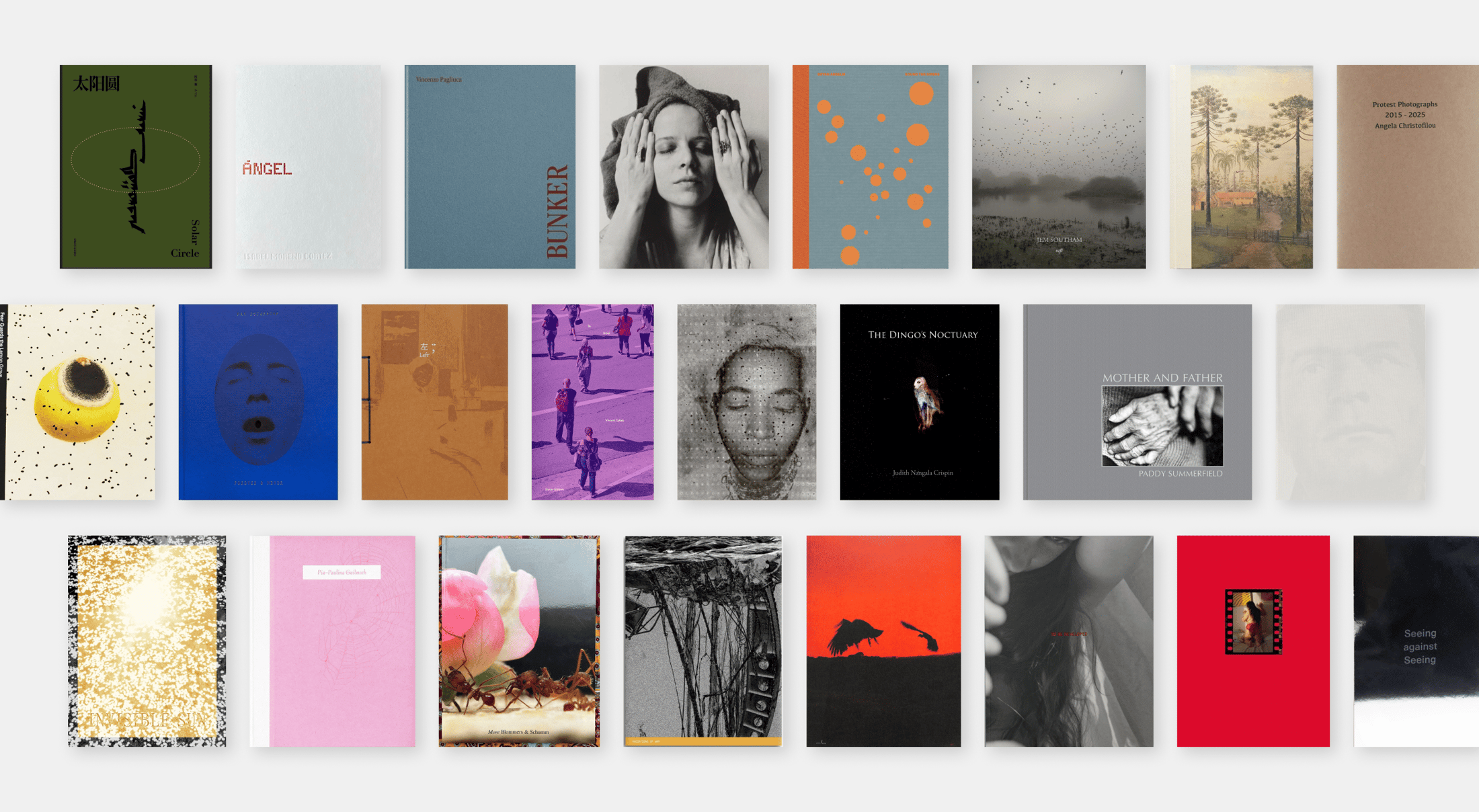
Here are more than 50 personal recommendations from experts who are passionate, super-knowledgable, and picky about photobooks. We reached out to friends and colleagues from around the globe and asked each to tell us about just one personal favorite photobook that stands out from the crowd for them in 2025.
The list is as diverse and wonderful as you can imagine from a group of luminaries with varied cultural backgrounds who have high standards, great taste, and discriminating points of view.
You’ll find hidden gems that were self-published, as well as some hefty retrospectives, edgy books from small presses, a zine, and an elaborate two-book set that is bound together by “a structure reminiscent of an umbilical cord.” Some of the books came to life over decades. One includes a photo made every single day of one year. Another of the favorite books (selected independently by three experts) was shot in one long magical day.
Which book stands out from the crowd for you?

Beneath its simple card cover, this zine holds a remarkable testament to resistance and solidarity. For ten years, Angela Christofilou has stood in the thick of London’s protests, photographing those fighting for change — from small reforms to seismic shifts. Drawn from her extensive archive, these images are a chronicle of collective action: raised placards, surging marches, sit-ins, camp-outs and vigils. Yet the work is more than documentation.
Christofilou photographs as both witness and ally. She reveals the humanity of protest—flashes of joy, surges of rage, acts of courage—that defy harmful narratives of protesters as faceless mobs. Instead, she creates vivid portraits of people gathering, together, demanding action.
- Ruby Rees-Sheridan, Assistant Curator, Photography, National Portrait Gallery, Curatorial Coordinator, Four Corners

Coreen Simpson is a legendary artist who has been photographing for many decades. She has a rich repository of unique portraits of luminaries like Toni Morrison, Ming Smith, and Nina Simone, as well as collage work, nudes, fashion, and street photography. I learned about Coreen Simpson’s work many years ago in her b-boys series and always appreciated her visual style. Normally I am overwhelmed when books incorporate many forms, however the design of this book is able to hold a wide range of her practice in the most sophisticated way.
- Noelle Théard, Senior Photo Editor, The New Yorker

Judith Nangala Crispin’s latest book – The Dingo’s Noctuary – is a remarkable synthesis of the timeless wisdom of Australian Aboriginal tradition and a radically innovative approach to printmaking. A photographer and poet, her illustrated verse novel transcends notions of ancient versus modern to glimpse the continuity of the world across time, place and dimensions of the spiritual. Through delicately nuanced allegory, her images envision the transition of life, in death, returning to the maternal earth as a metaphor for the profound interconnection, healing and respect that rests at the heart of the Aboriginal concept of Country. A truly unique work by a consummate artist.
- Alasdair Foster, Publisher, Talking Pictures

I first encountered Kazunari Suzuki’s Japan Guide Book as a juror for the Hong Kong Photobook Award and fell for it immediately. It shows how today’s visual clichés of Japan have been shaped through persistent repetition, tracing motifs replicated across postcards, guidebooks, and social media. The canonical viewpoints we know now go back to the meisho-e of the Edo period – woodblock prints that already established standardized perspectives on landmarks like Mount Fuji, Itsukushima, and Amanohashidate. By cutting these icons out as white silhouettes, Suzuki lays bare the construction of tourist imagery and reveals that our perception of Japan is the product of sustained visual conditioning. What remains visible is the overlooked periphery: the skies, the crowds, the mundane surroundings that never made it onto the pennants and posters. The result is an observant, lucid study of the interaction between tradition, commerce, and representation, clarifying why certain views endure, the processes that produced them, and which subtler features of the landscape have been consistently passed over. Having visited Japan repeatedly over the past thirty years, I feel familiar with many of these places – and yet this book made me see them anew.
- Andreas Müller-Pohle, Artist and Publisher, European Photography

Witnessing Life is my photobook of the year because it demonstrates, in clear and concrete terms, how Co Rentmeester shaped the visual memory of the twentieth century. As curator of the Witnessing Life exhibition at Foam and principal author of the book that accompanies it, I worked through an archive that shows how one photographer stood at many of the decisive turning points of modern history. Rentmeester documented the Watts uprising from inside the community at a time when mainstream media relied on visual codes that kept distance. He introduced color as an active stance in a field that treated it as secondary, shifting how civil unrest and state violence could be seen.
In Vietnam, he expanded the language of conflict photography by using remote-triggered cameras, aerial perspectives, and controlled timing to show the underlying mechanics of warfare rather than its aftermath. His work during the Munich Olympic hostage crisis established a new visual grammar for understanding the threshold between spectacle, politics, and threat. And in commercial photography, his two decades shaping the Marlboro campaign formed one of the most widely circulated visual mythologies of the late twentieth century. Few photographers influenced both public crisis and mass-market iconography with such precision and consistency.
Witnessing Life presents these contributions not as isolated episodes but as a connected system of methods, decisions, and responsibilities. The essays by Aernoud Bourdrez and Dr. Markha Valenta expand this further: Bourdrez analyses authorship, legal structures, and appropriation, while Valenta examines the political narratives that guide how images circulate and acquire meaning. Together, the essays situate Rentmeester’s practice within broader debates about visual ethics, cultural power, and the viewer’s role in receiving images.
This book shows that Rentmeester did not simply witness events; he defined how they would be pictured, understood, and later remembered. His archive is more than a historical record. It is a guide to the mechanisms through which images shape knowledge, judgement, and public imagination.
- Aya Musa, Curator, Foam

This photographic book explores the potential for conformity to underlie totalitarianism, a theme sparked by the ‘Ganbarou Nippon’ slogan (Let’s do our best together, Japan) following the Great East Japan Earthquake and the atmosphere of self-restraint during the COVID-19 pandemic. Japanese cultural emphasis on social discipline and collective harmony can often lead to intense pressure for conformity.
Focusing on this pervasive cultural concept of Kūki (Atmosphere), the artist spent over ten years documenting Yasukuni Shrine on the anniversary of the end of the war, and superimposed these images onto collages of Japanese newspaper pages spanning the pre-war, wartime, and post-war eras. The ephemeral, spectral quality of the Polaroid images—featuring men in uniform appearing like phantoms—serves to highlight the visual echoes between the past and the present. While the textual content of the newspaper articles provides deeper context for Japanese readers, the compelling design and layout of the book ensure the core experience resonates even with non-Japanese-speaking audiences.
Eighty years after WWII, Japan continues to exist in the ‘post-war’ era, sustained by Article 9 of the Constitution, which renounces war. The work sounds a vital alarm against contemporary populism and division on social media that eerily mirrors the shape of the past. The critical question remains: will the future define the present as the ‘pre-war’ era?
- Hideko Kataoka, Photo Editor, Newsweek Japan, Founder and Director, Miiraii Creative

In central Tokyo, where redevelopment and reconstruction advance relentlessly, an old apartment building stands in Ukima as if left behind. After marrying in his forties, the photographer Honda spent more than ten years photographing his wife in this place. This work emerged from that long accumulation of time.
In this world, everything with form will eventually break, and everything without form will sooner or later be forgotten. His photographs are, in essence, acts of confronting that inevitability. Just as the light that falls onto the palm of a hand, this work is created as if trying to grasp something that can never truly be held.
- Ihiro Hayami, Founder, T3 Photo Festival Tokyo

This book by Chinese photographer A Yin is the culmination of twenty years of photographing the Buryats living in his homeland. A Yin is an ethnic Mongol, and his people, like the Buryats, have lived in Inner Mongolia, China, for millennia.
Solar Circle is not a reportage, but a visual and artistic story, written in the first person and filled with love, compassion, and knowledge. The photographer is not a detached observer of the Buryat herders: he, like his subjects, feels himself an extension of the steppe, its sky, its land, and its laws of life. He depicts the caring relationships between people and their livestock, living as a united community in a harsh climate. This book brings together the stories of these people, many of whom have become friends with the photographer over the years. The photographer considers it his duty to become an artist and a voice for the steppe people.
The book’s particular value lies in A Yin’s meticulous rendering of color in his photographs. As a steppe dweller, he knows several dozen words denoting the color and condition of snow, and he subtly captures the nuances of the earth and sky—a skill not only beautiful but also imbued with practical meaning. The book’s design allows for wide-format horizontal photographs to be viewed; the silk cover recalls the precious fabrics in which Buryats wrap relics and gifts for good friends; and the meticulous translation of all texts into three languages—Mongolian, Chinese, and English—makes the book a photographic experience and a tool for communicating the culture of China’s steppe peoples to the outside world.
- Irina Chmyreva, PhD, Art Director, PhotoVisa International Festival of Photography

Filippo Barbero’s Borderland is a lyrical and deeply personal exploration of his childhood home in the Tuscan-Emilian Apennines, a rural village in northern Italy where his family has lived for several generations. Themes of memory, place, and the slow meandering of time abound through Barbero’s richly textured images. The book’s delicately printed black-and-white photographs convey the region’s scorching temperatures and intense light, making the heat and atmosphere palpable. Without succumbing to nostalgia, Barbero captures the spirit of youthful wanderings by photographing telling details – beads of sweat, a leaning tree, a makeshift fence – found in those marginal spaces, between civilization and nature or home and the wider world, where a carefree imagination flourishes. These intimate images invite the viewer into a world that is at once delightfully idiosyncratic and yet surprisingly relatable.
- Erin Hoyt Harris, Executive Director, Filter Photo

In September, MACK published Small Death by Martha Naranjo Sandoval, a body of work that quietly traces the last decade of the artist’s life through the 500 rolls of 35mm film she shot since moving to New York City. From this reservoir of images, Sandoval selected self-portraits, scenes from home, and rural and urban landscapes spanning Mexico and the United States.
I’m drawn to the visceral way Naranjo Sandoval engages her medium, a connection that feels both physical and deliberate. She presents images in their full 35mm frame, including printed details such as film type, frame numbers, and the sprocket holes that guided the film through her camera. In her self-portraiture, in particular, these marks feel almost like an extension of her embodied experience.
In one photograph, Naranjo Sandoval stands nude in her living room, lifting her gray-and-white cat so its hanging body obscures her own. On the opposite page, her partner appears, the perspective seemingly reversed. Time has passed (she is in frame 14, he is in frame 20), and she is now below him, looking up, her bare feet resting at his neck. The unfamiliar pairing doesn’t rely on visual shorthand, allowing us to construct meaning. I love the way this book shares moments of closeness without relying on predictable imagery or easy sentiment, making its vulnerability feel so honest.
- Liz Sales, Art Writer and Educator
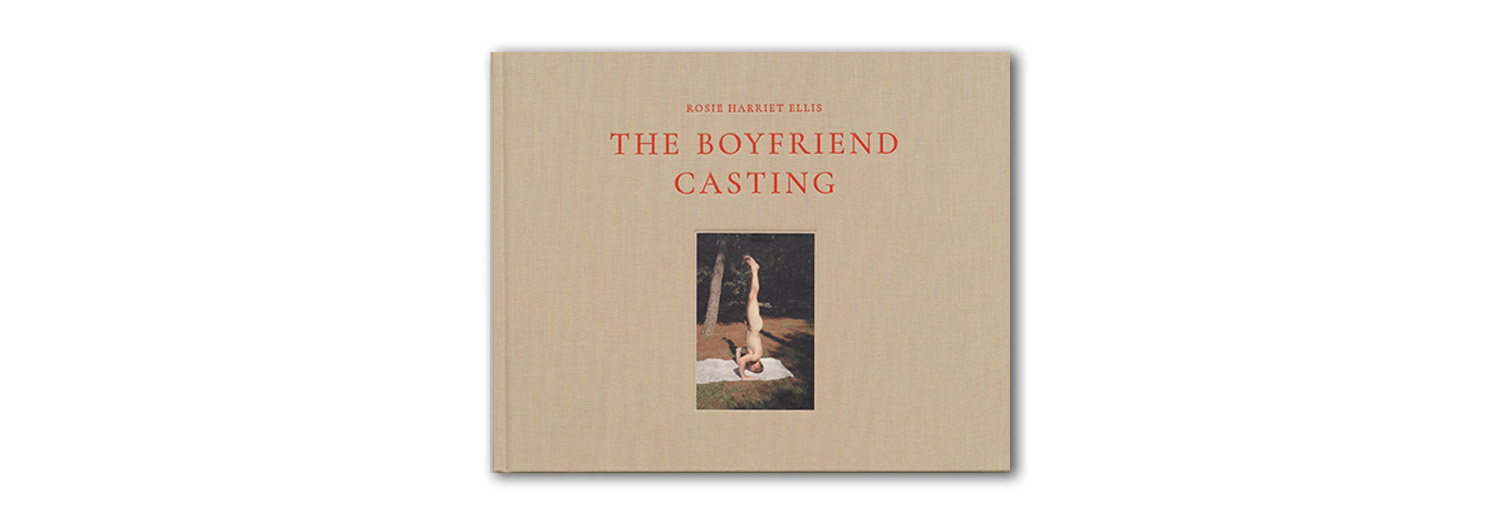
With The Boyfriend Casting, photographer Rosie Harriet Ellis creates a fascinating project exploring the relationship between desire, vulnerability, and the power of the image. The book, the result of five years of work, was born as a response to a personal wound: the withdrawal of consent by her former boyfriend Nick, who was originally meant to be the protagonist of a photographic series. Deprived of her initial subject, Ellis begins a sort of “boyfriend casting:” young, athletic, often anonymous men are invited to pose for her in a carefully directed process. This is not, however, a simple aesthetic pursuit. The entire project feels like a path to healing, an attempt to give shape to a pain that cannot be expressed through words alone. Each photograph is part of a personal reconstruction: an attempt to fill an absence and to understand how an image can define — or betray — intimacy. One of the most compelling aspects of the project is the power dynamic that shifts in relation to tradition. In a visual world dominated by the “male gaze,” Ellis takes control of the camera and overturns the perspective.
- Manila Camarini, Senior Picture Editor, D la Repubblica

This is a seemingly innocent book. Far from being another book about murmurations, Jem lets the scene build up and with a hint of sunset, mixed with a scatter of starlings, turns this into an irresistible book. Jem’s books always sell out, so grab one soon. It is also the first book published by his new company Raft.
- Martin Parr, Photographer
(Editor’s note: We are deeply saddened at the passing of Martin Parr. This was our last correspondence with him. He was a very kind, generous and supportive friend since the first time we met in 2005. We miss him already.)
Starlings by Jem Southam transforms a familiar, overlooked bird into a source of wonder, reminding us how extraordinary the everyday can be when we truly look. Southam’s photographs capture the starling murmuration with such quiet intensity that the ordinary world suddenly feels magical again.
- Rachel Barker, Co-Founder and Director, Stanley/Barker Publishers
I have always been a great admirer of Jem Southam’s work, having published his book Red River more than 30 years ago. Jem has now set up his own imprint and Starlings is the first of several titles he has planned. It is a beautiful and extraordinarily peaceful book and, as always with Jem’s work, it is deeply reflective. Photographed in a single afternoon at a wildlife sanctuary in Somerset, he photographs the birds as they fly in to roost from late afternoon onwards, with thousands of the birds filling the sky before they eventually disappear into the gathering darkness.
- Dewi Lewis, Dewi Lewis Publishing

I’m so happy this book finally was reprinted and back in the world at respectable price. This book has always been so intriguing to me, that these images were even made and how they sort of hover above the page and act as a memento more than a document of death. I’ve always been interested in simple folk structures of creating art. So the combination of classic western religious iconography, poetry and photos of the deceased is a triple whammy for me.
- Paul Schiek, Founder and Creative Director, TBW Books

From the very first pages, this book draws you in, and I found it almost impossible to put down. As a lover of the simple yet sophisticated Italian dish “pasta al limone,” I found myself suddenly drawn into the complex history of Sicily and its cultural interconnections via my culinary weakness. The photographs, illustrations and narrative passages had the same effect on my senses as the finely grated lemon zest on the dish itself: unmistakably distinctive. This distinctive ambivalence, which is as multi-layered as Sicily itself, reflects the complex and culturally woven history of the land.
- Roman Härer, Creative Director at plainpicture

With #shotbyadams, Bryan Adams once again proves that his artistic vision extends far beyond the recording studio. This collection of portraits, a continuation of his acclaimed 2012 volume Exposed, brings together nearly two hundred images captured over the past ten years. The book presents an extraordinary lineup of subjects. Icons from music, film, fashion, politics, and culture, all seen through Adams’ distinctive eye.
The portraits offer an intimate look at figures who have shaped the modern cultural landscape. Some are photographed in stripped-back simplicity, others in carefully composed narratives, but in every image, Adams manages to reveal both presence and personality. His portraits are confident, immediate, and alive, balancing technical precision with genuine human insight. The forewords by Giorgio Armani and Boy George enrich the book further, reflecting on what it means to be in front of Adams’ camera and on his unique ability to connect with his subjects.
Adams has long been a multifaceted artist. His photographs, like his songs, carry authenticity and emotional depth. Alongside his music, his commitment to photography and humanitarian causes underscores his creative and compassionate spirit. #shotbyadams is more than a photography book, it is a testament to a decade of artistic exploration by a man who continues to see the world with curiosity, empathy, and an perfect sense of style.
- Roy Kahmann, Director, Hungry Eye Group

Rarely do I find an artist’s monograph achieves something greater than a well-edited selection of images and a contextual essay. Dan Estabrook’s Forever & Ever does exactly that. It presents his work from the past three decades as almost a sculptural object that reminds us of the expressive potential of the book form.
The design (by Studio Elana Schlenker) honors Estabrook’s work creating a tactile and transformative experience. The purplish-blue cloth cover embossed with gold letters shimmers and feels regal and naughty at the same time. The mouth of the cover image is cut out revealing a black void. Other cutouts appear sporadically throughout the book. The black pages that precede and succeed the images along with the speckled black edges create a dark doorway or curtain into the mind and spirit of the artist. Each chapter page marks its section with silver paper and raised text. The printing of the images thoughtfully evoke the variety of early photographic processes and mixed media that Estabrook uses. Though often referencing the 19th Century, Estabrook’s work remains contemporary with its psychological complexity. It plays between the supernatural and the theatrical, melancholy and humor, and of course a touch of the macabre.
The book’s literary contributions are impressive in their own right but, in the context of the book, they honor the spirit of Estabrook’s work and speak to the complexity and sincerity of his themes and ideas. Lyle Rexer, known for his contributions to the histories of alternative process, offers Broken Fingers, a piece that is so in tune that it almost feels as if the artist could have written it. Arnold J. Kemp’s Sonnets were completely new to me and inspiring. A stanza I especially liked reads:
And does not music
Attend secretly spirit
Hidden chords in stars?
- Tom Gitterman, Gitterman Gallery

Île Brésil is Vincent Catala’s first monograph, the result of ten years exploring the outskirts of Rio, São Paulo, and Brasília. Far from familiar images, he reveals in-between territories where isolation is as much mental as it is geographical. Balancing technical precision with intuitive wandering, his photographs capture the ambiguity of a continental nation caught between fatalism and a desire for change. Beautifully designed, the book unfolds as three thick-paper leporellos, housed in a hard cover with a mauve screen-printed plastic jacket, offering a documentary yet deeply interior vision of an often-unseen Brazil.
- Xavier Canonne, Director, Le Musée de la Photographie

Punto Ciego by Santi Donaire was recommended by a close friend when he learned I am originally from Paterna, a town adjacent to Valencia in Spain. I grew up surrounded by my grandfather’s stories about the Spanish Civil War and the subsequent Franco dictatorship; the famine his family endured while working as laborers harvesting olives in southern Spain, the fear of standing by their values and beliefs. I knew Paterna had been one of the last strongholds of the Republican band, but I didn’t know that its cemetery was the second site in Spain with the highest number of documented executions after the end of the war. Between 2017 and 2025, Donaire documented the exhumation works carried out in Paterna from 2018 onwards, enabled by Royal Decree-Law 10/2018, which amended Law 52/2007 on Historical Memory. Coinciding with the 50th anniversary of the dictator’s death, the photobook presents black-and-white photographs of urban and environmental remnants of Franco’s regime, portraits of the relatives of fusilees, as well as material traces of their personal belongings. Punto Ciego stands as a visual testimony to the long-wished-for healing of the scars left by one of the darkest chapters in Spain’s recent history.
- Raquel Villar Pérez, Editorial Manager, WOPHA and Curator, Cómo ser Fotógrafa

Mexico-based Hungarian photographer Adél Koleszár offers an empathetic yet raw depiction of the brutal reality of systemic violence in Mexico. Far from the stereotypes of sensationalism and shocking graphic imagery, she approaches this sensitive subject matter with a quiet tone and a more contemplative style, weaving between documentary and art. Her visual research bears witness to the absence and the collective trauma. It highlights the women and families whose resilience and persistence has allowed the discovery of mass graves, unveiling the numerous disappearances. The book is a silent but powerful homage to their actions and grief, without forgetting the sociopolitical dynamics that are at the core of this structurally violent system.
- Arianna Rinaldo, Art Director, Educator, Curator, PhEST

Sound the Sirens brings the impact of natural disasters on communities directly into the viewer’s personal space, whether or not you have experienced such trauma first-hand. Despite decades of warnings from climate scientists that temperatures are rising, those in the path of tornados, rising waters and forest fires are experiencing the impact in greater frequency. Photographer Bryan Anselm has spent the past 10 years documenting the effects of natural disasters across America, sharing the consequences through news outlets – we see the images depicting the immediate aftermath in print and on screens, and the news cycle moves on…
Overlapse brings us Anselm’s powerful message in a book I found impossible to put down. It opens with a quote from Ralph Waldo Emerson: “One of the illusions of life is that the present hour is not the critical, decisive one.” He takes us to neighborhoods where family histories are ruined beyond recognition or repair, the natural world now entangled with the built environment, the lives of every living being impacted. The book is printed on uncoated paper with uncut pages which hold discoveries for the viewer within the emergency orange-colored inner-sleeve (a prominent yet subtle design element). Do not look away from the tragedies inflicted on others; instead, bring empathy and strive to gain an understanding of what we can do now to help our ailing planet.
- Mary Virginia Swanson, Author, Educator, Advisor

I discovered this book at the 2025 SF Photo Artbook Fair and have returned to it again and again. Between December 1972 and August 1973, Melissa Shook photographed herself nearly every day in her Lower East Side tenement apartment. A single mother with an eight-year-old daughter, she made this work as proof of existence.
Shook transforms ordinary domestic space through light, shadow, and an unfiltered gaze. These are not curated moments of beauty or aspiration; they are the actual texture of days. Her poses move from classical to raw expressionism without placing any hierarchy between them. Each day is documented with the same quiet devotion.
In an era shaped by curated perfection and impossible standards, Shook’s work feels necessary. The sustained serial format builds a portrait of selfhood spacious enough to contain multitudes. Daily Self-Portraits 1972–1973 is my book of the year because it reminds me that change happens not in grand gestures but in the steady act of witnessing ourselves exactly as we are, day after day.
- Sara Urbaez, Photo Editor

One of my favorite books that I added to my library this year is Blank Notes by Marshall To. It’s published by Charcoal Press and is a larger scale, dark black matte, book filled with all the imperfections that I feel we all desperately seek in this computerized world that we’re living in, especially right now. Marshall’s work is deeply personal, slowly made, and it’s incredibly beautiful. He hits the perfect note.
Most importantly, Mr. To strikes a tone of being about something passing, something moving, with many different creatures flying or trotting through the woods, many of them, especially owls, looking right back at us. Carefully woven in there are a few pictures of people and sparse dwellings that become implied places between worlds that complicate or defeat a narrative reading.
Instead, we are invited into a wild, dark, black world near a seemingly endless nighttime that fluctuates between being something real and something imagined. Timeless, and right on time.
- Todd Hido, Photographer

This November, Alexey Yurenev launched Seeing Against Seeing, an artist book in collaboration with Teun van der Heijden and the Anti-Krieg Museum in Berlin. It is the most recent iteration of his long-running project Silent Hero, in which Yurenev reconstructs his grandfather’s obscure WWII legacy through archives, interviews, and AI, probing how memory is built—and distorted. The book is constructed around Ernst Friedrich’s 1924 anti-war manifesto War Against War! and stages a powerful visual dialogue: Yurenev’s synthetic, uncanny wartime imagery confronts Friedrich’s searing WWI photographs. Woven between them runs the translucent script of No One Is Forgotten, his film in which AI-generated images ignite memories in WWII veterans. Ultimately, Seeing Against Seeing fuses these narratives on the concept of seeing into one astounding object, encased in solid metal.
- Claartje van Dijk, Senior Curator, FOAM

In Invisible Sun, Amani Willett explores another way of seeing—through the aperture of a childhood wound. As our fingers slowly turn each exquisitely thick page—including unfolding a hidden image of a child lying on an operating table—we’re reminded that we perceive the world, in all its sufferings and joys, with our entire body, not merely our eyes. Beautifully designed by Dust Collective’s Emily Sheffer, the book weaves together color, black and white, and AI-generated images of landscapes, nightscapes, seascapes, and portraits of Willett’s children acting as stand-ins as he visually charts “the space between memory and embodiment—where the body holds what the mind forgets.” The book ends with images of bodies in faint light and birds in flight—and the lingering sense that “wound” and “wonder” almost rhyme.
- Rebecca Norris Webb, Photographer & Poet

The most remarkable discovery of the year is The Classroom. It offers a striking showcase of the transformative power of photography in examining identity, whether personal or collective. The black pages create a sense of silence that contrasts with the original black-and-white compositions of the photographs taken between 1994 and 2000. At the time, the artist Hicham Benohoud was an art teacher at a school in Marrakech. He set up a makeshift darkroom and encouraged his students to use their imagination within the confines of the classroom. This was a kind of collective performance with strong educational and cathartic value.
- Francesca Marani, Senior Photo Editor Vogue Italia

Some photobooks neatly encapsulate a place, time, or story. Others emerge from a looser, more intuitive process. Liz Johnson Artur’s I Will Keep You in Good Company is all the more powerful for its messiness – a layered, tactile gathering of pages from her personal workbooks, spanning 30 years. These handmade volumes are intimate spaces of visual thinking, forming the foundation for her celebrated Black Balloon Archive, which honors communities across the African diaspora.
- Simon Bainbridge, Editor, British Journal of Photography

Originating from the powerful video installation El rastro de la serpiente, this photobook transforms the immersive, almost ritualistic experience of the artwork into a tactile and intimate object. The project took shape over five years of travel through Mexico, as well as Bolivia, Chile, Panama, and New Mexico, during which Maya Goded met women who carry local myths, rituals, and generational wounds. Their stories, marked by violence, intertwine with those of Goded’s own family and with the surrounding landscapes. The photographs lead us through caves, forests, rivers, and deserts, weaving together family images and historical documents to create a journey of discovery and healing. The serpent acts as a guide, an emblem of feminine wisdom and regeneration.
The design is distinctive: a bilingual Spanish-English boxed set containing two booklets. One gathers three texts, including an incisive historical-anthropological essay by Mexican curator Ángeles Alonso Espinosa. The other, composed of three overlapping signatures, mixes images with Goded’s own brief reflections. It is a book that must be opened with both hands, as two of the signatures are designed to be read simultaneously, guiding the reader toward the central booklet.
- Elena Boille, Deputy Editor, Internazionale

Bunker by Vincenzo Pagliuca is a rigorous and quietly unsettling visual journey through semi-enclosed, marginal contemporary spaces. With photography grounded in geometry and suspension, Pagliuca shapes a silent yet powerful narrative in which architecture becomes a metaphor for waiting, fragility, and resilience. A precise, essential book that delivers a lasting impression.
- Enrico Stefanelli, Founder and Artistic Director, Photolux Festival

This nuanced and multi-layered book is the culmination of Claire Beckett’s twenty-year exploration into the political and cultural phenomena of the U.S. military’s cultural simulation training for the wars in Iraq and Afghanistan – an inquiry that provocatively questions how Americans engage with other cultures. Clad in a green cover with elegantly designed, gold-foiled symbolic Arabic calligraphy, the book includes formal portraits of soldiers and hired civilians role-playing as well as landscape images depicting the fabricated counterinsurgency environments on the US domestic military bases where Beckett spent extensive time. Interspersed between groups of photographs throughout the book are excerpts from pamphlets produced by the U.S. government’s Defense Language Institute, some dating back to the 1960s and 1970s. These carefully selected cultural guidelines provide a counterbalance to the deliberate neutrality of the photographs, creating an equilibrium between text and image while also revealing the artist’s pointed critique of longstanding U.S. cultural biases toward Arab and Muslim societies.
- Kristen Gresh, Senior Curator of Photographs, Museum of Fine Arts, Boston

Buried in Style explores one of the most extraordinary funeral traditions in the world, the vibrant and artistic burial culture of Ghana’s Ga-Adangme people. Before being introduced to this series, I knew Regula Tschumi, photographer and ethnologist, through her brilliant street photography. When we met in Rome and she quietly showed me the burial project on her phone, I immediately recognized its significance. The intimacy and depth of those images revealed something rare that needed to be seen in the form of a book.
Through her images and texts Regula introduces us to Ghanaian funeral rituals with an impressive visual language shaped by twenty years of work. Her photographs offer a sensitive and surprising insight into Ghanaian funeral culture, where figurative coffins and dance performances celebrate life rather than death, farewell and moving on, and beauty and transience. Free of clichés and full of empathy, this book presents the diverse and dynamic farewell ceremonies of the Ga people with remarkable aesthetic depth.
- Gulnara Lyabib Samoilova, Founder, Women Street Photographers

This photobook is composed of snapshots the artist took during the five years she spent in New York beginning in 2007. The cover image—set against a yellow wall and showing a small flame quietly burning at the tip of a pencil—is particularly striking. The flame neither flares up nor seems about to disappear; it simply hovers there, steady and calm. Turning the pages, the sequence begins with a photograph of a book containing star charts and astronomical images, and from there the photographs unfold as if moving back and forth between interior spaces and the streets of New York. Scenes of domestic life—shattered glass on the floor, the view from a windowsill, a kitchen cluttered with objects—alternate with images from the city: portraits of people who appear ordinary yet slightly odd, tulips on a street corner, a doll with a hand held over its mouth. The images drift between these realms, echoing the artist’s oscillation between introspection and external observation.
At first glance, the snapshots may appear disparate or without narrative connection. Yet this very accumulation of heterogeneous moments forms Life Studies, a meditation on the life of the artist living within this unruly world and on the lives of those he encountered along the way.
- Yuri Yamada, Curator, TOP Museum

Earlier this year, Anton Corbijn was named the recipient of the Icon Award at the 2025 Abbey Road Music Photography Awards for his groundbreaking and influential work concentrating on artists and musicians. This book celebrates this contribution presenting an incredible career spanning collection of work (released as a companion to the Fotografiska Stockholm exhibit this past summer), it’s a weighty tome worthy of one of the greatest photographic artists working today. I’ve been a massive fan but even this book surprised me on the scale and scope of his work.
- Sacha Lecca, Deputy Photo Editor, Rolling Stone
Anton Corbijn is now a star in his own right, having photographed almost every famous international musician over the course of more than 50 years. Many generations (including mine) have grown up with his photographs and films. Whether it’s U2, Depeche Mode, Tom Waits, Nirvana or the Rolling Stones — Anton Corbijn has portrayed them all. His book is a tribute to him, as an innovative and passionate photographer who has influenced visual art and pop culture to this day. This illustrated XXL-format book pays tribute to his obsession with rock ‘n’ roll – an interest that has led to lifelong friendships with Bono, Nick Cave, Tom Waits, Michael Stipe, Dave Gahan and other legendary musicians. The book looks back on three decades and features hundreds of creative, unusual images that Corbijn was able to capture thanks to his close relationships with his subjects. The book was published to coincide with Corbijn’s 70th birthday.
- Andreas Trampe, Co-founder, Hamburg Portfolio Review

Can we understand death as a cycle rather than an end? El Paraíso Come Carne questions the structure of life through metamorphosis and movement. In painted landscapes, animal cadavers merge photography and painting, establishing a dialogue between the symbolic and the material. Photography emerges as a small death, yet glimpses immortality by transmitting the spirit and lightness of existence. Poetic and intense, this book presents redemptive and revolutionary images, a necessary work for times when the fantastic and the spiritual seem scarce.
- Ângela Berlinde, Photography Curator

The images in this book were made over a span of 30 years by Russian photographer Alexey. There is such a beautifully gentle and timeless quality to his work. The book was reissued by the photographer this year, and now more people can enjoy it. I find it enchanting.
- Chris Pichler, Founder and Publisher, Nazraeli Press

The beautiful L is for Look: Children’s Photobooks, designed by Ina Kwon and Helmet Völter and published by Spector Books, is the outcome of many years of research and cross-institutional collaboration focusing on the history of photobooks for children. The three cover designs for English, German (S wie Sehen) and French (R comme Regardez) readers reflect an approach to the subject which is both playful and serious in its intention, variously colored pages inside denote chapters dedicated to subjects from pedagogy to animals, but it is the variety and layout of the featured books themselves that make this such a rich and enriching publication, for all ages.
- Clare Grafik, Head of Exhibitions, The Photographers’ Gallery

Cai Dongdong’s Left, Right is a quiet, radical meditation on the photograph as a political and human document. Through the mirrored sequencing of anonymous portraits, Dongdong transforms state-issued identification into a visual dialogue across time and ideology. The book reminds us that systems may shift, yet the human spirit— its tenderness, hope, and dignity—remains constant. The physical act of turning both volumes simultaneously becomes an embodied reflection on history itself: how we look, remember, and recognize ourselves through others. Left, Right restores individuality to the archive and reveals the photograph as both evidence and empathy.
- Azu Nwagbogu, Director, AAF/LagosPhoto Festival

I was one year old when Arthur Tress photographed the Ramble, one of the world’s most iconic cruising grounds. He captured the hidden yet open nature of the space, along with the joyfulness, awkwardness, and mischievousness of cruising for sex. I remember my own cruising days in the 1980s in Chicago, and these images instantly resonate — the risks, the provocative postures, the thrill of being seen without being seen.
Tress’ black-and-white photography feels rich, physical, and alive. One image in particular — a man in an overcoat standing by a tree, exposing himself, pant legs pinned to give the illusion of clothing — is almost surreal. It’s funny and bold and, unsurprisingly but strangely inviting. It’s the kind of photograph that shouldn’t exist and yet absolutely had to be made.
The book moves between broader cruising scenes and more intimate portraits, capturing gestures and expressions that feel fully inhabited. Photographed in daylight, the images feel radical given the time. Made the same year as Stonewall, they show men claiming space on their own terms in Central Park.
One of the strengths of the book is the endpapers, which mimic a spotlight falling on a silhouette in the forest — a nod to the anonymity and theater of cruising landscapes. My only critique is the pointy, blocky font; it doesn’t quite match the feeling of the work.
Tress takes something usually unseen and makes it visible without stripping away its mystery. That he kept these photographs private for decades, until it was safe to share them, gives the work a weight — a sense that these images were handled with care, both for the men pictured and for the world that wasn’t ready to see them. And while it’s unclear how much he saw himself as a participant versus a witness, his perspective as a gay man gives the photographs a charged intimacy. For me, The Ramble, NYC 1969 isn’t just a book of photographs — it’s a window into an era I’ve only glimpsed in my imagination, made immediate and alive on the page.
- Richard Renaldi, Photographer

Flowers Drink the River is a gorgeously quiet monograph of haunting nocturnes replete with moths, snakes, and owls, which are animated by raw, animistic rituals—including naked women sensuously wrestling in mud and others pissing upon open hands from tree branches high above. The high-contrast images are at turns euphoric and perilous, magical and foreboding. But it is not until one of the final pages when a cryptic statement appears belying the metaphor implied by the beguiling photographs—namely the first two years of Guilmoth’s gender transition while living in a rural, predominantly right-wing town.
- Brian Clamp, Director, CLAMP

Odette England has been making personal, evocative and smart photobooks for sometime now - and this newest publication released through Australian-based Tall Poppy Press feels like the third part of a trilogy that started with Dairy Character in 2021, and The Long Shadow in 2024.
This book is the most open and vulnerable of the three - it is large, soft, monochrome, and feels slow and gentle. The images inside also have this sense, meditative yet deliberate - they seem to gentle ebb and flow as the pages turn. Continuing a collaborative approach to making work, with her daughter Hepburn, England shows us limbs, obscured landscapes, dreamy meadows, and makeshift sheets as backdrops for ephemeral still life photographs. She places objects and bodies too close or too far away to be precisely discerned, and the result draws you into a tender and personal space. It’s easy to imagine all these images are stills taken from a BW Super 8 film such is their flow, and their undeniable transitory and delicate quality.
The book itself approximates the scale of a scrapbook, and some of its pages evoke that sensibility further, showing ripped images, and pieces of tape holding ideas/moments together. The shifts in scale and placement of images show us a photographer/editor thinking deeply about the poetics of the book as an intimate space. The paper stock is itself warm and earthy - occasionally a soft, pale pink tinge infuses a page, reminding us of the bodies at the centre of the visual narrative.
Even the occasional muted, pastel colour images do little to snap us out of the dreamlike space this book creates. Each page layout, and the way each sequence moves and oscillates seems to hint at the transitory nature of childhood, motherhood, nature, and relationships. This book embraces the short-lived space of each moment in all its fragmentary, confusing, tactile, bodily nowness - a rare achievement.
- Daniel Boetker-Smith, Centre for Contemporary Photography, Australia

This book has made a vital contribution to photography, race, and representation by reshaping how Black presence in British visual history is understood. Through its painstaking assembly of 19th- and early 20th-century studio portraits—many previously unseen—the book challenges the assumption that Black subjects were absent from early British photography. Instead, it reveals a rich, complex archive of individuals whose identities, achievements, and cultural significance were long overlooked.
Mussai’s curatorial approach foregrounds dignity, agency, and historical context, encouraging viewers to consider how photographic practice both reflected and shaped racial narratives. The book positions these images not as curiosities but as integral to national history, expanding the canon of photography. By bringing marginalized stories to light, Black Chronicles prompts critical reflection on how race has been visually constructed and invites contemporary audiences to reconsider the legacies of representation that continue to influence photographic culture today.
- Mark Sealy, Director, Autograph

Brooke DiDonato’s first monograph Take a Picture, It Will Last Longer, is an easy one to stand behind. Her surreal, sharply composed images have stayed with me since we first exhibited her work in 2018, and they’ve only grown more compelling. This book brings together her most resonant series with strong new work, highlighting the uncanny, tender, and psychologically charged spaces she constructs. It’s a smart, beautifully made volume that captures the full force of her imagination. If you care about contemporary photography, this belongs on your shelf.
- Sam Barzilay, Creative Director & Co-Founder, Photoville

In Too Many Products Too Much Pressure, Janet Delaney returns to a body of work she made in the 1980s, when she photographed her father during his final week before retiring as a beauty-supply salesman. What emerges is a deeply personal yet sharply observed portrait of a man defined by incessant movement—driving, carrying, talking—his restless, pulsing energy animating every frame.
In her twenties and newly armed with an MFA, she was already questioning the constricted gender roles and relentless consumerism embedded in this commercial landscape. Her images carry echoes of 1930s documentary photography—with its focus on labor and the dignity of workers—as well as the visual anthropology of John Collier Jr.
Revisiting and publishing this series 45 years later gives the photographs new resonance. Time has a way of reframing our parents: who they were, what they sacrificed, and how their labor shaped our own paths. Delaney writes and sequences the book with the awareness that adulthood brings—an understanding that seeing our parents clearly is both an act of love and an act of becoming.
- Monique Deschaines, Director / Owner, Euqinom Gallery

My favorite photobook of 2025 is More by Blommers & Schumm. This remarkable volume offers a beautifully curated overview of 25 years of collaboration between the Dutch duo, revealing the depth and evolution of their photography. Blommers & Schumm blur the boundaries between fashion, portraiture, and conceptual photography, creating images that feel both effortless and carefully constructed. The tension they cultivate, between beauty and strangeness, public image and private intimacy, is perfectly summed up in the book, and resonates with why they still have such a strong and renowned name in the industry.
- Narda van ‘t Veer, Founder, The Ravestijn Gallery

A collaboration between Jackie Furtado and Jennifer Haare, this book follows the journey of Tornado, a mustang making its way through the Sonoran Desert. With its roots in early moving image experimentation pioneered by Eadweard Muybridge and Etienne-Jules Marey, who were concerned with capturing the unseen moment a horse’s hooves leave the ground, the book is composed of stills taken from GoPro footage. Unlike the exacting, scientific gaze of its predecessors, Tornado takes us on a wild ride; the camera is strapped to the belly of the horse, producing a series of dizzying images marked by motion blur, grit, sand, pixels—a chaotic undoing of the desire to capture, control, measure embedded in the photographic gesture. After journeying through the book, whose sequence can be animated like a flip book, we discover a playful text by Kim Beil that frames a series of moments in the life of Eadweard Muybridge in the form of tableaux.
- Sophie Wright, Writer

Combining the history of the Autonomous School Zurich and the wish-granting ship myth – about a magical boat on Lake Geneva that, according to legend, would appear and grant wishes to those who saw it – Emilio Nasser offer a counter narrative of Switzerland migration policies in a well-crafted book where photography, drawings, archival images, participatory narratives, and essays are carefully employed to express a human perspective and the relevance of the photobook as a vehicle to see contemporary issues from a different angle.
- Giuseppe Oliverio, Founder and Director, PhMuseum

Yana Kononova argues that war does not end when the explosions fall silent. This conviction underlies her exceptionally designed and crafted photobook. Her black-and-white photographs trace the enduring presence of war in Ukraine - not as documentary evidence, but as an encounter with a landscape where catastrophe continues long after its initial impact. The land becomes both witness and archive; when the front line recedes, the ruins left behind reveal a terrain transformed, bearing the imprint of everything that has passed through it.
For Kononova, the term radiation captures the complex, contaminated nature of wartime experience as it reverberates across generations. The book offers a deeply personal response to what she observes in her own country. Despite the brutality and destruction of war, the images retain a remarkable dignity and convey a strange, quiet calm that reaches the viewer.
- Alexa Becker, Publishing Consultant & Photography Coach

In a year with ever more books being published it’s hard to really pick one, but as I reflected on all the hyped books and oversized ones, and the splashy super commercial feel to so many others, oddly, the one little book I kept coming back to was Paddy Summerfield’s endearing, touching, tender hearted book called Mother And Father, published by Dewi Lewis, with a lovely text by Gerry Badger. I was given this slow, subtle and deeply felt book by Richard Ovenden of the Bodleian Library, when he and I held a public conversation there this fall, and where Paddy’s beautiful exhibition, curated by Alex Schneideman, who introduced me to Paddy’s work, is on view.
The humility, intimacy, and ordinariness of the late years in a parents life is so exquisitely seen and tenderly described here; that the pages just melted into a space for reflection on time’s passing, aging, the seasons, and the great journey that even a seemingly ordinary life contains. This is as poetic as a visual book can be.
- Joel Meyerowitz, Photographer

It’s Hard to Be a Rebel That Time Travels is a poetic exploration of time, identity, and inherited trauma. Through layered images and intimate reflections, Raymond Thompson Jr. problematizes and repositions the Black body as both an archive and a futurity that remembers, resists, and reimagines itself across generations.
- Steven Evans, Executive Director, FotoFest

Claire Rosen’s monograph Birds of a Feather is an exquisite compilation of her series of the same name. The variety of birds in the portraits, paired with lush Victorian wallpaper backgrounds, makes each page a fresh adventure. The photographs highlight the personalities of these feathered subjects, conveyed by their expressions and body language.
There are layers in the book beyond physical beauty. Rosen explores the connection between art and nature, as well as the greater relationship between humans and birds. As she wrote in a recent column for The Washington Post Opinions, ‘All of these species are impacted by human society, whether through inadequate care in captivity, habitat loss, light pollution, illegal wild trapping, chemical and plastic pollution, animal testing or the brutality of factory farming.’
Hopefully Birds of a Feather will inspire acts of conservation for these stunning creatures.
- Chloe Coleman, Senior Photo Editor, Opinions, The Washington Post
Claire Rosen’s Birds of a Feather presents live birds—bold, bashful, ornate, or unruly—posed against lavish, historically inspired backdrops, creating portraits that reflect on beauty, domestication, and our urge to categorize the natural world. Through 120 color photographs, the book blends ornithology, art history, design, and ethical reflection. What began as a visual study became a meditation on our relationship with nature, revealing the distinct personalities of its avian subjects. Ultimately, it asks: if nature inspires art, how might art reshape how we see nature?
- Ron Haviv, Co-Founder, The VII Foundation

In Waiting for the Snow, Katarzyna and Marianne Wasowska explore Polish migration to South America in the 19th century and early 20th century. Through a mix of new photographs, family albums, and archives, the book captures a migration story that may be new to many. Ideas around identity, reconstruction, colonialism, home, and collective memory are all wrapped into this book. There is a fairy tale-like aspect to some of the imagery, underscoring how fiction and storytelling are often just as important to the construction of identity as documents and facts.
- Magali Duzant, Artist and Writer

Isabel Moreno Cortés’ Ángel Miguel is one of the most profoundly moving photobooks I encountered this year. Born from two devastating yet interlinked losses in her family, the work traces a delicate, almost uncanny resonance between the lives of two boys whose stories echo across time. Through fragments of photographs, documents, and embodied memory, she constructs a dual narrative that could only exist as two books bound together—held by a structure reminiscent of an umbilical cord. What stays with me is the quiet determination behind every choice: a deeply personal journey transformed into a work of uncommon clarity, tenderness, and strength.
- Yumi Goto, Publisher, Curator, Author, Director of Reminders Photography Stronghold

