Cambridge, Minnesota, 2017. After the most recent U.S. election, I stopped traveling and stayed home in Minnesota. I also stopped photographing strangers. I preferred to drive into farm country without talking about politics or ideology. But I was also aware that my ability to do this sort of apolitical wandering was the result of the enormous freedom and privilege with which I was born. Every landscape, no matter how subdued, can be seen as a political landscape. © Alec Soth/Magnum Photos
Village of Jayyous, West Bank, Palestine, 2003. I made this picture on my first trip to Palestine. I remember how coming upon this scene felt like a mirage. All around it were checkpoints, barbed wires, Israeli military jeeps and the hum from the construction of the separation wall; this woman seemed oblivious to it all as she calmly filled her bucket with olives.The wall now cuts through this village making 75% of the land inaccessible to her and to the farmers who'd worked the land for generations. I dedicate this picture to her and to a future where Palestinians are free from the Israeli occupation of their land and lives. © Alessandra Sanguinetti/Magnum Photos
Miami Beach, Florida, 1989. Would I have seen this beach scene unfold before my eyes if I hadn't already spent years photographing in Haiti, with its tropical light and volatile weather? This particular afternoon on Miami Beach, a gust of wind caught this boy's tangerine-colored towel as he rushed off the beach before the storm. Only later did I notice how the sweep of his beach towel echoes the sweep of the dark clouds overhead. © Alex Webb/Magnum Photos
Nuevo Laredo, Mexico, 1991. Photography is considered a tool for conveying diverse visual perspectives into the world; but it is, first of all, an adequate strategy to shape one's understanding of existence while actually existing. I maintain free will, revealing the intimacy of physical and mental experiences, embracing contemporary violence, generating a proper position inside the social order and the existential void. The act of photographing accepts no compromise. © Antoine d'Agata/Magnum Photos
Istanbul, Turkey, 2015. I used to think that I was a street photographer. I pushed myself to take photos on the streets, but in a way, it never felt comfortable. I always had the feeling that I was 'stealing' photos from people. With Ou Menya, my project in Russia, things changed. I entered people's homes to photograph the intimacy of families, and for the very first time, I felt both connected and at ease with the medium, as well as toward the people I was photographing. Although I may have been physically 'trapped' inside the house, for the first time I felt free. The relationships I built with the people I photographed was crucial to this evolution. I now see photography as a conversation, even though we don't often share the same language. © Bieke Depoorter/Magnum Photos
Alabama, USA, 1965. From 1961 to 1965, I bore witness to various demonstrations in the civil rights movement. In this photograph, a group of civil rights demonstrators march from Selma to Montgomery to fight for the right to vote. Freedom was then, as it remains today, something that had to be fought for. © Bruce Davidson/Magnum Photos
A preserved sea bream displayed in the history museum in Aralsk, a dried up Soviet fishing port on the shore of the former Aral Sea. Kazakhstan, 2009. We usually understand freedom through its opposite: captivity. To me, this image deals with the juxtaposition of these two concepts: From the sealed jar, isolated pedestal and stark room we get confinement, whereas the prism of light entering from the left side of the room, from somewhere outside, suggests an alternative place that might look like freedom. I think this image leads to a lot of other open-ended questions too, about life and death, nature and artifice, and the scope of time. © Carolyn Drake/Magnum Photos
Untitled, New York, New York, USA, 2014. Free enough to take pictures of things that don't matter, like spilt cherries on a crosswalk, for instance. © Christopher Anderson/Magnum Photos
Ouidah, Benin, Africa, January 2016. This image was shot on the beach of Ouidah in 2016, a small town in Benin, where most slaves were shipped from Africa to America. It is an outtake from the series 'Midnight at the Crossroads' that I did in collaboration with Bruno Morais. Traveling to different strategic shores, we followed the path of Legba, the Yoruba spirit in charge of the energy of life, and one who is thought to trick you along your journey in order that you may take control of your life and question everything. The different transformations of this spirit in Benin, Cuba, Brazil and Haiti, for example, are indicative of its overarching power and meaning within the history of slavery; he turned religion into a form of resistance. © Cristina de Middel/Magnum Photos
Chile, 1987. On my right wrist is a small tattoo: a red balloon. Why? It's in honor of the '50s French classic short film The Red Balloon. Saw it when I was a kid. Watched it last week. The last scene has always been burned into the back of my brain. When I saw this boy in Santiago, Chile, that ultimate image of freedom popped into my head. There are all kinds of freedom. Creative freedom being one of the most rewarding. © David Alan Harvey/Magnum Photos
Arizona, USA, 1980. 'Grace is the beauty of form under the influence of freedom.' - Friedrich Schiller
I have spent many enjoyable days and months in Arizona: a place totally opposite in politics and weather to my home country of Wales. The people, though, are similar. They are extremely welcoming and generous with their time, attention, and friendship. Total freedom seems, to me, to be tubing on the salt river. Floating down a river in a lorry wheel inner-tube, embellished with a floating picnic, soaking in the sun and showing off one's probably burnt body. © David Hurn/Magnum Photos
Venice Beach Rock Festival, California, USA, 1968. Fifteen years since my first trip west, I have some new thoughts about Gloryville. Every idea that Western man explores in his pursuit of the best of all possible worlds will be searched at the head lab-California. Technological and spiritual quests vibrate throughout the state, intermingling, often creating the ethereal. It is from this freewheeling potpourri of search that the momentary ensembles in space spring, presenting to the photographer his surrealistic image. However, to the Californians it is all so ordinary, almost mundane. The sensibility of these conditioned victims is where it is all at, right, left, up and down. Our future is being determined in the lab out West. There, a recent trip blew my mind across this state of being, as I collected images along the way to remember the transient quality of the Big Trip. © Dennis Stock/Magnum Photos
Doud, age 11, Wolfsburg, Germany, 2017. It was night when Doud boarded a small rubber boat. It was his first time seeing the ocean, and now he was amongst a group of refugees, escaping their homes in search of freedom elsewhere. Doud didn't know how to swim and feared the boat would sink. A year later, now in Germany, he is with a handful of other refugees learning to swim as a way of overcoming their fear of water associated with the journey they made to Europe. When I look at this image, I see the trauma that accompanied Doud's sacrifice. It's a constant duality for me: there's no freedom without that risk. © Diana Markosian/Magnum Photos
John Crump. Washington D.C., USA, 1992. I took this photograph shortly after the hotel fiasco in St. Louis. The location is symbolic: As the president who issued the end of slavery, Lincoln's memorial was a meeting ground throughout the civil rights movement and continues to be a symbol of national unity for all races. Crump stands dignified in front of Lincoln's statue, which recalls the virtues of America: 'land of the free, home of the brave.' © Eli Reed/Magnum Photos
Buckpool Harbour, Moray, Scotland, 2011. A brief feeling of freedom is enjoyed by our Scottish jumper cooling off on a warm summer's day…as long as he lands in the water. © Elliott Erwitt/Magnum Photos
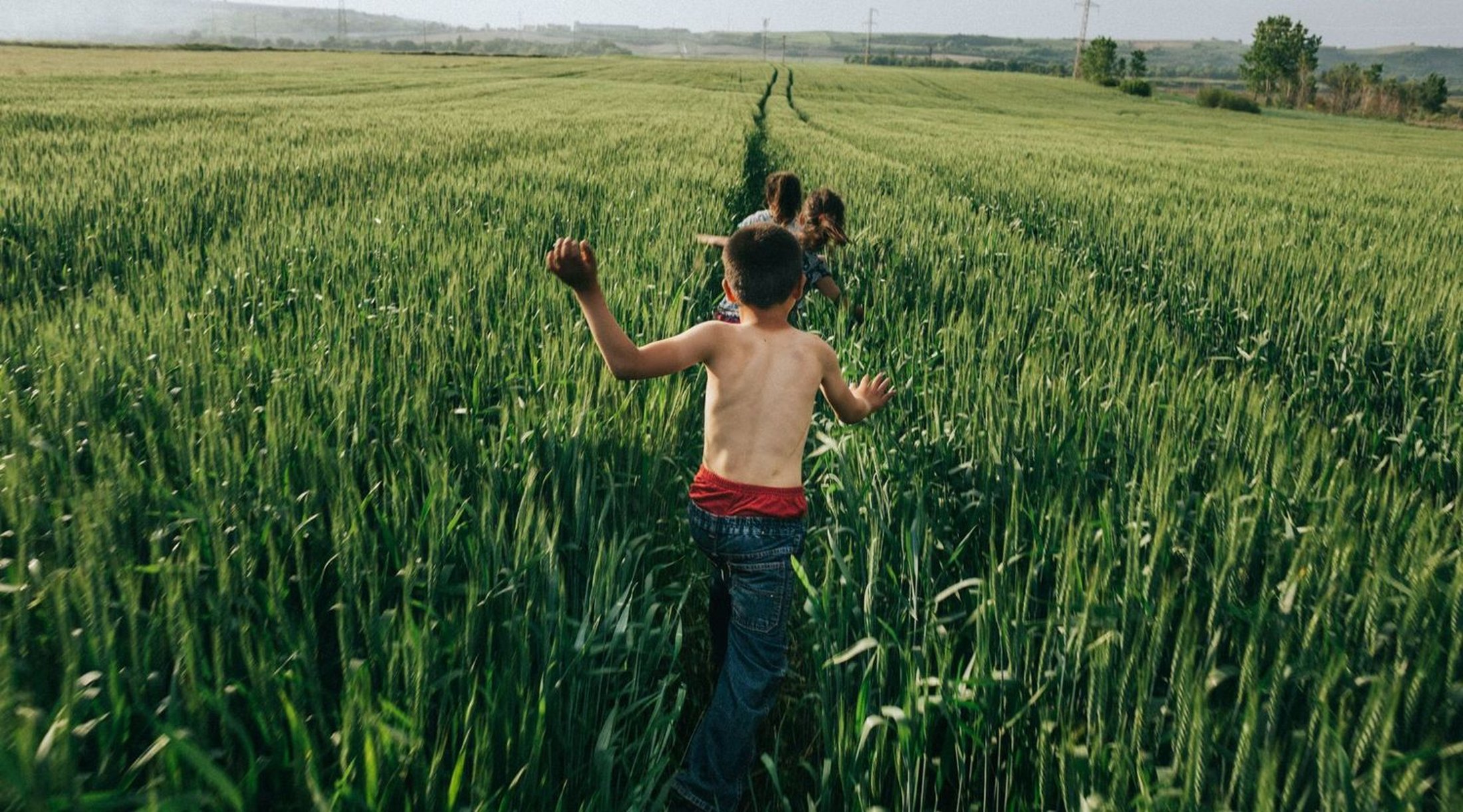
Children run in the wheat field and enjoy nice weather during the local traditional spring festival, Kirklareli, Turkey, 2017. The cold winter leaves the Thrace region of Turkey and welcomes spring with its shining sun and warm winds. People connect again to nature by celebrating it every year during the first week of May in Kirklareli. When I shot this photo, I was running in the wheat field and enjoying the nice weather, remembering my childhood memories with these kids. For them, as for me, it was a moment of pure freedom. Buckpool Harbour, Moray, Scotland. 2011. © Emin Ozmen/Magnum Photos
Boy on a swing, Tirana, Albania, 2005. During the 90s, when the communist regime collapsed, and for the years that followed, many families from northern villages and small towns migrated to the suburbs for a better life. When you are an immigrant you feel that nothing belongs to you. Your freedom to dream and to imagine is the only thing you have. Photography is the only freedom I have. © Enri Canaj/Magnum Photos
Handcuffed Blacks Arrested for being in a White Area Illegally, South Africa, ca 1965. When I say that people can be fired or arrested or abused or whipped or banished for trifles, I am not describing the exceptional case for the sake of being inflammatory. What I say is true-and most white South Africans would acknowledge it freely. They do not pretend these things are not happening. The essential cruelty of the situation is not that all blacks are virtuous and all whites villainous, but that the whites are conditioned not to see anything wrong in the injustices they impose on their black neighbors. © Ernest Cole/Magnum Photos
Bar girl in a brothel in the red-light district, Havana, Cuba, 1954. I have been poor and I wanted to document poverty. I had lost a child and I was obsessed with birth, and I was interested in politics and I wanted to know how it affected our lives. I am a woman and I wanted to know about women. © Eve Arnold/Magnum Photos
Discotheque, Moscow, 1993. As The New York Times correspondent in Moscow, I encountered all kinds of fascinating characters and subcultures, and felt the new powerful wave of youthful energy, vitality and passion amplifying social changes. I might compare it with the Russian avant-garde of Malevich, Mayakovsky and Eisenstein, which went hand-in-hand with the revolution beginning in the 20th century. It was like a tsunami. The previous generation was not able to protect their values of national unity and traditional social order-the tsunami was rising, flooding and overthrowing the unsteady and corrupt political power. To me, this was not unlike Europe in the 1960s, a conflict of generations, youth overthrowing their corrupt parents, yearning to come to power and proclaim new justice. © Gueorgui Pinkhassov/Magnum Photos
Berlin Wall. Sunday, December 31, 1989. After photographing the jubilation of this overexcited crowd a few days after the fall of the Berlin Wall, I decided to move to a quiet place. I glimpsed, hidden by a row of shrubs, a young couple sitting astride the top of the wall. They were surrendering to this intimate and peaceful moment to love each other and celebrate this new freedom. © Guy Le Querrec/Magnum Photos
Los Angeles, California, 1981. This picture is part of East/West, two separate books gathered in a split case and published in 2017 by Thames and Hudson and Textuel. One presents images of Los Angeles and Las Vegas shot in 1981 and the other, images of Moscow shot in 1989. As opposed to the liberation associated with the former two cities, Moscow was still a communist country and very much considered state-controlled. There is a striking contrast between the vivid colors of California and Nevada and the moody atmosphere of Moscow. Strangely enough, I felt much freer-and more welcome-in Moscow than I ever did in Las Vegas or Los Angeles, both aggressively money-obsessed places which left me with an overwhelming impression of loneliness. © Harry Gruyaert/Magnum Photos
A hunter and his dogsled caught in a snowstorm on their way home, Tiniteqilaaq, Greenland, 2000. The current under the ice was strong and almost dragged Hans toward the darkness. Trapped in the icy waters, Hans thought he would die. It wasn't until he thought of his daughter that he managed to gather enough strength to fight his way back to the surface. We can now see open water across the ice, so we're forced to head for land and make a detour along the foot of the mountains. We slow down, as does our breathing, and our sweat turns cold. The rain pours down. The mountains arch above us, enclosing us, luring us further and further toward the end of the fjord where new mountains await new tracks. © Jacob Aue Sobol/Magnum Photos
Saint-Martin-de-Ré Prison, France, August 21, 1978. There was an exhibitionism quite surprising in the prison courtyard: tattoos, bare chests, athletic activities. I then understand how detainees want at all costs to find at least in their bodies a way to assert themselves, a semblance of fulfillment, of confidence in themselves, a type of freedom. © Jean Gaumy/Magnum Photos
Ciudad Juárez, Mexico, July 17, 2009. On weekends in summer, the families of Ciudad Juárez come to relax on the edges of the Rio Bravo at the boundary of the border between Mexico and the United States. To me, this image represents the freedom that modest people can afford. Spending a moment with family to perhaps forget the difficulties of everyday life. Behind them, a grid designates the limits of Mexico, as well as their freedom. © Jerome Sessini/Magnum Photos
INRI Cristo's disciples rolling him around on the compound grounds on his rolling pedestal, Brasília, Brazil, 2014. 'And you shall know the truth, and the truth shall set you free.' John 8:32
These famous words from the Bible were ringing in my head throughout the three years I spent searching for men who claim to be Jesus Christ's second coming. For INRI Cristo and his 12 disciples, who live in a gated compound outside of Brasília, INRI is the long-awaited Messiah. His disciples claim this knowledge releases them from the dogmas and misunderstandings that plague the rest of humanity. To them, to believe in INRI is the greatest act of emancipation. © Jonas Bendiksen/Magnum Photos
Baltimore, Maryland, October 31, 1964: Dr. Martin Luther King Jr. being greeted upon his return to Baltimore after receiving the Noble Peace Prize. Dr. MLKing Jr.: an icon of peace and freedom. © Leonard Freed/Magnum Photos
A young boy working as a blacksmith. Kobanî (Ayn al-Arab), Syria, August 8, 2015. I don't believe in freedom applied to a collective society any longer, but I do still believe in a man alone with his freedom. I have met more free men living in oppressive regimes than in so-called Western democratic societies. I feel that freedom is a solitary and individual research that leads you to finding a personal balance in life, whatever the context you may be living in. A constant silent rebellion. © Lorenzo Meloni/Magnum Photos
England, 1994. Freedom comes in many shapes and sizes, but a classic interpretation is high speed travel, like skiing or riding a bike downhill.
Perhaps one of the most recognizable of this genre is the ride in an open top car. This image was taken for the BBC series, 'From A to B.' Directed by Nicholas Barker, it explored people's relationships to their cars. © Martin Parr/Magnum Photos
High security prison in Beersheba, Israel, 1971. Prisons are not camera friendly, especially not high security ones. When I was finally granted permission to photograph inside the Beersheba prison, it was under the condition that I did not talk to the prisoners. When I approached this solitary confinement cell, the prisoner did not even try to communicate. Rather, he posed himself in the beam coming in from the skylight porthole. It was the perfect frame. This image was published on the covers of many books in many languages, describing the yearning for freedom. I still think it needs no words. © Micha Bar Am/Magnum Photos
Lindiwe Mutoma (female detective), Lusaka, Zambia, 2005. Detective Lindiwe Mutoma, 28, when photographed is a different kind of detective. Working in a male dominated profession, her successes are often the result of the freedom that comes from being invisible, unexpected, underestimated. When asked if it helps to be female in her line of work, Lindiwe answered yes: 'Before antagonizing a man you have to try seducing him. Men like confiding in women, but they also underestimate women. This helps as a detective.' © Mikhael Subotzky/Magnum Photos
Iran, 2017. The young woman in red hesitates as she enters the water. Perhaps this is the first time she has seen the open sea. I did not ask her. I just watched. Her two female family members rest in the sand, their feet in the water.
Everywhere in the world, freedom and eternity find one another on the far horizon of the endless sea. Freedom is often described with big words, but we encounter it every day in the little things we do. © Newsha Tavakolian/Magnum Photos
Havana, Cuba, 2014. The carelessness of afternoon play in a Havana courtyard, near Cuatro Caminos: Where different paths intersect, and you can choose which one to take or not to take. At the tip of your fingers lay boundless possibilities: the light, the ball, the universe. © Nikos Economopoulos/Magnum Photos
Watching TV at home. Jeddah, Saudi Arabia, 2009. In Saudi Arabia, notions of privacy and freedom have an intertwined and complex relationship. For some, privacy is a requirement to feel relaxed and be free; others consider the privacy they are forced to keep under a hijab as an inhibitor to their freedom, and there are those who simply want to be out of sight from their families or people that know them. I came across girls from all camps and spent a lot of time trying to understand what their idea of freedom was and where the boundaries of their privacy lay. As a woman, in the company of only women, I was able to see scenes that were not to be shared. But as a photographer, this became a huge problem. © Olivia Arthur/Magnum Photos
Singer Jiang Xin in her car in Sanlitun, Beijing, China, 2001. I hesitated to choose a picture of the Tiananmen Square protests, which would have been a more obvious illustration of 'freedom.' What made me choose this picture? Maybe it was the woman, and her expression that leads me to believe she feels free. For so many decades, night life was nonexistent in China; then, suddenly, lights, bars, discos invaded the streets of the big cities. The car, as seen in the mythology of the cinema, is often a symbol of freedom: free to go away, sometimes far away. It may be a superficial freedom, but in China, full freedom doesn't exist. © Patrick Zachmann/Magnum Photos
Robert Kennedy funeral train, USA, 1968. The freedom to make pictures is essential to my being. When I boarded the train that carried RFK's body from New York to Washington for his burial in the Arlington National Cemetery, the press corps was not allowed to take pictures within the cars themselves. I was frustrated by my inability to record the event, until the train came out of the tunnel and into the light, and I saw the tracks lined with folks wanting to say goodbye to Bobby. By turning my camera outside of the train, and photographing these people, I created my own freedom to chronicle this important event in a way I had not anticipated when I received the assignment from Look magazine at the time. © Paul Fusco/Magnum Photos
Cowes, England, 2001. Peter was a sailor, more of a messing about on boats sailor than a pro, but his love for sailing was the same. He sailed a 1932 Jack Powles 32-foot Broads yacht, and jumped at any opportunity to photograph on yachts, on the ocean, in the freedom of the wind and on a boat in full sail. © Peter Marlow/Magnum Photos
Arizona, USA, 2012. The subject of the photograph, patrolling his land on the Mexico-United States border, has the freedom to bear his firearm, and the weight of the law on his side to protect his property. The migrants crossing his land are largely seeking economic freedom and take massive risks to achieve it by illegally crossing a partially-militarized border. As photographers, we have the freedom to choose what to photograph, and in what manner. That freedom is a weighty one. How do aesthetics line up with beliefs, and how do beliefs align with attempts to render events with complexity and thoughtfulness? Freedom and responsibility are close bedfellows, and never seem to fully reconcile. This photograph is no exception. © Peter van Agtmael/Magnum Photos
Invaded sports field, Grenada, 1983. Grenadians for generations had welcomed the only foreigners they encountered-tourists. So U.S. forces had the rare experience of being surrounded by polite and friendly locals. For many Americans, the Grenada invasion was seen as a morale booster after their defeat in Vietnam. Griffiths' Welsh roots gave him a natural sympathy for the Davids over the Goliaths of this world, and in the course of his travels to over 120 countries during his career, he was often focused on documenting the struggle for freedom: from Algeria to Vietnam to Grenada in 1983. © Philip Jones Griffiths/Magnum Photos
Trees, India, 2013-2015. India is a hot country, June the hottest month, and it was almost dark when there was a sudden dust storm followed by intense rain-the pearl-like magic drops covered my whole space and how desperately I wanted to capture them all. When passion is charged with intensity, intuition provides you the freedom to capture something beyond that which is known. © Raghu Rai/Magnum Photos
Foot, ice cream popsicle and guitar on West 3rd Street, New York, USA, 1970. New York. Greenwich Village. 1970. Do whatever you like! © Richard Kalvar/Magnum Photos
Tiananmen Square, Beijing, China, 1989. 'Man is free, but men aren't. There are no limits to the freedom of one, there is no freedom for all. All is an empty room, a clumsy abstraction until one finds one's independence is lost.'
- Louis Aragon (1925)
This photograph was taken in late May, 1989, during the Tiananmen Square uprising, led by Chinese students and their supporters. They were protesting corruption and activating for freedom of expression. © Stuart Franklin/Magnum Photos
Wall. Managua, Nicaragua, July 1979. Watching from afar as events rapidly unfold in Nicaragua today, I can't help but think of the dreams that propelled the Nicaraguan people nearly 40 years ago, and what they continue to demand and deserve as they struggle again for their future. © Susan Meiselas/Magnum Photos