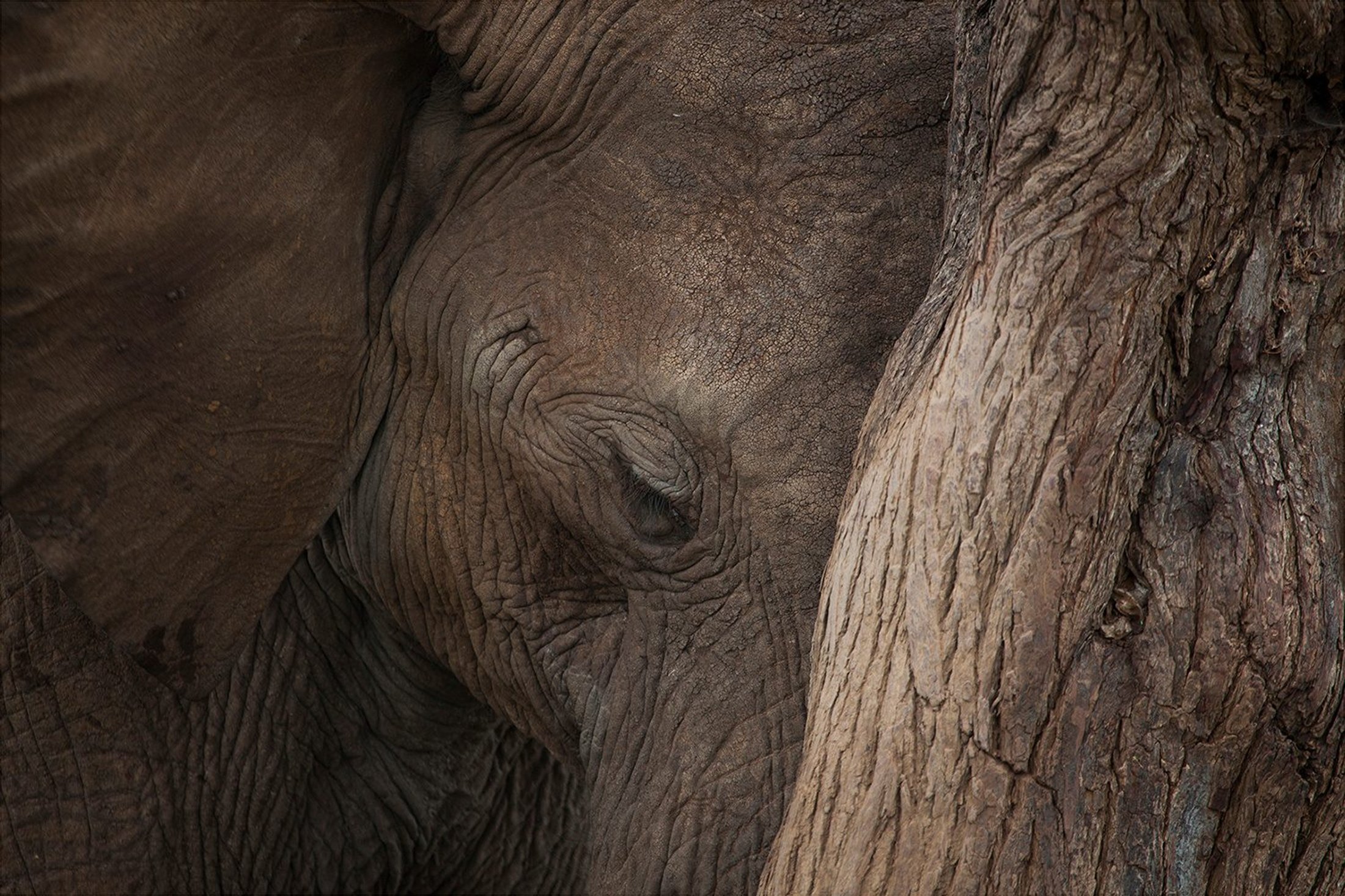
Resting Under a Midday Sun. Elephants search for the shade of trees as the midday African sun demands a change of pace. Resting against the bough of a tree, elephants seem to enter a state of trance. © Martin Middlebrook / Stop Ivory
The Ivory Stockpile. A ranger from Kenyan Wildlife Services holds the tusk from a Tusker elephant. The ranger is 6" tall and yet is dwarfed by the ivory he holds - which, in itself, is modest for a tusker, weighing in at just 30 kgs. The ivory stockpile holds tusks of up to 48 kgs. The stockpile contains hundreds of these massive tusks, the last witness to a DNA oddity that created giants—giants that will not be seen again. © Martin Middlebrook / Stop Ivory
Community Conservation. The primary school in the Leparua Community in Kenya. The community has benefited greatly from the new philosophy of community conservation. After the acceptance that billions of dollars had been wasted over 40 years of conservation effort, this much-needed rethink has begun to cement the future for both wildlife and people. © Martin Middlebrook / Stop Ivory
Night Patrol. Each night teams of rangers camp out in the Sera Conservancy. They work in total silence, without light, listening for the sound of poachers. Beyond the possibility of encountering poachers, they have to endure constant mosquito bites and the threat of scorpions. In the last twelve months, two rangers have contracted malaria and one helicoptered out due to a life-threatening snake bite. © Martin Middlebrook / Stop Ivory
The Lukumai Elephant Clan. A Samburu women in the town of Seriolipi, Kenya. The Samburu, unlike many tribes across Africa, have a special relationship with elephants. If they come across a dead elephant they will place branches, leaves or flowers on the carcass, in exactly the same way they would place flowers at a funeral. They deem elephants to be their "elders" and accord them an almost reverential respect. © Martin Middlebrook / Stop Ivory
African Elephant Dusting. Only the speed of a camera can capture the explosion of an elephant dusting itself. © Martin Middlebrook / Stop Ivory
Anti-poaching Patrol, Sera Conservancy. Outside of safe havens, or in areas where there has been a history of poaching, elephants display significant wariness and are extremely skittish. On patrol with the 9-1 anti-poaching team, this large bull turned on its heals and ran for the relative protection of the forested river bank. This learned behaviour seems unbreakable and is distressing to observe. © Martin Middlebrook / Stop Ivory
An Inexcusable Loss. To observe an elephant is a profound privilege. They have a majesty that connects us to them, and them to their environment. To lose them would be a damning indictment of humanity. © Martin Middlebrook / Stop Ivory
Anti-poaching Dog Team. Tipper the Bloodhound is trained to apprehend a suspect, whilst the rest of the dog team move in and secure the scene. In addition to supporting the work of anti-poaching teams across northern Kenya, they are also integrally involved in apprehending bandits and cattle rustlers. © Martin Middlebrook / Stop Ivory
Samburu Community Outreach. Samburu tribesmen hope to sell goats and cattle at the Seriolipi cattle market. Held each Sunday in a specially built compound on the edge of town, employees of NRT (Northern Rangelands Trust) take the opportunity to leave the conservancy and talk with the Samburu. Community outreach, the building of strong relationships, is at the heart of modern-day wildlife conservation. © Martin Middlebrook / Stop Ivory
Elephant Migration. As pastures begin to dry in the north of Kenya, an annual migration begins that sees herds move south through Lewa, before navigating the Elephant Corridor to traditional grazing lands in Mount Kenya National Park. © Martin Middlebrook / Stop Ivory
The Elephant and the Samburu. Samburu traditionally sleep on animal hides. In Samburu legend, it is said that this is how an elephant got its ears—and when an elephant flaps its ears, it is trying to remove the hides so that it can be free. © Martin Middlebrook / Stop Ivory
Solar Conservation. A slash of gold; a solar panel glints as the sun sets over the Sera Conservancy. The solar panels drive boreholes that extract deep lying water, filling water holes that support this delicate and complex ecosystem. © Martin Middlebrook / Stop Ivory
The Team. Members of the NRT anti-poaching team, and environmental images to illustrate the landscape of Sera Conservancy. It is a punishing but beautiful terrain, and a brutal climate, that exacts physical demands and requires great passion and commitment to operate in. Samburu County, Kenya. © Martin Middlebrook / Stop Ivory
Anti-poaching Rangers in Kenya. Kenyan anti-poaching rangers have four days off per month, and a month of annual leave. The punishing schedule, and a deep commitment to their profession mean that there is only one way to keep in touch with family and loved ones—the mobile phone. At night around the kitchen area in Sera, constant conversation lights the sky like fireflies; ribbons of light trace the meandering of rangers. © Martin Middlebrook / Stop Ivory
Elephant Dusting. Elephants dust themselves frequently, and particularly after a bath. The dust forms a protective coating, shielding their skin from the sun, and mitigating the effects of insects. © Martin Middlebrook / Stop Ivory
Julius Kimani, KWS. Julius Kimani, Acting Director of the Kenyan Wildlife Service (KWS). By 1989, Kenya’s elephant population had plummeted to just 16,000 (from a high of 130,000 in 1973). It now stands at close to 100,000. These figures stand in bleak contrast to much of Africa. If Africa is to retain its diversity of species, Kenya's is an exemplary model to follow. © Martin Middlebrook / Stop Ivory
The Trunk. The elephant’s trunk contains over 40,000 muscles, divided into as many as 150,000 individual units. It is compelling to observe these powerful animals use their primary tool so delicately. Whether a tender social caress that tightens family bonds to powerfully ripping branches off trees. © Martin Middlebrook / Stop Ivory
The Elephant Corridor. With the spread of agriculture and the building of infrastructure projects, elephants' traditional migratory routes have become increasingly obstructed. An elephant underpass was built, connecting Lewa to Mount Kenya. Once again the annual migration can continue unimpeded. © Martin Middlebrook / Stop Ivory
Learning for the Future. As Sir David Attenborough says, "The question is, are we happy to suppose that our grandchildren may never be able to see an elephant except in a picture book?" © Martin Middlebrook / Stop Ivory
The Lookout. Oleyaso Lonyamal from the Lewa anti-poaching team. Rangers camp out for seven days at a time, choosing high positions that overlook 45,000 hectares of rich savannah. From here they can observe any infraction and coordinate efforts with Lewa HQ and the Lewa Dog Team. © Martin Middlebrook / Stop Ivory
The Ivory Stockpile. 140 tons of ivory with a black market value of $100 million. Each tusk denotes a dead elephant. Tusks are either collected from naturally dead animals or confiscated from illegal poaching. The ivory stockpile at KWS contains five separate rooms packed with individually marked and catalogued samples. The largest tusks weigh 48 kg each, and the stockpile contains samples from the last great Tusker elephants. © Martin Middlebrook / Stop Ivory