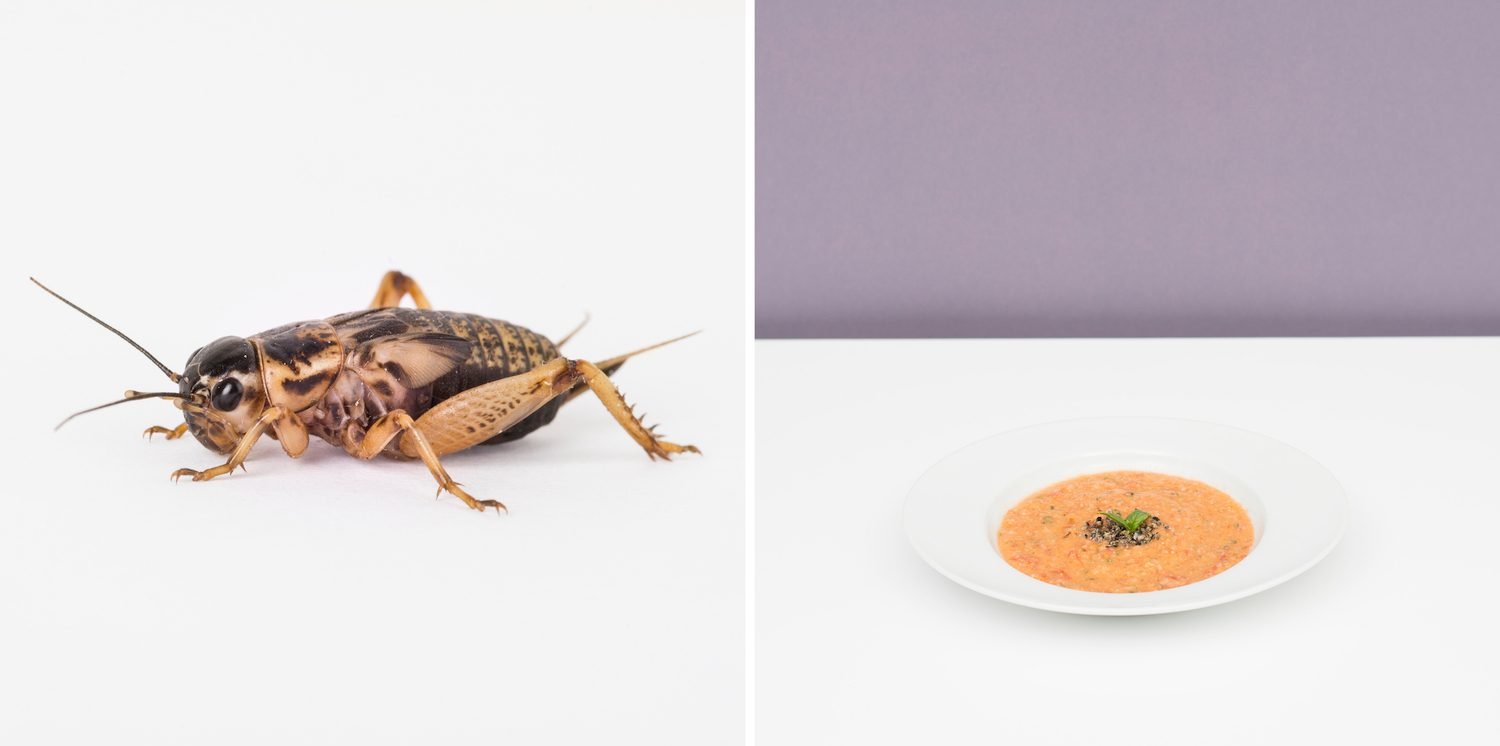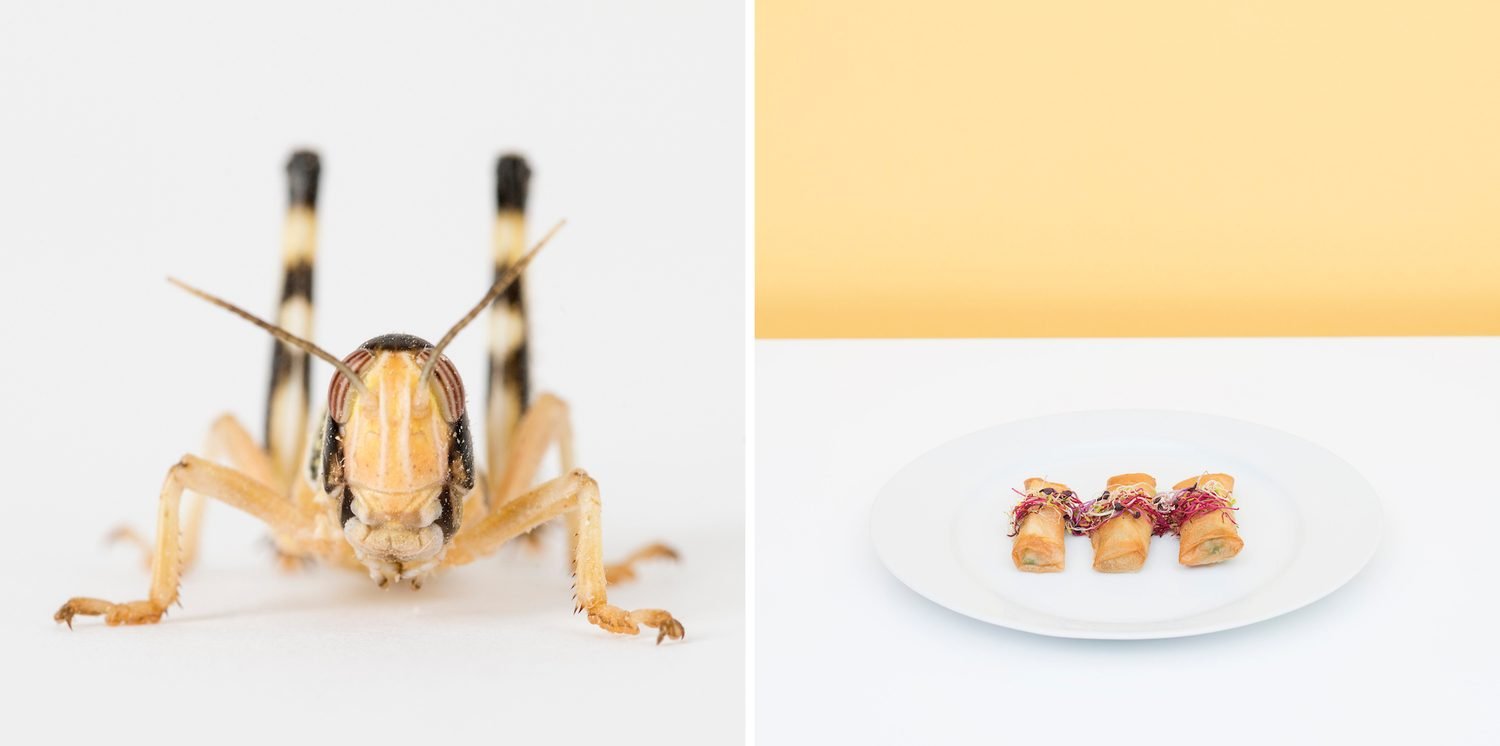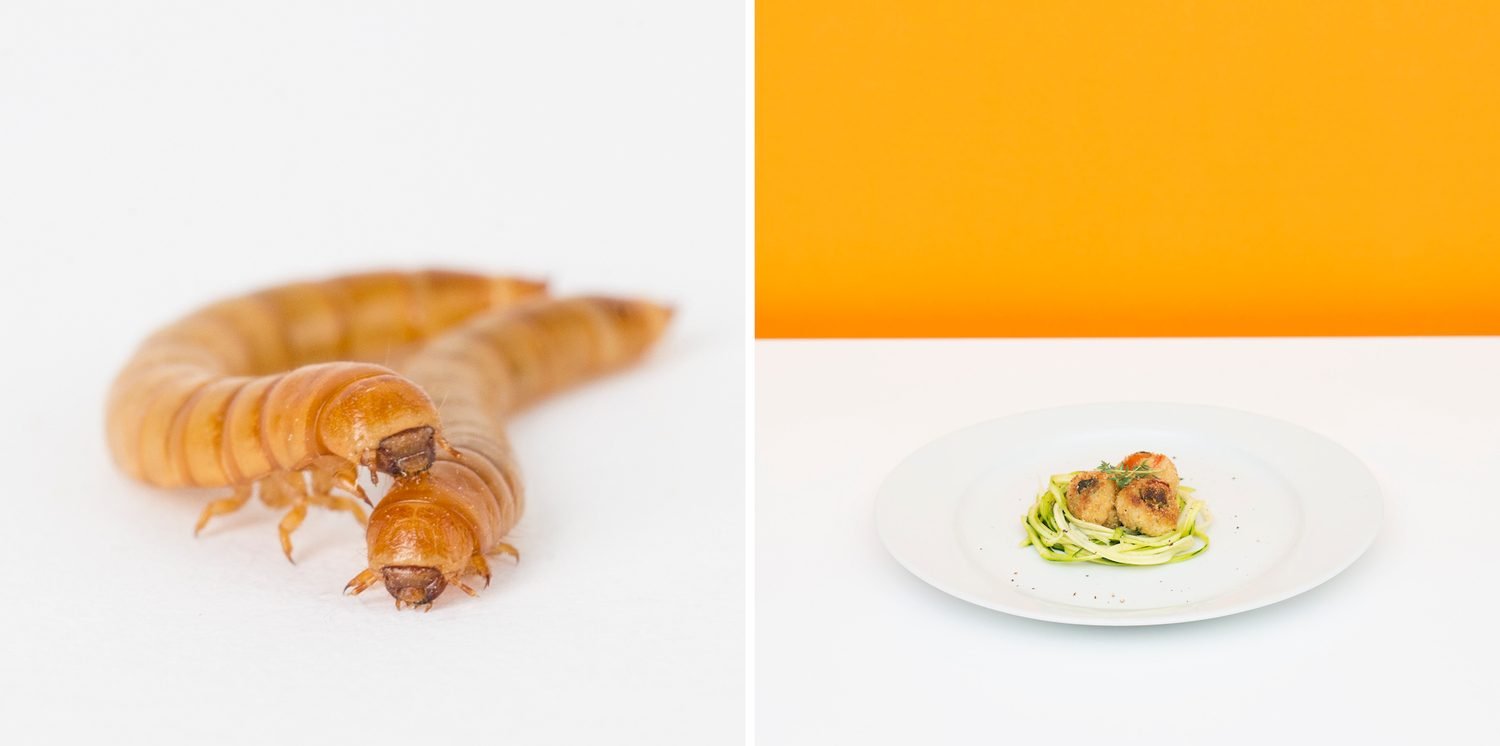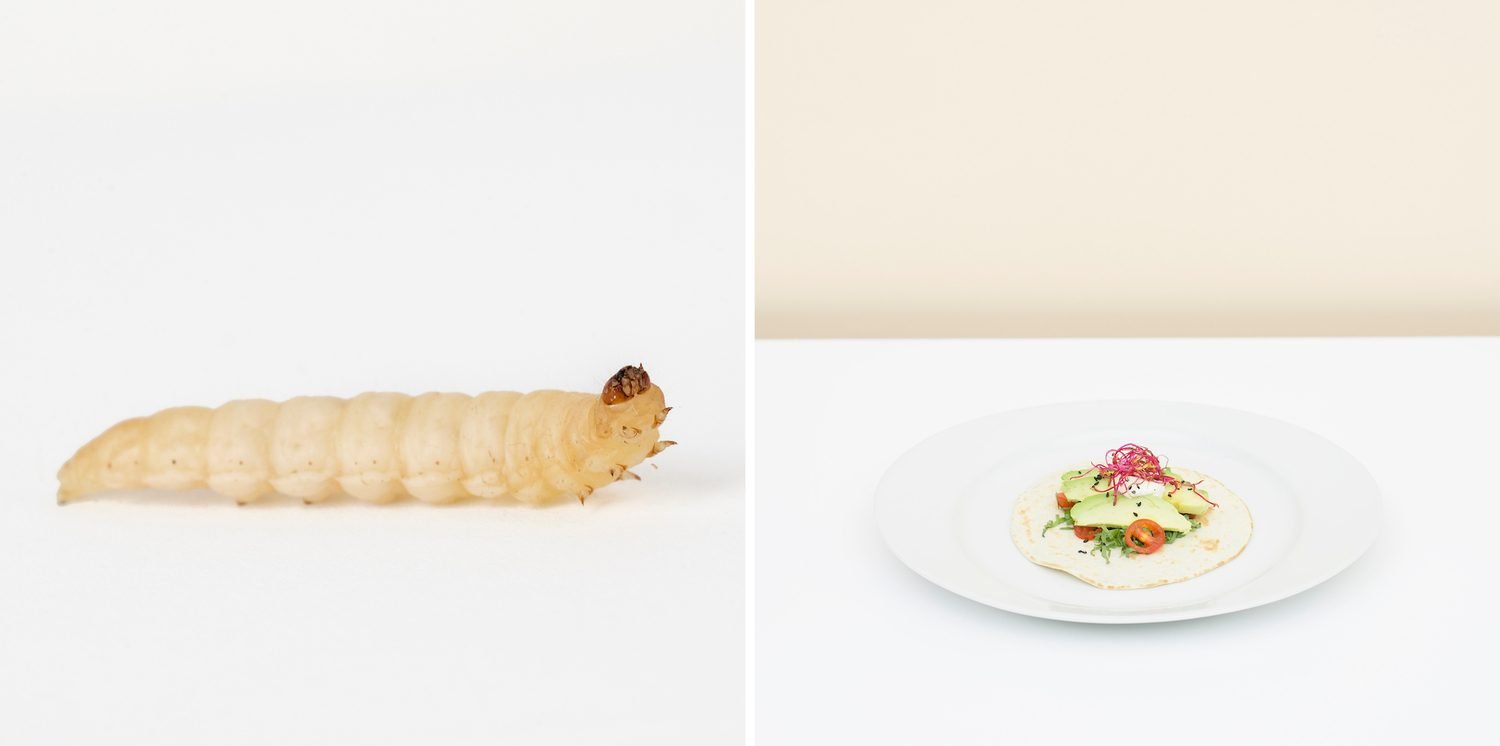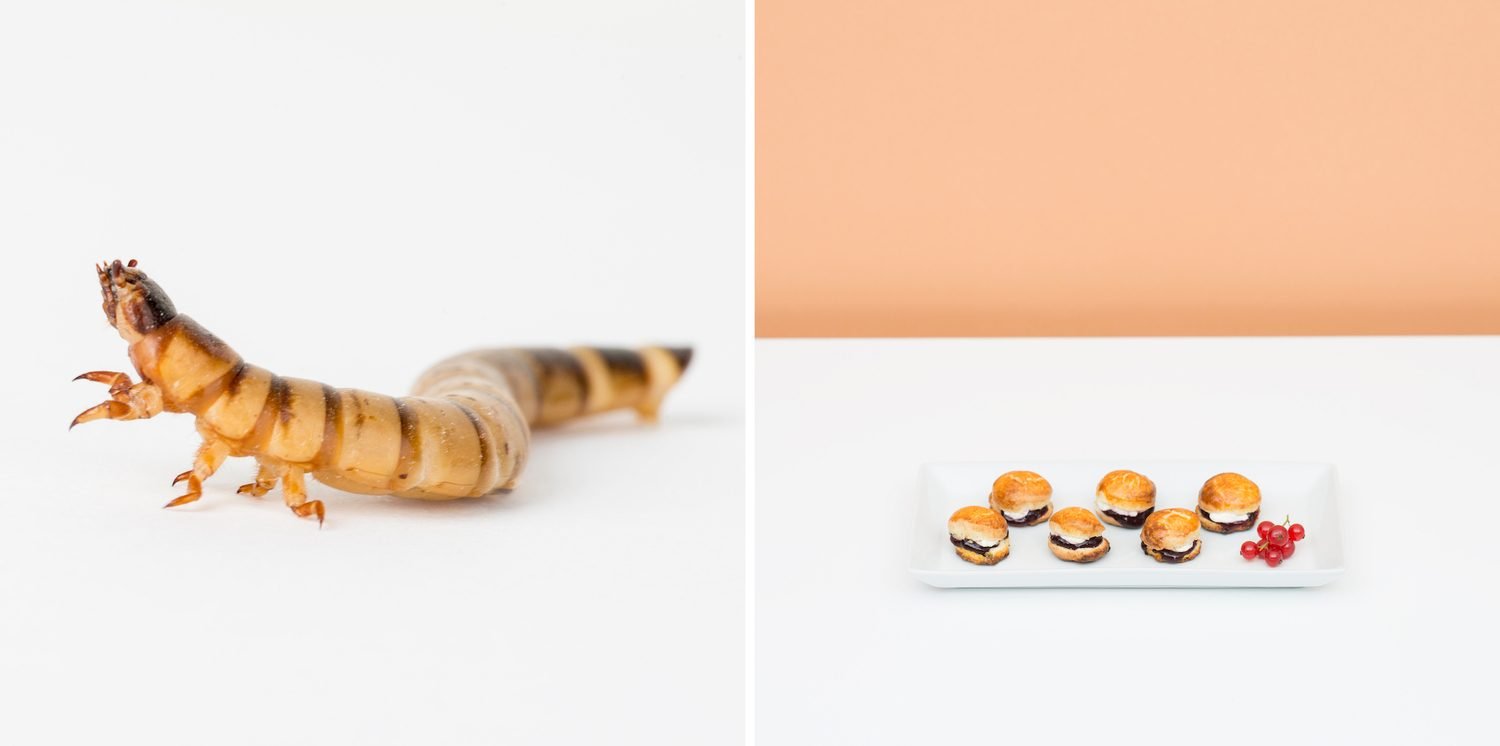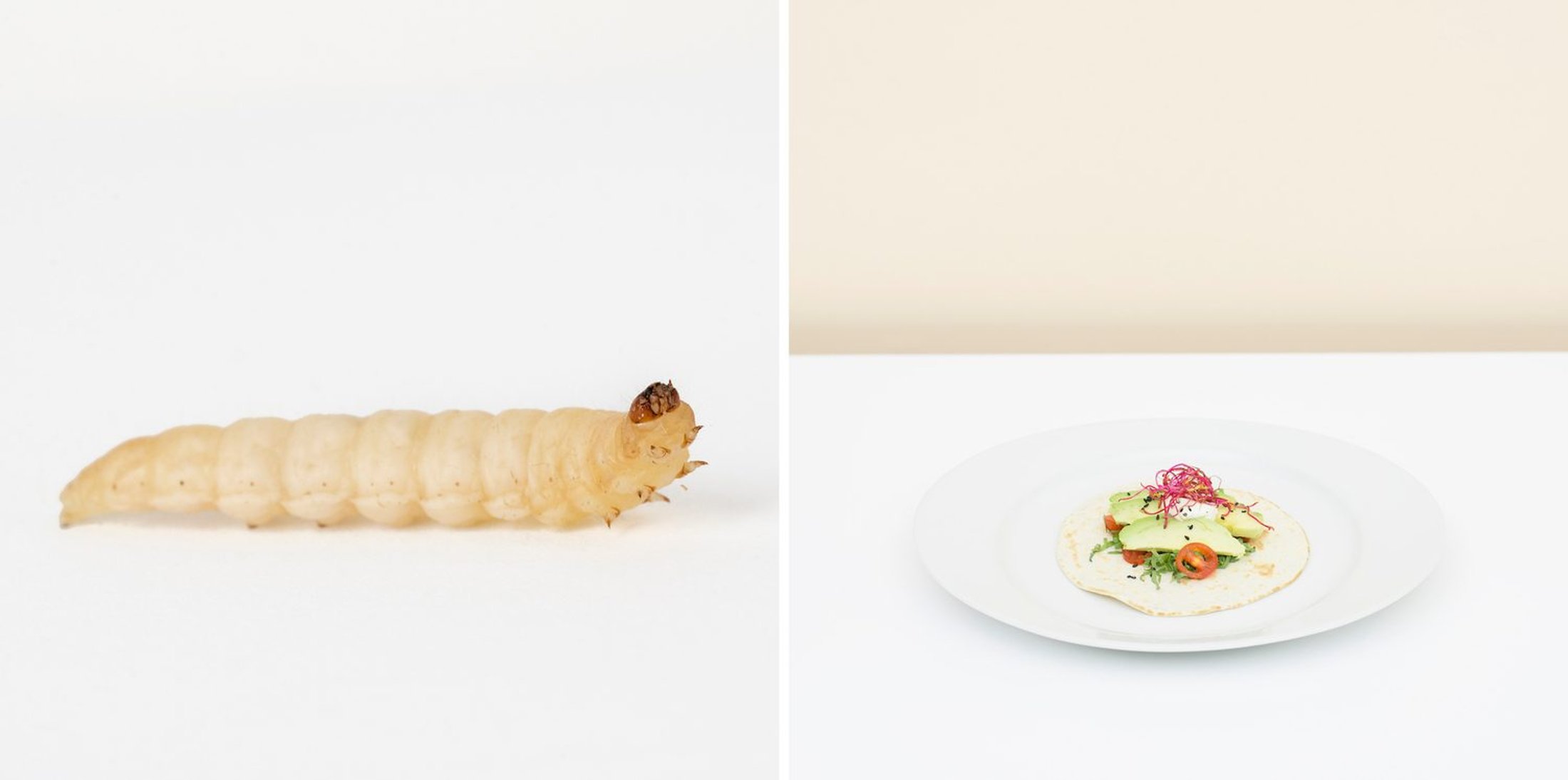
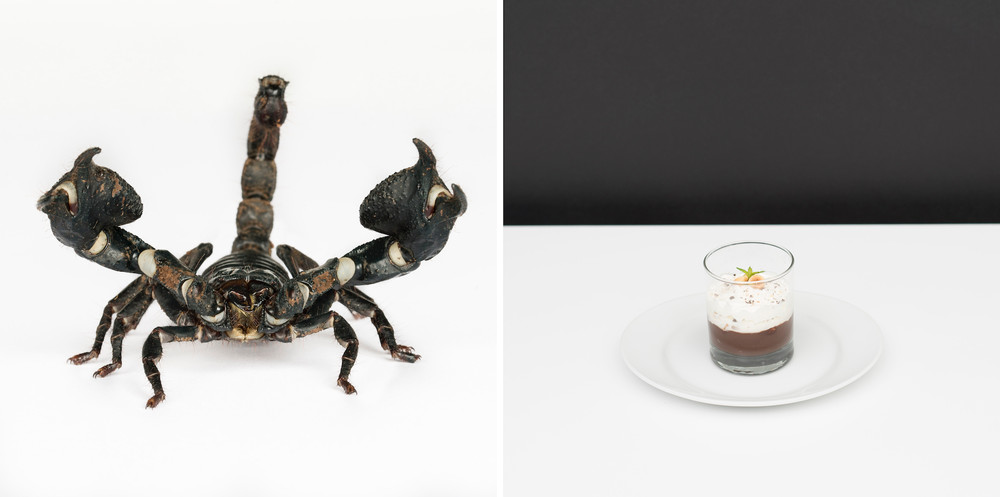
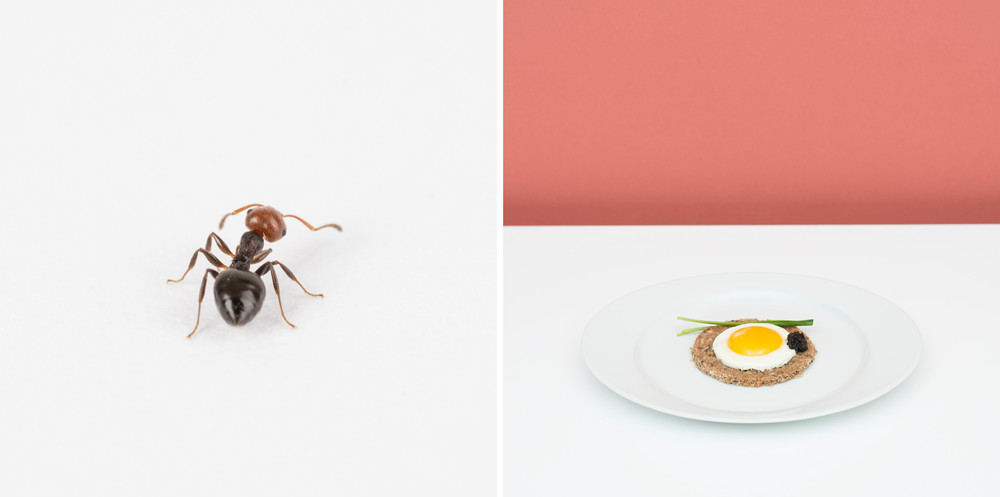
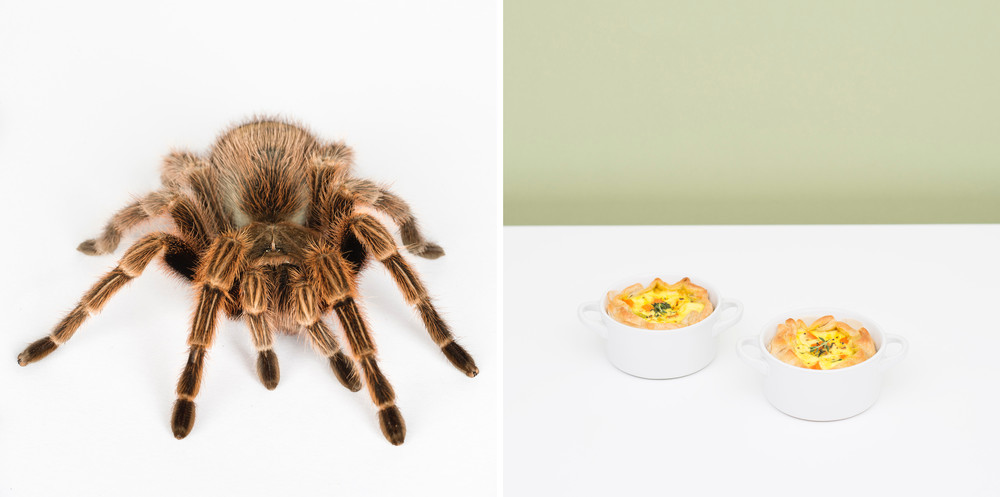
The thought of adding crickets to a summer gazpacho or making your tacos out of honey bee moths is likely to make the majority of us squirm. But faced with a future of growing food scarcity, insects may soon become a kitchen staple; a regular ingredient in our everyday cooking. In Beatle in the box, Italian photographers Michela Benaglia and Emanuela Colombo combine various genres such as still life and food photography in a bid to normalize this fact visually.
Rich with proteins, vitamins, carbs, omega-3 fatty acids, calcium, iron and other micronutrients, bugs and beasties have a low environmental-impact as food. They are small, meaning they cause less greenhouse gasses which is an important factor in livestock farming, and they can also be bred easily with few resources. In short, they might be the food of our future. The photographers propose a handy comparison: the growth and spread of sushi through the West in the 1990s—first as a trend, then as a food business.
In this interview with Sophie Wright for LensCulture, the pair discuss the benefits of eating bugs, the process of insect studio photography and their favorite recipe.
Sophie Wright: How would you describe the key concerns that drive your photography practice? And did Beatle in the box grow out of any existing interests or does it mark a departure from your previous work?
Michela Benaglia & Emanuela Colombo: As documentary photographers we usually work on various current issues that capture our interest and have not yet been explored. Beatle in the box is not an exception: we usually work as reportage photographers, but for this theme the studio photography seemed to us the most effective.
SW: How did your interest in the topic first arise?
MB & EC: We discovered a new law that, starting in 2018, ‘Novel Food’ will enter into force facilitating the sale and the supply of insects within the European Union, bringing all member states on a par with Holland and Belgium where insect-based products have already been for sale in supermarkets for a long time.

SW: Themes of science, food, nutrition, sustainability overlap in the realm of ‘entomophagy’ (the technical term for eating insects)—a crucial area of research as globally we head towards a food scarcity crisis. How can eating insects provide a solution?
MB & EC: By 2050, we will be more than nine billion people. We will live on a planet with increasingly scarce resources, less arable and available land, water pollution, deforestation caused by grazing and overheating of the global climate. How can we cope with a situation like this? Insects are one of the likely responses that have been circulating among food and nutrition experts from all over the world for some time. More than two billion people already use insects for food purposes and there are currently over 1,900 edible species on the market.

SW: For the images you made, you worked with several different experts from the sphere of entomophagy. Can you tell me more about your collaborators?
MB & EC: We have collaborated with the founders of Entonote, an association based in Milan who have been involved for years in spreading entomophagy through Italy and who organize themed dinners for the club’s members. Founded by Giulia Maffei, biologist and scientific communicator and Giulia Tacchini, food designer, they became passionate about the topic of entomophagy during their academic career. They founded Entonote in 2015—the first Italian company to explore the theme of insects on plates from different points of view.
SW: You work as a duo, can you tell me about this process and the different roles you play within this working dynamic? What did each of you bring to this specific project?
MB & EC: It was easy actually. Emanuela is ‘specialized’ in photographing animals in the studio so it was immediately clear that she would also photograph the insects and ingredients this time. Michela instead was born as a graphic designer and has experience in food photography, so she made the photographs of the dishes. Michela, who is also a very good videomaker also created footage as the dishes were prepared, which seemed indispensable to prove that these appetizing dishes were really made using the ‘ingredients’ and insects as these images show.
SW: From photographing the live insects to researching and making the recipes, there were many layers to creating each image. Can you talk me through your work process and how you arrived at this idea?
MB & EC: It was quite difficult to find live insects and to be able to photograph them. A cricket or a locust moves really quickly and are not very willing to pose… It was also difficult to find a chef who was involved in entomophagy and who was able to prepare desirable dishes with our ingredients. In the end, we found and collaborated with the girls from Entonote to get the ‘tasty’ results that you can see in the images.
SW: The aesthetics draw on studio food photography, the live insect portrait sitting next to a finished recipe. Why did you decide to present the two side-by-side?
MB & EC: As Europeans we are all conditioned since childhood to think that insects are ugly and ‘disgusting.’ This conditioning passes above all from the sense of sight, making it impossible for us to think that an insect could be eaten or, even more, could be considered appetizing. The idea of the project was to play on this conditioning and to show how a ‘disgusting’ insect could turn into an appetizing dish; one that we would all eat if we didn’t know that inside we find the ‘beasts’ shown beside. The recipes strive to make our insect dishes normal and show that they can be cooked by everyone.
SW: In some sense, you use photography here for quite a functional purpose—to draw attention to the sustainable possibilities of eating bugs. What kind of impact do you hope your images will have in this world of research and on the wider public?
MB & EC: As photographers we don’t want to give opinions or solutions: we bring a story to the attention of the public and show it as it is, without making a judgment upon it. It is up to the observer to think about the theme, and we hope our works will do this; make people think about something that maybe they would have never thought of alone.
SW: Did you taste the fruits of your labor? What was your favorite recipe?
MB & EC: Yes, of course. Our favorite dish is the homemade pasta with cricket flour. We are European and even though I believe that insects are the future of food if we want to survive and help the planet, the idea of eating something in the shape of a locust or a honey-bee moth is a bit disgusting—even to us. In this pasta, the crickets have been pulverized, and are therefore no longer identifiable. The taste is reminiscent of chestnuts and therefore recognizable and ‘friendly.’ It’s very good!
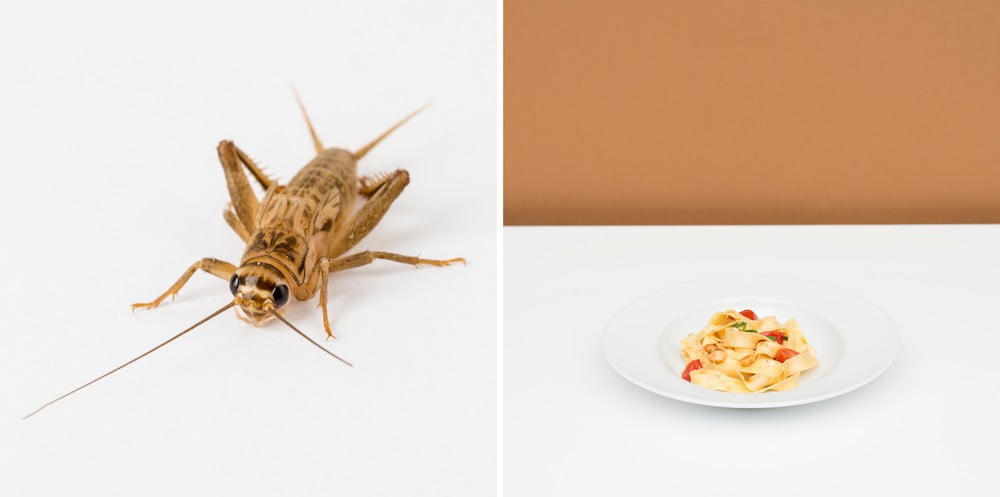
Curious to try for yourself? Here is Michela and Emanuela’s favorite recipe: tagliatelle with cricket flour (watch the recipe here).
Ingredients:
• 100gr Plain flour (Italian type “00”)
• 10gr cricket flour (ACHETA DOMESTICUS)
• 1 egg
• Salt to taste
• A knob of butter
• 10 cherry tomatoes
• Basil leaves
• Nuts
• Bio lemon zest
• Chives
Method:
Mix plain flour “00” with cricket flour and sift them together. Make a well in the centre and stir eggs well into the mixture adding a pinch of salt. Knead until you get a thick dough and leave it in the fridge for about half an hour. In a frying pan, warm a knob of butter, nuts and tomatoes cut in halves. Roll out the dough by using a machine until you get two thin sheets, roll them up on themselves then cut off approximately half centimetre and shape the “nest”. Boil a pot of water and cook pasta for two minutes. Stir-fry the dough with its dressing, add some basil leaves, cut the chives and grated bio lemon zest.