I’ve been a football fan ever since I can
remember. In my earliest memory, I must have been 5 or 6 and my dad took
me to watch a Liverpool match. It wasn’t an interesting game –
in fact, we were losing 1-nil with only 10 minutes to go when it was decided
a good time to leave. As we walked out, we heard an intense roar of celebration
so we quickly ran back up to our seats. From that point on, I was hooked on the thrill of being part of a passionate, sometimes fanatical cheering crowd.
Now, 24 years later, I still watch my team most weeks but I also developed
a keen interest in the people, like me, who watch it. I started documenting
British football fans in 2004 and ever since, it’s been an ongoing
project.
I think that what originally connected me to this subject was that I could
combine two of my biggest passions, supporting Liverpool and taking pictures.
Now after four years I’m more interested with the social documentation
of this culture. I like both the real-life passion and rawness of the
support, but also the super-realism that is more apparent at people’s
homes.
One of the main reasons to photograph Liverpool fans in a positive light
is because all through my youth, the fans had a horrible reputation for
being hooligans, especially in Europe. However, I had generally experienced
a friendly atmosphere at home games and when I started to travel abroad,
the fans were treated badly by the local police. Now I believe British
football grounds are the safest in Europe.
Football is by far the most tribal sport and fans are the most passionate
towards their team. It’s only football where fans wear thousands
of replica shirts, sing songs throughout the game, travel across the world
to follow their team and live their lives through the team. However after
saying this, a group of England cricket fans called, ‘The Barmy
Army’ do have a similar fan culture.
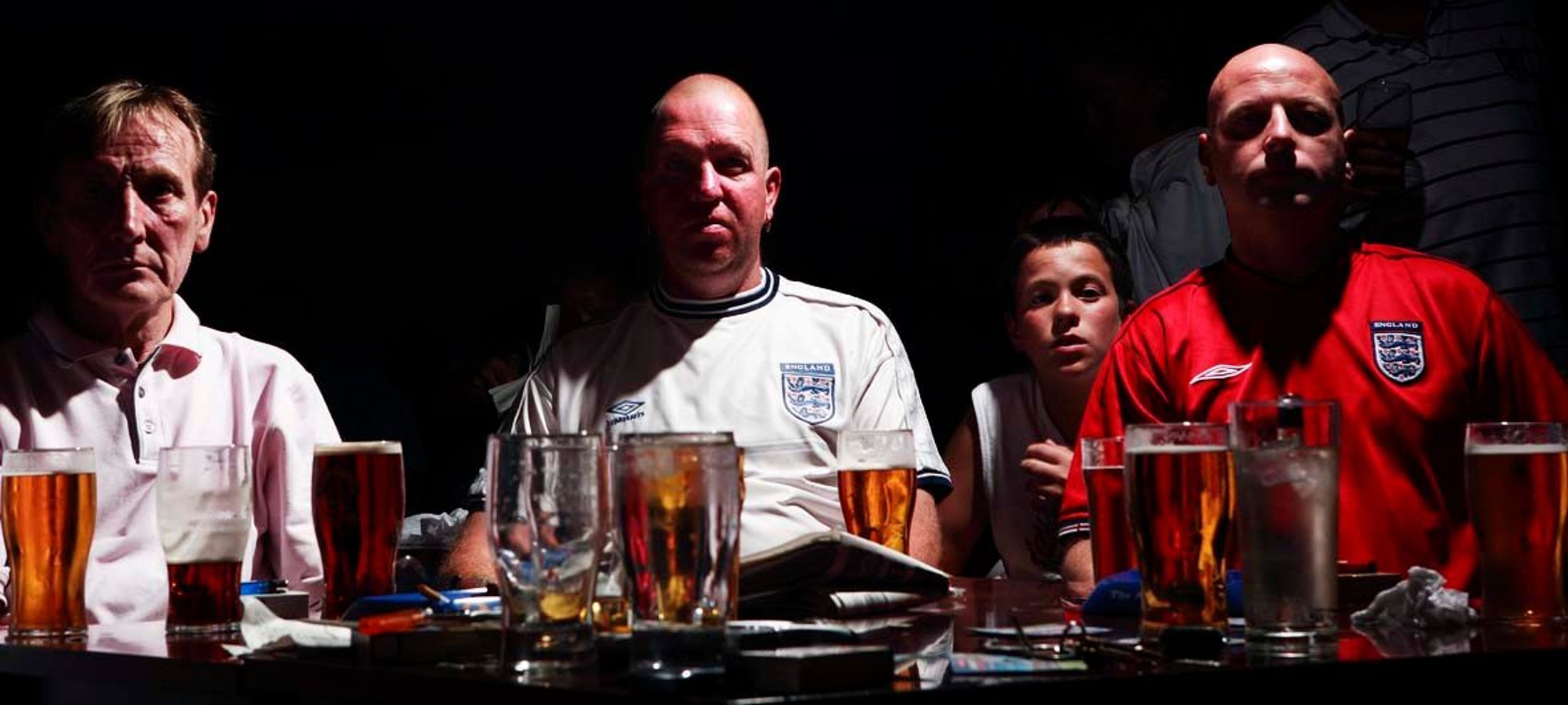
Some of the images were shot in a British Legion club in central London.
The Royal British Legion is a UK charity providing financial, social and
emotional support to people who have served, or who are currently serving,
in the British Armed Forces. In the club everybody was supporting England
in the European Cup, and the game went to a penalty shoot-out. The club
where I photographed also acted as a community center for the people that
lived nearby in the council estate.
Other photographs were taken at fans' homes around the UK. One of the
subjects was 92 years old and had supported Liverpool all her life. Just
before I shot her, she appeared on a national TV program in a feature
called Fan of the Month. At this age she was still organizing a group
of fans to travel a 300-mile roundtrip each week to follow their team.
The shot was taken in her bedroom, a unbelievable collection of Liverpool
memorabilia dating back 60 years.
The photograph of the two smiling ladies was taken at one of their homes.
They have been going to each home game together for the last ten years.
One of their unique activities was they would cut out players’ faces
from newspapers and magazines and then make badges out of them.
Other photographs in the collection are taken before and after Liverpool
matches, both in the UK and abroad. The shot of the guy showing off his
‘man tits’ was taken in Cardiff at about 11 a.m. He is Norwegian
and had started his day at 4 a.m., with a bottle of vodka, needless to
say he was certainly under the influence by 11 a.m. Moments later he had
passed out, but only until the next round of drinks came his way.
— Adam Rubin

Feature
UK Football Fans
Adam Rubin documents the hyper-real passion of football fans in the UK — from the stadiums and the pubs, to how they dress and decorate their homes.
View Images
Feature
UK Football Fans
Adam Rubin documents the hyper-real passion of football fans in the UK — from the stadiums and the pubs, to how they dress and decorate their homes.
UK Football Fans
Adam Rubin documents the hyper-real passion of football fans in the UK — from the stadiums and the pubs, to how they dress and decorate their homes.
 © Peter Hinsmann
 Street Photography Awards 2026
This photography competition is your opportunity to be recognized worldwide.
Top Awards include: An Exhibition in London, International Media Exposure, Cash Prizes, Solo Feature on LensCulture
Enter Awards
Deadline: June 17, 2026
