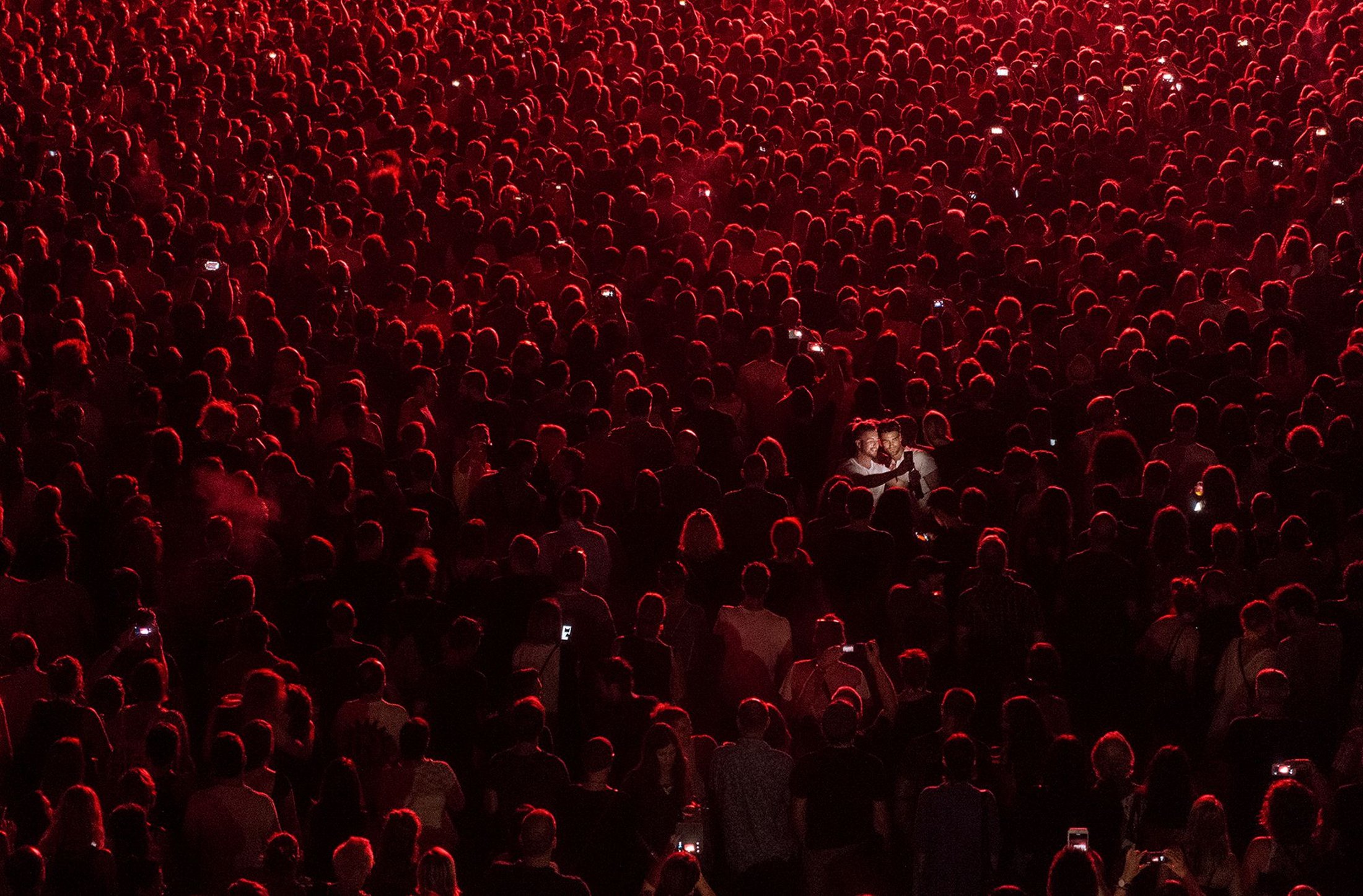
Selfie culture © Jelena Jankovic, recipient of the Grand Prix as well as the winner in the Everyday Life category.
Shadows © Irfan Licina, winner in the mobile phone category.
Church in the fields of Sorško polje. Church of Saint Ursula in the fields of Sorško polje just before sunrise. Photography links together tradition, progress, nature and spirituality. © Andrej Tarfila, winner in the Nature and Environment category
Vlăduț just went shopping with his parents in the village center of Letea, Danube Delta, Romania. © Ioana Cîrlig, winner in the Portrait category
Blue body. Photo is part of the series “Bodies in Space.” © Djula Bezeg, winner in the Nude category
Fashion fetish. © Franjo Matković, winner in the Fashion/advertising category
Traditional wrestling, known as Jobbarer Boli Khela, celebrated on April 25, 2016 in Chittagong's Lal Dighi Moydan, Bangladesh. © MD Tanveer Hassan Rohan, winner in the Sports category.
Frenetic City. This photograph is part of an on-going series titled "Frenetic City," which documents the chaotic pace of life in Hong Kong. This was made using between 10 to 25 multiple exposures on B&W negative film. © HanShun Zhou, runner-up and winner in the Creative Photography category
S' Ardia. Barbagia is a large mountainous area in the central-eastern part of Sardinia. One of these villages is Sedilo, where every year on July 6, a hundred of the best, most daring and brave horse riders participate in a wild and unrestrained race called the S'ardia. They don't run for money or glory, but to show their devotion to a warrior saint, Saint Constantine. Officially, he is not a saint, but he is a saint to Sedilo's people. Each year, they celebrate his deeds through this grand spectacle. Riders race down the hill at full gallop, pounding towards the narrow entrance below the Arc of Constantine amid rifle shots and clouds of dust. The speed is crazy and a mistake can be lethal. It has been, many times: the last death occurred in 2009. As I stood there, dust filled air, harsh with the smell of gunpowder and the crowd's frenzy. © Mattia Vacca, winner in the Cultural Heritage category
Idomeni, border closed. A man stands in a tree close to the border fence between Greece and Macedonia. He can't get over, but he can cut branches to make a fire that will keep him warm. © Olmo Calvo, winner of the News and Events category
Nicola Struzzi, Rome, Italy. The project "Veterans" is a series of portraits of people who took part in Second World War—the one event in human history that cannot be compared with anything else on the scale of catastrophe, human tragedy, and the degree of impact on the future of our civilization. © Sasha Maslov, winner of the Photostories category
Dmytro Verholjak, Markova, Ukraine. “We were busted in the forest by the N.K.V.D., the People’s Commissariat for Internal Affairs. There were five of us, and they fired at us. I got hit then, in my left foot. I wanted to blow myself up with a grenade so they wouldn’t take me alive..."© Sasha Maslov, winner of the Photostories category
Tadakazu Usami, Chiba, Japan. © Sasha Maslov, winner of the Photostories category
Shiu Narain Dagar. This project aims to look behind the emotional curtain of each individual photographed. After 70 years since the war that took millions of lives ended, the photographer strives to analyze and compare the fates of those who survived and are still living. © Sasha Maslov, winner of the Photostories category
Jack J. Diamond. Miami FL, USA. “I got captured and the US army sent a telegram to my home stating that I’d gone missing in action in Germany. It was received by my sister, who was 13, and she did not want to upset my mother, who was already a widow, so she kept it to herself. My mother only found out when the army sent another telegram saying I’d become a prisoner of war..."© Sasha Maslov, winner of the Photostories category
Ye YuLiang. Beijing, China. “My name is Ye YuLiang. I was born in March 1922 in Beijing. My ancestral home is in Fuzhou city, Fujian province. My grandfather was a Jinshi in the former Qing Dynasty, which meant that he was an advanced scholar who passed the triennial court exam, a very high honor. But after the Nationalists took power and the Qing Dynasty collapsed, my dad lost his job and the family moved to Beijing, where I was born and went to primary school and middle school. When the Marco Polo Bridge Incident happened on July 7, 1937, I happened to be on my way to Nanjing. I left Beijing on 6th of July and arrived in Nanjing on the 8th. I had an uncle there, and we were afraid the war would come to Nanjing too, so together with my uncle and his wife, I fled to Fuzhou, my ancestral home…” © Sasha Maslov, winner of the Photostories category
Anna Nho, Almaty, Kazakhstan. "In 1937, lots of Korean families were deported from the USSR. Mine was moved from Vladivostok to Kazakhstan. We lived in tents; it was so cold that someone died every day. My uncle couldn’t take it, so he walked to Moscow to see Stalin. They’d met before. We all thought he died, but he made it. He dressed as a homeless man to get into the Kremlin. Finally, he got in—and Stalin remembered him. Stalin sent him to help people grow rice in the Caucasus. Later, we saw in the paper that he was looking for us, so we went to join him. © Sasha Maslov, winner of the Photostories category
Balkan Photo Festival Opening held in Sarajevo.