BLUE. Ari Atoll, Maldives. Coral reefs encircle lagoons – in the center of the large Ari Atoll, there are many ring structures of this type. As the tropical sea is very clear in this region, the water absorbs a large part of the light spectrum and therefore reflects mainly the colour blue, which we perceive with our eyes. © Bernhard Edmaier
Tidal flat, Roebuck Bay, Australia. Tides can turn a coastline into an abstract painting, where streaks of blue sea water and grey sand mingle. © Bernhard Edmaier
Bering Glacier, Alaska. Furrowed, in summer, blue crystal-clear meltwater fills the deep furrows of Bering Glacier. © Bernhard Edmaier
Sea Ice, Liverpooland, East Greenland. In summer, the thick ice sheet covering Greenland’s sea in winter, gradually breaks up. Tightly packed ice floes drift in the sea. The sunlight which is reflected by the ice below the water surface makes the shimmering ice islands glow turquoise blue. © Bernhard Edmaier
Tidal gully, Long Island, Bahamas. As the tide recedes, the clear blue water gathers in tidal inlets carved in the lime sediment, and flows into deeper basins. When the tide comes in again, it brings sea water with it which covers the white areas of lime sediment. © Bernhard Edmaier
Grand Prismatic Spring, Yellowstone National Park, USA. The basin of the hot spring is 80 metres in diameter. The water temperature reaches 80 degrees centigrade. The basin is covered by mats of heat-loving algae and bacteria, which deposit on the cooler edge of the basin as well as in its drain channels, giving it its green, yellow, orange-red and brown colours. © Bernhard Edmaier
GREEN-YELLOW. Alligator River, Kakadu National Park, Australia. A narrow belt of mangrove trees fringes the shore of the river, forming a frontier with the land. The deep green river water meets the yellow muddy water of a distributary. Their different levels of density make it impossible for them to mix. © Bernhard Edmaier
Laguna, Venice, Italy. A tidal flat in the Venetian lagoon. © Bernhard Edmaier
Lena Delta, Siberia, Russia. In the few weeks of Siberian summer, the permafrost ground in the Arctic Lena Delta thaws. A mosaic of lakes is built and the tundra vegetation around explodes into life. © Bernhard Edmaier
Morbihan, France. © Bernhard Edmaier
Maelifellsander, Iceland. Bright green moss has colonized a hill in the middle of Maelifellsandur, a black desert of lava and volcanic ash in Iceland. The hill is all what remains of a once active cinder cone, ground down by ice of the nearby retreating Maelifell glacier. © Bernhard Edmaier
River Thjorsa, Iceland—the largest river in the country. © Bernhard Edmaier
John Day National Monument, Oregon, USA. The ash masses that today form the yellow hills of the John Day National Monument were spat out long ago by volcanoes that have since disappeared. The hot discharge settled layer by layer. These layers owe their bright yellowish colours to weathered volcanic minerals. Rivers have cut deeply into this soft rock material. © Bernhard Edmaier
Isluga, Chile. © Bernhard Edmaier
Landeyjarsander, Iceland. The moor water is bright yellow as a result of dissolving iron minerals out of the dark volcanic soil which it transports to the coast. It floods the wide dark beaches and creates weird patterns there. © Bernhard Edmaier
Cerro Colores, Chile. © Bernhard Edmaier
Laguna Roja, Chile. It looks as if a giant had emptied a bucket of red paint on this plateau in the unpopulated mountains of the Parinacota volcano region in northern Chile.The blood-red water that collects in the Laguna Roja has a temperature of 40–500 C (104–1220 F). The vivid colour is due to thermophilic red algae that thrive at these high temperatures. © Bernhard Edmaier
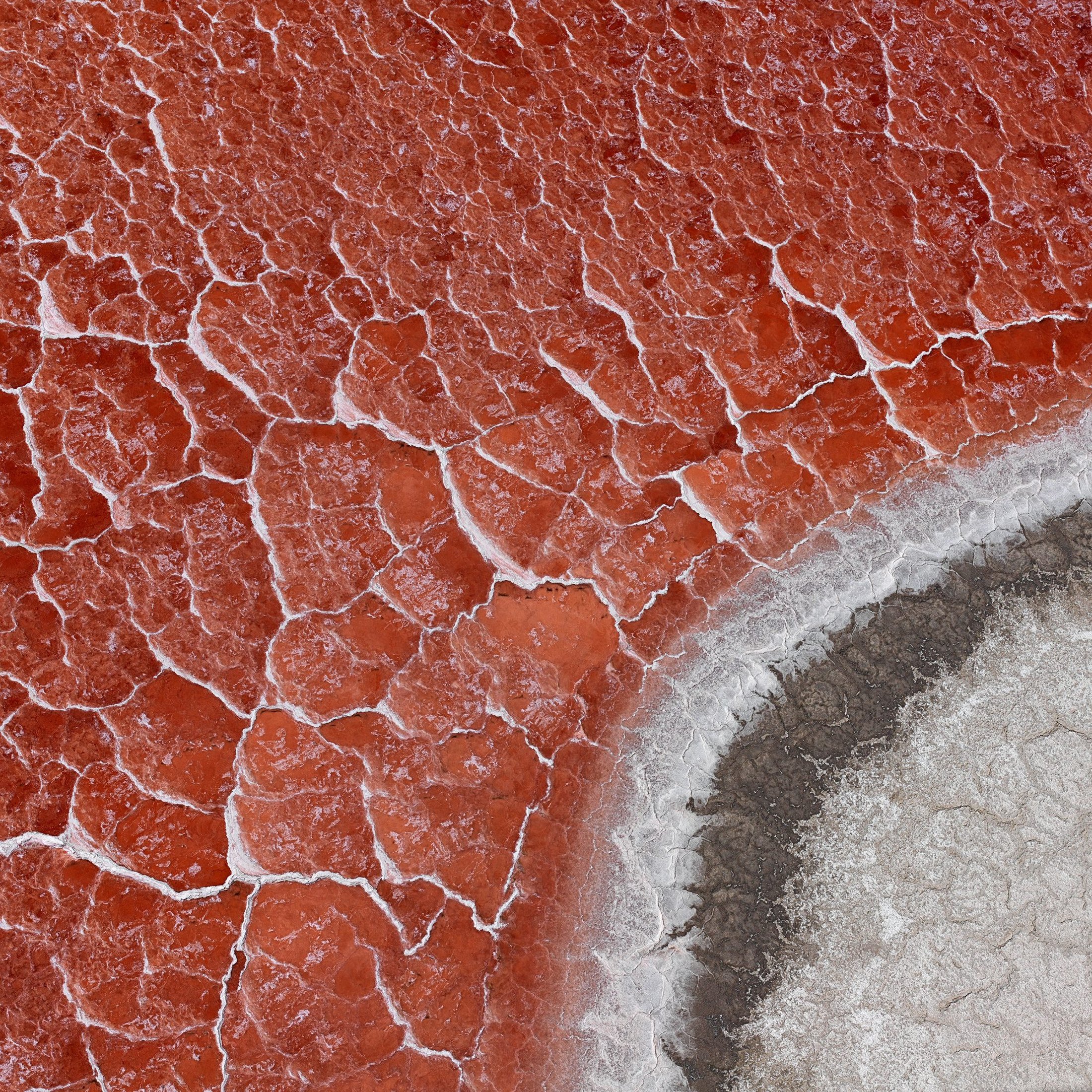
ORANGE-RED. Searles Lake, USA. Masses of red, salt-loving algae live in the swamps on the banks of Lake Searles, a salt lake in the Mojave desert. The lake is named after John Searles who ran the first salt mine there in 1873. Even today borax is still mined on the shores of this salt lake. © Bernhard Edmaier
Comb Ridge, Utah, USA. These sandstone layers whichhave been tilted and then erodedby runoff water contain weathered iron compounds. They look orange, purple or bright yellow depending on the light. © Bernhard Edmaier
Namib Desert, Namibia. The countless grains of sand that make up the dunes have long been exposed to weathering.As a result, they are coated with iron oxide and are orange-red in appearance. © Bernhard Edmaier
BROWN. Namib Desert, Namibia. Here, the dunes wander. Grains of sand are blown by the wind up one side of the dune to the top, where they roll down the other side. In this way, the narrow ridges slither across the dry, stony ground. © Bernhard Edmaier
Nizina Glacier, Alaska, USA. Huge chunks of ice interspersed with moraine rubble float in the muddy meltwater lake at the front of Nizina Glacier. The colour of the water depends on the rock which the glacier ice ‚has planed’ while flowing. © Bernhard Edmaier
WHITE-GREY-BLACK. Huns Mountains, Namibia. © Bernhard Edmaier
Sidu Glacier, Iceland. The icy wastes of Iceland are often criss-crossed by black lines and cross-hatching. These patterns are the result of the interplay of volcanoes, snow, sun and wind. When one of the many volcanoes in Iceland erupts – which happens every few years – they spew out black volcanic ash. This forms ash clouds high above, which rain onto the glaciers. Snow then covers the carpet of black volcanic ash. In this way, white and black layers settle on top of one another, countless times over. © Bernhard Edmaier
Lake Silvaplana, Switzerland. During very cold periods in wintertime when there is no wind and snowfall,a crystal clear ice sheet can grow on lakes. It is called “black ice“, because one can see through it into the deep dark water. Air bubbles gather beneath the ice sheet and form round white fields. Tensions in the ice surface create flaws, which appear as white lines. © Bernhard Edmaier