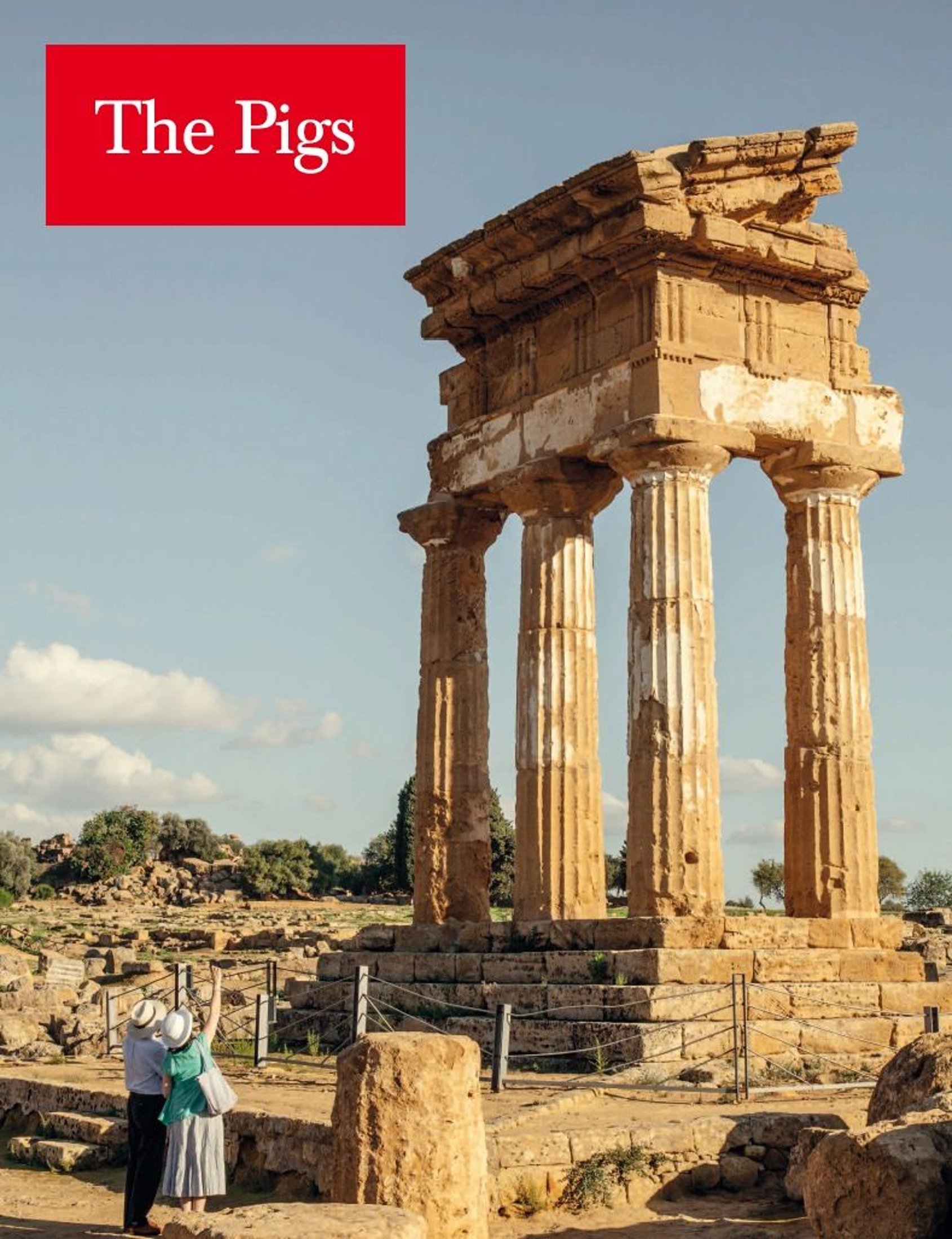
"The Pigs" echoes the design and form of "The Economist" to deliver photoessays of real situations in four countries suffering in economic crisis in the EU: Portugal, Italy, Greece, Spain — referred to by the financial press with the disparaging acronym PIGS © 2013 Carlos Spottorno
Lisbon, Portugal: Tile painting is one of the well-known crafts from Portugal. Here, they use a traditional technique to write this message: "Holy Europe of Hope", and added many euro symbols also painted on tiles. Thanks to the extreme austerity measures imposed by the so-called Troika, this feeling is quickly disappearing, just like the tiles on the wall. © Carlos Spottorno
Portimao, Portugal: A young Gypsy holds his horse after cleaning it. It's always striking to see working horses in an urban context. It's like different development ages coexisting in time. When I see this image, I can't help thinking about the painting Boy Leading a Horse, 1906, by Picasso. Some icons live long lives, and therefore coexist with their own future. © Carlos Spottorno
Sintra, Portugal: The office of a renowned artisan basketmaker's shop. They sell their products all around the world but it looks like they still use an old-fashioned accounting system (much like they keep making their products by hand). This might prove that you can be internationally successful without using computers. © Carlos Spottorno
Lisbon, Portugal: A Gypsy woman begs in front of a church. In the background, tourists are driving a tricycIe built for navigating the city's narrow streets. The economic crisis makes the poor poorer, while the tourists benefit from internal devaluation. And that, paradoxically, may be the only way to recovery as long as the Euro circulates. © Carlos Spottorno
Sintra, Portugal: A guard at the entrance of the National Palace of Sintra displays self confidence and authority. In a culture where hierarchy is still pertinent , being the master of your own square meter is more relevant than one might think. As a photographer, I have experienced the capriciousness of security guards many times. This is my tribute to them. © Carlos Spottorno
Carinia, Sicily: Garbage accumulated on a street corner because of a strike of the company that collects it. They were not paid by the city council, which is always short of resources. Also, there are suspicions of the Mafia being involved in the recycling business, complicating matters further. © Carlos Spottorno
Gela, Italy: Saro Spataro is a Sicilian-born Argentinian. He has been unemployed for years. He was hit by the Argentinian economic crisis in 2001, so he moved to Spain. He lost everything in 2007 again, so he moved to Sicily to see if his parents could help. He sells "madonnine" at the side of the road. He makes them with clay and black concrete. © Carlos Spottorno
Palermo, Italy: Corrado Valvo, mayor of Noto in full dress uniform, demonstrates in front of the City Council in Palermo to protest the closing of Noto's hospital. He is surrounded by his city’s local police, who back him. The “gang-like” image of this photo is misleading: they are not the evil ones in this situation. © Carlos Spottorno
Palermo, Sicily: Two young men dragging a horse on their scooter. The horse is wearing a mask because it's going to run in a race close to a highway. In Central Palermo there are a number of horses that are supposedly used for tourist attractions, but in reality, they are part of a million-dollar business of gambling on illegal races (run on asphalt). © Carlos Spottorno
Palermo, Italy: An advertising photo shoot in the Vucciria Street Market. A sexy, blonde woman is a timeless cliché that seems to work in every possible situation. At first I didn't notice it was a set up situation. It caught my attention, but it didn't seem impossible to be true. I never knew what they were advertising. © Carlos Spottorno
Athens, Greece: A flea market near the Acropolis. The sense of urgency with which the two men proceed looks like they are running for their lives, taking with them their most precious belongings. I know they're just selling stuff, but I see a metaphor here. © Carlos Spottorno
Naxos, Greece: While Isaac Newton sat under a tree thinking about scientific matters and discovered the laws of gravity, a Greek philosopher simply took a nap under another tree, and woke up relaxed, ready for dinner. This is what came to my mind when I saw this man sleeping under the attentive observation on his ducks. © Carlos Spottorno
Athens, Greece: Inside a garbage container at a flea market, a homeless man looks for any useful thing to take. After years of deep economic crisis and hard austerity measures, and with no clear future in the horizon, Greece has become a poor country. The violent robot graffiti suggests the crisis may be the consequence of a hyper-technological life. © Carlos Spottorno
Nafplion, Greece: Greek tourists enjoy the seashore under the remains of a restaurant and leisure center close to Akronafplia Fortress. The decay of luxurious facilities somehow chases away foreign tourists, while the locals reconquer their space, paying less attention to the relatively bad conditions of the site. © Carlos Spottorno
Athens, Greece: "Hey, boss, where shall I put this 3,000 year-old piece of column?" - "Uh… I don't know, just put it there, behind the office, with the other ones." Hundreds of massive archaeological ruins at the Acropolis are piled here and there, around the restorers’ provisional offices. The weight of history is just too heavy for the southern European countries. © Carlos Spottorno
Carboneras, Almeria, Spain: Hotel "El Algarrobico" was built in a protected Natural Park with the complicity of local authorities. Popular activism and pressure from Greenpeace stopped the project. But after a decade of litigation, it has not yet been demolished. Many locals would like the hotel to start operating, in the hopes of revitalizing the local economy. © Carlos Spottorno
Mollina, Spain: Young men play mud-football. The budget for patronal festivities has been cut so much that only very cheap activities are possible. © Carlos Spottorno
Seseña, Spain: Residencial Francisco Hernando was built in the early 2000s. It’s a clear examples of wild speculative urbanization that took place during the last decade in south European countries, and especially in Spain. Many low-middle class families bought one or two apartments for speculating, and got caught by the bubble burst. © Carlos Spottorno
Jerez, Spain: This newly built suburb illustrates everything that went wrong in Spain: rapid growth based on seemingly limitless borrowing, which produced a glut of houses and office space that nobody wants. This city of 212,000 people owes one billion euros. Unemployment in Jerez is around 34 percent. © Carlos Spottorno
Algeciras, Spain: Despite the widely spread stereotype of lazy siesta-sleeping Spaniards, and the very depressed context of the area, Algeciras harbor is increasing in container traffic, reaching 90 million tons in 2012, only 10% smaller that Hamburg, Rotterdam and Antwerp. © Carlos Spottorno