Road entering Vukovar from the East. © Colin Dutton
The river Danube at Vukovar which marks the border between Croatia and Serbia. The town was held under a 3-month siege in 1991 by Serbian artillery positioned across the river. © Colin Dutton
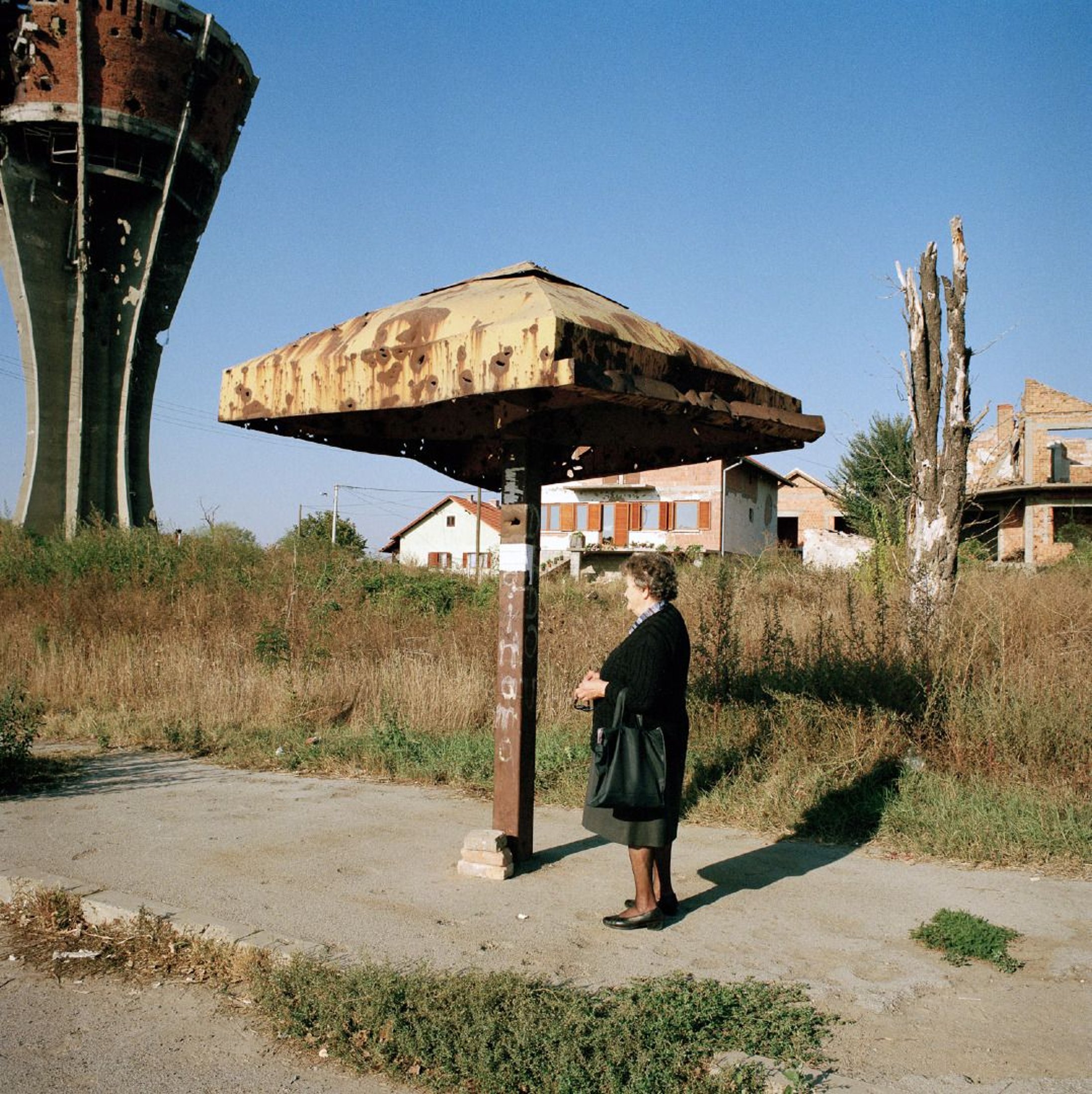
A lady waits for a bus in a residential area that was largely destroyed during the war. The damaged water tower on the left has become something of an icon for the town. © Colin Dutton
It is estimated that half a million shells were dropped on the town during the three-month siege in 1991. © Colin Dutton
Vukovar's town center. © Colin Dutton
Shrapnel holes in the shutters of a house in Vukovar. © Colin Dutton
People waiting for the arrival of a procession in the town center. The building behind them hosted the founding of the Yugoslavian Communist Party in 1920. © Colin Dutton
Majorettes carry the flags of Croatia and Vukovar through the town centre during a procession. © Colin Dutton
A make-shift altar and seating in the damaged Cathedral. Ethnic differences in the region follow religious lines, separating Catholic Croats from Orthodox Serbs. © Colin Dutton
The club room at Youth Peace Group, one of the few places in Vukovar where young Serbs and Croats socialize. Most of the young people I talked to hoped to move abroad to find work. In 2001, the local unemployment rate was 80%. © Colin Dutton
Building blocks in one of the town's cemeteries. During the war, some graves were desecrated. © Colin Dutton
A woman enjoying her new house. Many new houses were being built for Displaced People (DPs), whose homes were destroyed as well as for Internally Displaced People (IDPs) who had moved into the empty houses of those who fled. If IDPs were moved to a new house, it meant the original owners could return. In fact, very few wanted to come back. © Colin Dutton
The kitchen of a newly built home for a Displaced Person. © Colin Dutton
Shell-damaged garage door at a house in Vukovar. © Colin Dutton
A minefield just outside of Vukovar. Large areas of farmland were still mined when these photographs were made, meaning that many farmers remained unable to work their land. There is a story of a farmer's wife who, in desperation, cleared the field herself with a shovel—and survived. © Colin Dutton
A gathering to celebrate the newly repaired roof on Vukovar Cathedral. © Colin Dutton
Men at a gathering to celebrate the newly repaired roof on Vukovar Cathedral. © Colin Dutton
The Borovo Shoe Factory was once the largest employer in the area with over 20,000 workers. © Colin Dutton
The Borovo shoe factory was established by the Czech industrialist, Jan Bata, in 1931. Of the 79 buildings that make up the site, only 5 remained operation in 2001. © Colin Dutton
Milenko Krenaic, the chief engineer at the Borovo shoe factory, stands at his old desk. © Colin Dutton
At its peak, the factory was producing 20 million pairs of shoes each year and had a chain of 600 shops around the former Yugoslavia. © Colin Dutton
Despite substantial damage, production continued at the factory. There was a staff of around 500 at the time I made these images. © Colin Dutton
A severely damaged building in the Borovo shoe factory. © Colin Dutton
Foot molds in different sizes. © Colin Dutton
Some areas of the Borovo factory remain untouched since the first days of bombing in 1991. © Colin Dutton
Cloth remains on the Borovo factory floor. © Colin Dutton
Long untouched workers' lockers at the shoe factory. © Colin Dutton
A tree growing from a toilet in the factory. © Colin Dutton
Young apprentices at the Borovo shoe factory. © Colin Dutton
A young apprentice hoping to learn machining skills. © Colin Dutton
A long-forgotten decoration. © Colin Dutton
Children playing in Borovo Naselje, the residential area built around the shoe factory to house its workers and provide them with shops, schools, cinema and sports facilities. © Colin Dutton
Some of the oldest houses at the Borovo Naselje 'workers colony' were built to house the growing workforce in the 1930s. © Colin Dutton
Young men playing chess at the Borovo Naselje school. © Colin Dutton
Children playing in the main park. © Colin Dutton
The majorettes were seemingly everywhere during my time in Vukovar. Here they are lined up to welcome some dignitaries in the foyer of the Radnicki Dom (the 'workers' hall') which still stands at the heart of the Borovo Naselje social life. © Colin Dutton
Winners podium at the Borovo Naselje swimming pool. © Colin Dutton
Girls sitting at the Borovo Naselje Olympic-sized swimming pool. © Colin Dutton
A "Mrs. Doubtfire" advertisement at the Borovo Naselje cinema. The cinema still offered a daily program of films but would only show them if more than 5 people turned up. © Colin Dutton
The residential areas that compose the workers colony. © Colin Dutton
A park in Borovo Naselje, the workers colony. © Colin Dutton
A home's cellar. © Colin Dutton
Children playing on pipes ready to be installed at Borovo Naselje. © Colin Dutton
A man fitting a new window onto the Borovo Naselje sports center. © Colin Dutton
Waiting for the bus. © Colin Dutton
Two images that were made in the same place, six months apart. A changing view from the banks of the Danube. © Colin Dutton