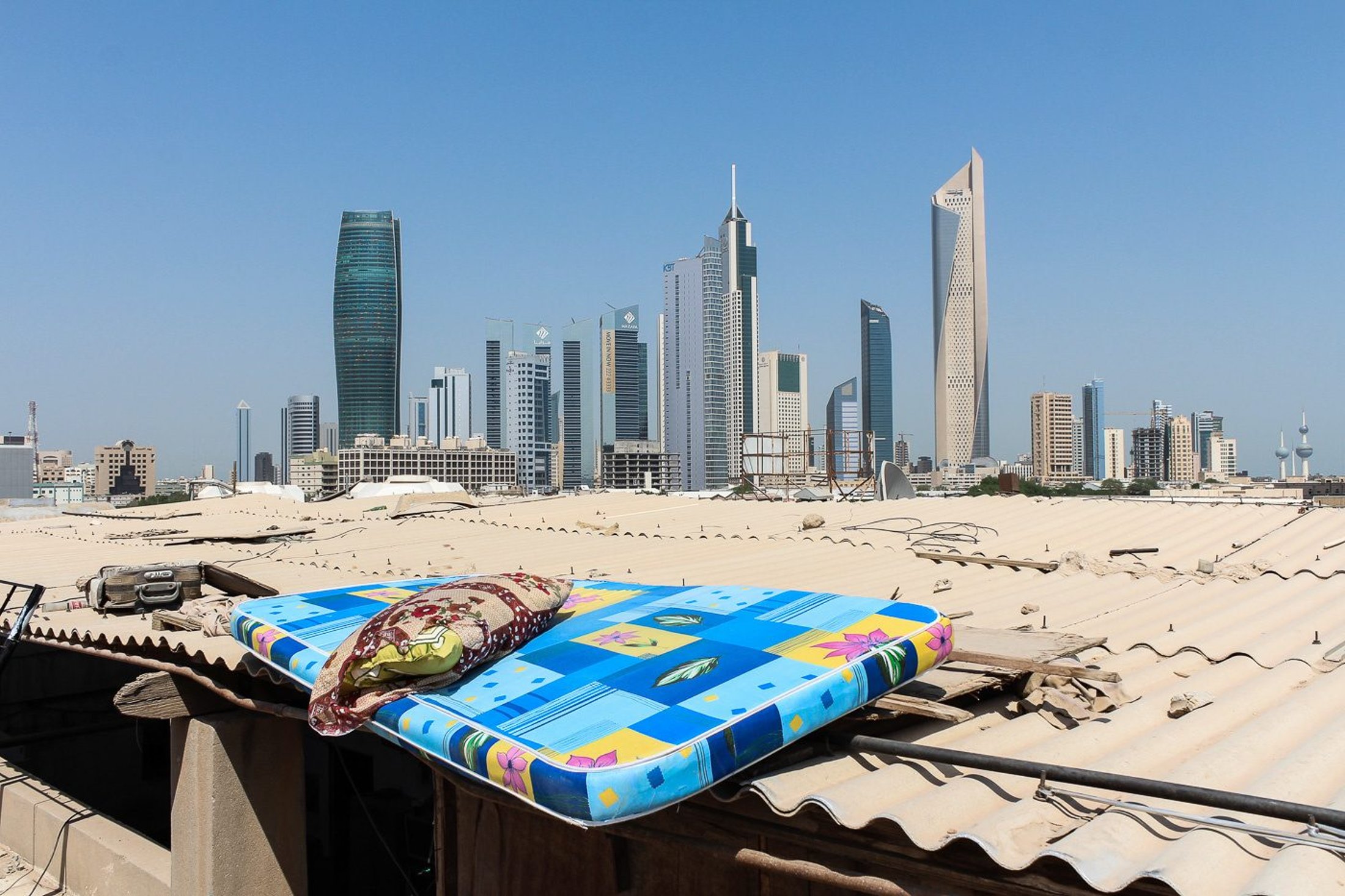
Kuwait. 2012. Sharq. A view of Kuwait's financial center from the rooftop of a building in Sharq where low-income migrant laborers live. © Faisal Al Fouzan
Kuwait. 2013. Salmiya. An old house in a prime location in the commercial district of Salmiya that will be demolished soon. Many migrant workers live in old, ramshackle and decaying buildings that are often scheduled for demolition. © Faisal Al Fouzan
Kuwait. 2014. Jeleeb Al Shuyoukh. Poorly maintained and dangerous wiring are common in many buildings housing migrant laborers as new cables are added at random. © Faisal Al Fouzan
Kuwait. 2014. Bnaid Al Qar. Raja 30 years old, from Rajasthan, India works as a car mechanic. Here in deep sleep minutes before getting up for his 12 hour shift in a repair shop. © Faisal Al Fouzan
Kuwait. 2014. Sharq. The main meal of an Iranian who works in the local fishmarket. Fish constitutes most of his diet as he gets it for free. © Faisal Al Fouzan
Kuwait. 2014. Salmiya. Jamal Jadallah, a construction worker from Qina, Egypt. He has work in Kuwait for the past 22 years. © Faisal Al Fouzan
Kuwait. 2014. Salmiya. Ali Ahmed, a 23-year-old construction worker from Sohag, Egypt, relaxes after a long day of manual labor. © Faisal Al Fouzan
Kuwait. 2014. Sharq. Reflection of Al Sanabil tower, one of the tallest office buildings in Kuwait. © Faisal Al Fouzan
Kuwait. 2012. Sharq. Old house in Kuwait City with 65 rooms that accommodates more than 300 low-income migrant laborers from different countries. Its big yard and corridors has been converted into makeshift shared bedrooms, kitchens and communal bathrooms © Faisal Al Fouzan
Kuwait. 2014. Sharq. The satellite dishes provide access to television channels from laborers’ home countries, serving both as a literal and emotional connection to their homeland. © Faisal Al Fouzan
Kuwait. 2015. Bnaid Al Qar. A street vendor visiting the buildings where migrant workers live to sell random items. © Faisal Al Fouzan
Kuwait. 2013. Mirqab. Laundry waiting to be picked up by an affordable laundry cleaning company. © Faisal Al Fouzan
Kuwait. 2014. Sharq. Due to the lack of space, Husain hangs his whole wardrobe above his bed in the only private space he has. To put on his clothes, he must climb up and stand on his bed to reach them. Husain can recite the entire Holy Quran and came to Kuwait from Bangladesh nine years ago hoping to work as a muezzin (the man who calls the faithful to prayer from the mosque). But he couldn’t find a job so he took whatever work he could get and has worked as a painter, blacksmith, cutting aluminum, mixing and selling fragrances and now he works as an office porter serving tea, making photocopies, scanning and archiving company documents. © Faisal Al Fouzan
Kuwait. 2014. Sharq. Photos of Jameela and Al Ameen, the children of Ismail from Bangladesh, hang on the wall by his bed. He works as an office boy. He sees them once every two years. © Faisal Al Fouzan
Kuwait. 2014. Sharq. A group of workers from India gather on the first day of Eid Al-Adha. While eating traditional sweets, they discuss the news about Israeli soldiers preventing Palestinians from Eid prayers at Al Aqsa Mosque. © Faisal Al Fouzan
Kuwait. 2014. Hawally. A portrait of Jesus Christ by a bed. © Faisal Al Fouzan
Kuwait. 2014. Sharq. Mohammed Saber, a housepainter from India drinking tea. © Faisal Al Fouzan
Kuwait. 2014. Bnaid Al Qar. Futoor of Pakistani workers that consist of fruits mixed with yogurt. © Faisal Al Fouzan
Kuwait. 2014. Bnaid Al Qar. Toothbrush and tongue cleaner. © Faisal Al Fouzan
Kuwait. 2014. Bnaid Al Qar. Courtyard of a house near Kuwait City that has been converted into makeshift shared bedrooms, kitchens and communal bathrooms. © Faisal Al Fouzan
Kuwait. 2014. Salmiya. Some workers grow plants for food as well as decoration. © Faisal Al Fouzan
Kuwait. 2014. Bnaid Al Qar. Exposed and overloaded electricity wires usually lead to power cuts or fires in the buildings of migrant laborers. Many of the buildings housing migrant workers are overcrowded and do not have the necessary electricity to serve so many users. © Faisal Al Fouzan
Kuwait. 2014. Sharq. A Indian visiting his relatives in Kuwait on a family visit visa. © Faisal Al Fouzan
Kuwait. 2014. Salmiya. Symbols of Hindu worship in a laborer’s room. Kuwait is a Muslim country but its laborers come from diverse religious backgrounds including Christianity, Hinduism, Buddhism as well as the various sects of Islam. © Faisal Al Fouzan
Kuwait. 2014. Bnaid Al Qar. Due to the large number of laborers inside some buildings, a cottage industry in freelance services has grown up with home cooked meals, tailoring, cleaning and haircuts and shaves all available. © Faisal Al Fouzan
Kuwait. 2014. Sharq. Seventy-year-old Sayeed came to Kuwait 40 years ago for a job in construction. As he aged, he could no longer do the hard manual labor so he took a job as a watchman and cleaner for a migrant workers house. © Faisal Al Fouzan
Kuwait. 2014. Salmiya. Bangladeshi Mohamed Kayes, 34 years old, used to work as a satellite technician but after the shop where he worked for eight years closed down, he found a job as a lorry driver. Now he picks up goods from warehouses and drops them off to different supermarket branches. Jamal (praying) also from Bangladesh, works as a porter in a super market. © Faisal Al Fouzan
Kuwait. 2014. Sharq. Most migrant laborers work six days a week for very long hours (often 10 to 12 hours and many have second jobs). Most are too exhausted for anything else but sleep on their day off. © Faisal Al Fouzan
Kuwait. 2014. Salmiya. Ali Ahmed, a 23-year-old construction worker from Sohag, Egypt. Before coming to Kuwait, Ali worked in a resort by the Red Sea, cleaning tables and providing towels to swimmers by the beach. He came from a conservative village. He told me “Women in my village do not leave their homes without permission, and are fully covered. I could not stand working where I had to serve women in their bikinis, partying and doing unimaginable things.” He left the resort without getting his last pay check, and came to Kuwait. © Faisal Al Fouzan
Kuwait. 2014. Salmiya. Mohamed Kayes showing messages between him and his 28- year-old wife, Nezmat, who lives in Dhaka, Bangladesh. © Faisal Al Fouzan