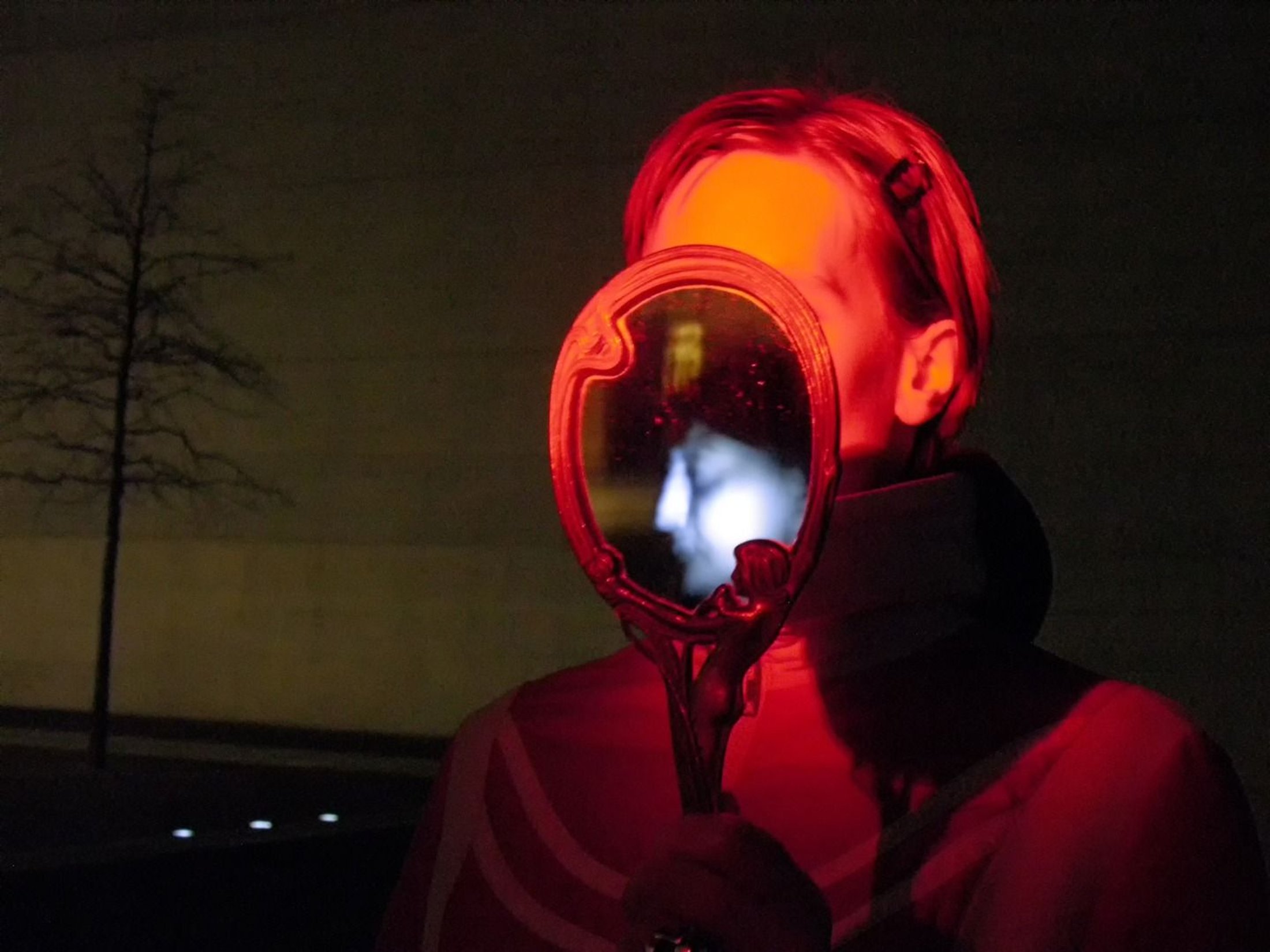
The Poems—Poem #55. Boris Eldagsen's photographs utilize the external reality, to paint the inner reality, that of the unconscious, archetypical and unspoken. © Boris Eldagsen, courtesy of FORMAT15
The Poems—Poem #03. Without excessive materials or digital effects, he combines street with staged photography to create images that sit between painting, film and theater. © Boris Eldagsen, courtesy of FORMAT15
The Poems—Poem #88. Inaccessible to the rational mind, his POEMS compel the viewer to resort to their own memories and feelings. These images are not a series but rather a meta-series of single images that can be combined in various ways and sizes. © Boris Eldagsen, courtesy of FORMAT15
Anecdotal. In our collective unconscious the nuclear age is synonymous with the explosion of two atom bombs. Hiroshima and Nagasaki. But since 1945 it has been documented that more than 2000 nuclear bombs have been detonated on Earth. Since the end of the Second World War, nuclear power countries methodically bombed their own lands. Self mutilation in the name of self defense. © David Fathi, courtesy of FORMAT15
Anecdotal. This series' starting point is the unfamiliar stories and anecdotes around nuclear armament and testing programs. Mixing archival photos, satellite imagery, packshots and road-trip photos, I have tried recontextualizing a history wavering between a horrific investigation and an absurd farce. © David Fathi, courtesy of FORMAT15
Anecdotal. All that is documented here is true, but seems to be from a work of bad fiction. We find stories of contaminated ministers, bombs lost and never found, the invention of the bikini, the power struggles between colonial powers and local populations, vaporized chickens, etc. © David Fathi, courtesy of FORMAT15
Great Wall. © Fan Shi San, courtesy of FORMAT15
Great Wall. © Fan Shi San, courtesy of FORMAT15
Great Wall. © Fan Shi San, courtesy of FORMAT15
Matt Henry's personal practice focuses on America during the 1960s and 1970s. The works take the form of staged scenes constructed as set-builds in the UK using props sourced from here and the United States. The devout modernism of this period is a particular interest, with utopian political and cultural ideals heralding some of the great liberal successes of our time (e.g. Civil Rights). © Matt Henry, courtesy of FORMAT15
Henry's current long-term project focuses on the American counterculture and social protest in the years 1964-74, which is also the subject of my doctoral thesis. This series is titled, "The King," and traces the re-appropriation of the cultural icon Elvis Presley all over the world. © Matt Henry, courtesy of FORMAT15
Simon Taylor from Clifton Cameras said of the work, “Matt’s intriguing series explores how some people relate to nostalgic memorabilia with adoration. The series is an interesting reflection of human behaviour.” © Matt Henry, courtesy of FORMAT15
Remotely Piloted Aircraft (RPAs) have been used by the US military since the First World War. Assault RPAs were deployed in the closing stages of the Second World War, and the first major combat use of Unmanned Aerial Vehicles (UAVs, commonly known as drones) was during the Vietnam War. UAVs are now the norm in warfare and are deployed both in-theatre and remotely. © Lisa Barnard, courtesy of FORMAT15
The video feed captured from drones is presented via a visual interface to the pilots as a series of small images that form one large moving picture. Such photomosiacs were widely used to map the trenches during WWI, for example. © Lisa Barnard, courtesy of FORMAT15
The photographs that constitute the mosaics are from the first edition of Jane's Pocket Book of Remotely Piloted Vehicles, published in 1977, and unidentifiable landscapes photographed from either the USA or Pakistan in 2011-2013. Each montage is accompanied by a "pattern." © Lisa Barnard, courtesy of FORMAT15
The story of Andre Breton’s encounter with the enigmatic figure Nadja is told in the poet's semi-autobiographical novel of the same name. Nadja, or Leona Camille Ghislaine D. was 24 years of age when she met Breton by chance on the Rue Lafayette on October 4th 1926. Struck by the other-worldly detachment of the young woman, her ghostliness and visionary quality, Breton pursued her for days. © Martina Cleary, courtesy of FORMAT15
Nadja’s mystique lay in her inexplicable, almost clairvoyant capacity to move lucidly between regular and alternative states of consciousness. She was for that very brief period of time the embodiment the Surrealist femme enfant, the conduit, or door to the marvelous. Breton’s infatuation with Nadja, though short-lived, drew him towards a dark undertow, a psychological voyeurism. © Martina Cleary, courtesy of FORMAT15
Breton chose 44 photographic plates to accompany his text, many by the photographer Jacques-André Boiffard, whom he commissioned to record certain places related to the story, others haphazard illustrations of objects and artifacts. In the summer of 2012 I travelled to Paris in search of Nadja. Over a period of 10 days, using Breton’s text and Boiffard’s plates, I followed the same routes. © Martina Cleary, courtesy of FORMAT15