Jens Liebchen, a young photographer from Germany,
has already published several small, clever photobooks that are beautifully
designed visual musings, often paired with thought-provoking philosophical
texts.
In this one, DL07 stereotypes of war, a photographic investigation,
he has constructed a series of black-and-white photos of a city under
seige – menacing helicopters buzzing abandoned buildings, furtive
figures scrambling down deserted streets, smoke-filled skylines, blood-stained
walls and sidewalks, too-young children armed with machine guns…
Yet he took all of these photos in a city (Tirana, Albania) while it was
at peace.
By co-opting the cliched genre of war photography and presenting a sequence
of photos in a deliberate manner, the “reportage” easily carries
the burden of reference that 150 years of war photography has etched into
our collective consiousness.
Ian Jeffrey, author of photographic history and professor at Goldsmiths
College, University of London, writes in his introductory essay:
“There is ... more involved here than the analysis of a genre. Liebchen’s
is, in actuality, deconstructive work, for not only does he present the
elements in the practice of “war photography” but at the same
time he gives an account, by implication, of their developments. War photography
is a dangerous business, which stands to reason, and in the age of the
heroic modernists it was expected that the war photographer should face
dangers squarely: Robert Capa and Eric Borchert are two who paid with
their lives for the sake of this unmediated coverage. Post-modernists,
on the other hand, don’t take that heroic standpoint, mainly because
the wars they report form no part of a larger cause. Mostly, these wars
have local dimensions incomprehensible to an outsider, and might be carried
out by devoted patriots, but equally by robbers and deluded children…
The photgraphic reporter is of necessity in these conditions a transient,
principally a nervous traveller in unreliable streets.”
With these thoughts in mind, then, the reader goes back to look carefully
at each picture, with some kind of personal delight, to deconstruct each,
and to analyse how the sequence of presentation helps to build a strong
fiction. Even in this age of enlightened media distrust, we realize how
easily it is to be tricked by “accepting” images at face value
(even without captions or explanatory text which could further distort
the truth).
This is a beautiful little hardbound book, published in an edition of
750 copies by J.J.Heckenhauer.
* * * * *
Jens Liebchen discussed this book with Jim Casper in an interview conducted
via email:
JC: Do you think the best vehicles for communicating
your ideas are
books? If so, why? Have you also shown this work in other ways?
Jens Liebchen: Indeed I do think that books are a very
good media to communicate ideas, concepts, stories in photography, and
personally I love photography books. A good photography book is compact
and complex at the same time. When I was working on DL07 from the beginning
on I wanted to present it as a book.
Publishing a work as a book offers additional layers to put in information,
by means of graphic design corresponding to the subject, by presenting
the photographs in a special order and of course by using different sizes
of reproduction. In this respect a book could work in a way like a movie.
DL07 starts with the most obvious and direct image, a soldier with a gun
on top of a stairway, but having seen that image makes it possible to
understand the second image with the little helicopter: You are already
intrigued.
I presented this work as well in exhibitions in form of framed prints:
Pretty small prints of 30x40 cm and a classical presentation makes most
people react as looking at a “real” reportage whereas the
larger version of 115x150 cm prints strengthens particular images.
In any case the title “DL07” is very important – there
is something no one can understand, something that is strange and in this
respect it makes you sensitive and astonished.
When did you start making books? How many have you made?
In fact DL07 has been my first book and it has been a wonderful coincidence
that I got to know Roger Sonnewald (J.J.Heckenhauer) in those days who
made it possible to publish it. The great thing really has been, that
there were no regulations concerning this book – and I do think
that in the end this is a great part of its success. I got more and more
interested in publications and editions and I have done quite a lot, since
than. Beyond others, in 2004 I published an edition with schaden.com entitled
“The Flag”: A big box, wrapped in red silk, with a collection
of 7 reproductions of Polaroids I did some years ago… Finally in
2005 I published my latest work “Playing Fields”, designed
by Winfried Heininger in form of a magazine with images from Kazakhstan,
Uzbekistan, Georgia and Armenia. Published again by Edition Heckenhauer
it brings in exemplary images the hidden traces in those places where
geopolitics is at work in search of power and oil.
How did you choose to collaborate with Ian Jeffrey?
Again a nice coincidence: In fact we got to know each other in Tirana
where I participated in a show that was partly curated by him. After I
had started to work on that series and the general concept was fixed I
sent him some images and he liked the idea from the beginning.
From my personal point of view I consider texts as very important for
photography books in general, at least when the book is conceptual. Concerning
DL07 and Ian Jeffrey we had a wonderful exchange and I am very happy to
have this text printed in the book.
Were you surprised at how easy (or perhaps how difficult) it was to
make the photos for this book?
Even if it looks very simple to take these images in the end it seemed
to be pretty difficult. Actually the first pictures I took during the
time when the general idea for this project came up just happened –
and that of course was just fun. But when I returned to Albania for a
longer trip and I was in fact searching for special images – that
evolved to be very difficult.

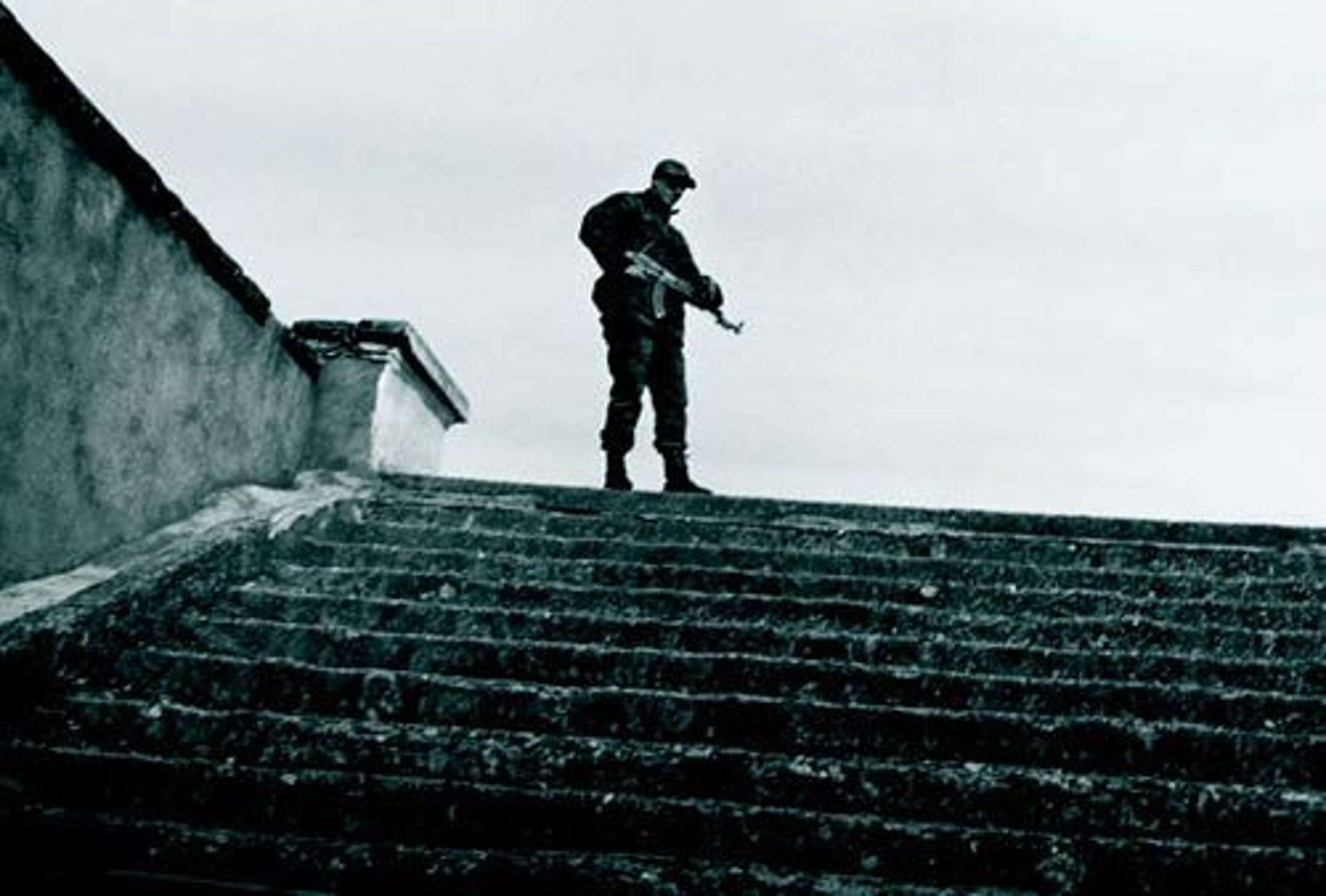
Feature
DL 07 stereotypes of war
Jens Liebchen co-opts the visual language of war photography
to create a menacing portrait of a town that is actually not engaged
in war.
View Images
Feature
DL 07 stereotypes of war
Jens Liebchen co-opts the visual language of war photography
to create a menacing portrait of a town that is actually not engaged
in war.
DL 07 stereotypes of war
Jens Liebchen co-opts the visual language of war photography
to create a menacing portrait of a town that is actually not engaged
in war.

Top Awards include: Full publication with Nazraeli Press, valued at more than $25,000, Los Angeles Exhibition, Cash Prizes, Solo Feature on LensCulture.
