Wild West Stand-off. © Charlie Hamilton James, UK. Finalist, "Mammals.". A grizzly bear charges at ravens trying to grab a piece of the feast. The bison is a road-kill that rangers have moved to a spot they use for carrion to avoid contact between predators and tourists. This photo was taken in Grand Teton National Park, part of the Greater Yellowstone Ecosystem in the Western US, where grizzlies still roam. "Approaching a bear’s lunch is a dangerous thing to do," says Charlie. So there were strict protocols for getting out of his vehicle every time he went to check his camera trap. Over nearly five months, he had thousands of images of ravens and vultures, but only a few of wolves or bears. None were up to the high standards he set for himself until this photo. "The moment I saw it, I was so excited. It had taken nearly five months to get a decent image out of the set-up. It’s rare that I like my images, but I really like this one—though I still get annoyed that the top raven is positioned right over the Grand Teton mountain." The Yellowstone grizzly population has been protected since the 1970s, but now that numbers are recovering, it has been proposed that the population should be removed from the federal list of protected species, allowing hunting outside the two parks. This has raised concerns not only about the grizzlies’ fate but also about the effect on the ecology.
Wildlife Photographer of the Year is developed and produced by the Natural History Museum, London.
Eviction Attempt. © Ganesh H Shankar, India. Winner, "Birds.". These Indian rose-ringed parakeets were not happy. They had returned to their roosting and nesting hole high up in a tree in India’s Keoladeo National Park (also known as the Bharatpur Bird Sanctuary) to find that a Bengal monitor lizard had taken up residence. The birds immediately set about trying to evict the squatter. They bit the lizard’s tail, hanging on for a couple of seconds at a time, until it retreated into the hole. They would then harass it when it tried to come out to bask. This went on for two days. But the action only lasted a couple of seconds at a time and was fast-moving. The branch was also high up, and Ganesh had to shoot against the light. Eventually the parakeets gave up and left, presumably to try to find another place to rear their young. These Indian birds are highly adaptable, and escaped captive parakeets have founded populations in many countries. In Europe, where they are known as ring-necked parakeets, they are accused of competing for nest holes with some native species—such as nuthatches—and even bats, but other birds such as starlings are quite capable of evicting the parakeets from their nest holes. Wildlife Photographer of the Year is developed and produced by the Natural History Museum, London.
Playing Pangolin. © Lance van de Vyver, New Zealand/South Africa. Finalist, "Black & White.". Lance had tracked the pride for several hours before they stopped to rest by a watering hole, but their attention was not on drinking. The lions (which inhabit South Africa’s Tswalu Kalahari Private Game Reserve) had discovered a Temminck’s pangolin. This nocturnal, ant-eating mammal is armor-plated—its scales are made of fused hair—and it curls up into an almost impregnable ball when threatened. Pangolins usually escape unscathed from big cats, though not from humans, whose exploitation of them for the traditional medicine trade is causing their severe decline. But these lions just wouldn’t give up. "They rolled it around like a soccer ball," says Lance. "Every time they lost interest, the pangolin uncurled and tried to retreat, attracting their attention again." Spotting a young lion holding the pangolin ball on a termite mound close to the vehicle, Lance focused in on the lion’s claws and the pangolin’s scratched scales, choosing black and white to help simplify the composition. It was 14 hours before the pride finally moved off to hunt. The pangolin did not appear to be injured, but it died shortly after, probably not just from the stress of capture but also from being out in the heat all day. Wildlife Photographer of the Year is developed and produced by the Natural History Museum, London.
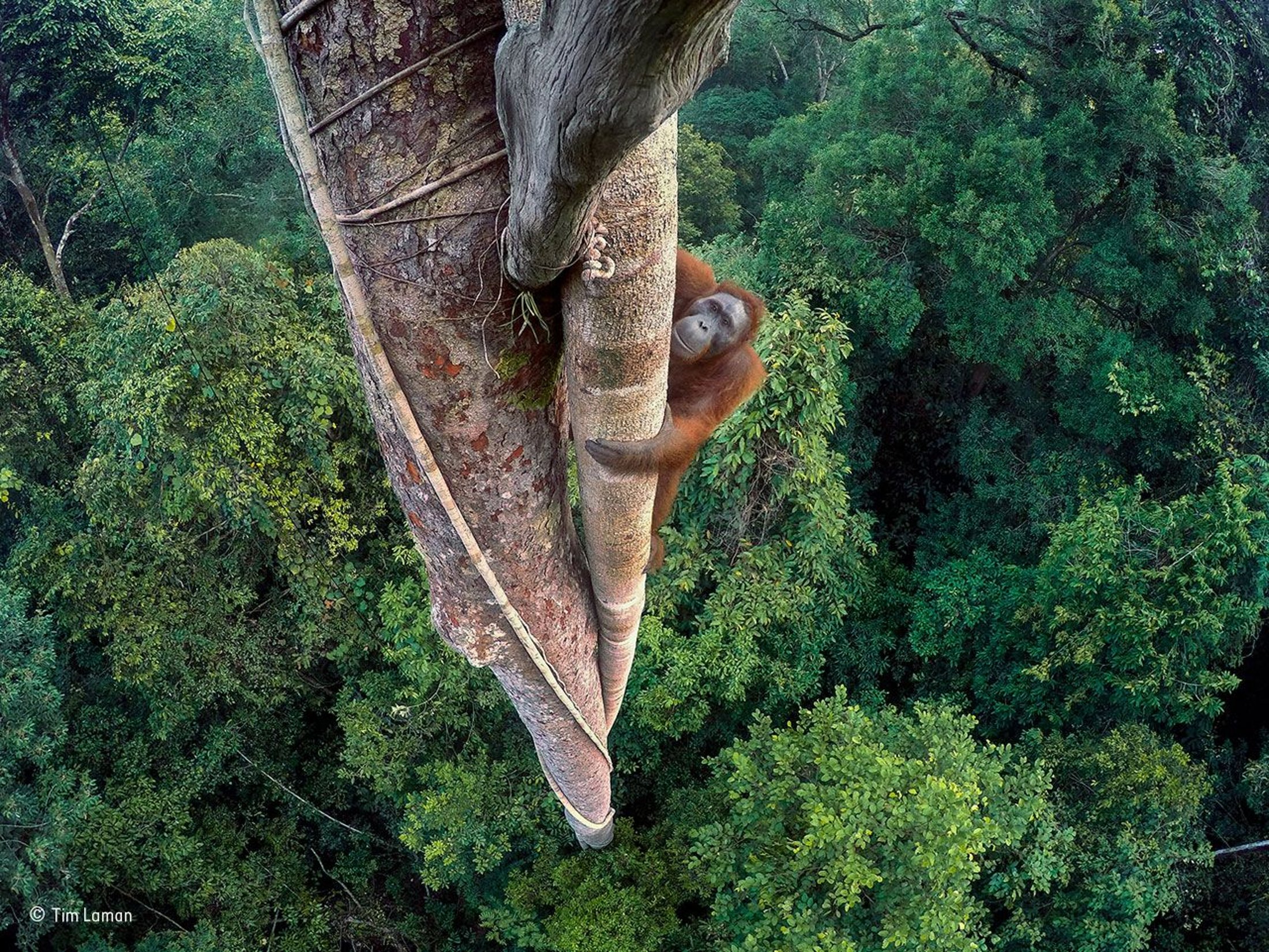
Entwined Lives. © Tim Laman, USA. Winner, "Wildlife Photographer of the Year 2016.". A young male orangutan makes the 30 meter (100 foot) climb up the thickest root of a strangler fig that has twined itself around a tree emerging high above the canopy. The backdrop is the rich rainforest of the Gunung Palung National Park, in West Kalimantan, one of the few protected orangutan strongholds in Borneo. The orangutan has returned to feast on a crop of figs. He has a mental map of the likely fruiting trees in his huge range, and he has already feasted here. Tim knew he would return and, more important, that there was no way to reach the top—no route through the canopy—other than up the tree. But he had to spend three days climbing up and down himself, by rope, to place several GoPro cameras that he could trigger remotely. He intended to snap a wide‑angle view of the forest below as well as a view of the orangutan’s face from above. This shot was the one he had long visualized, looking down on the orangutan within its forest home. Wildlife Photographer of the Year is developed and produced by the Natural History Museum, London.
The Pangolin Pit. © Paul Hilton, UK/Australia. Winner, "The Wildlife Photojournalist Award: Single Image.". Nothing prepared Paul for what he saw: some 4,000 defrosting pangolins in one of the largest seizures of the animals on record. They were destined for China and Vietnam as part of the exotic meat trade or for traditional medicine (their scales are thought, wrongly, to treat a variety of ailments). Pangolins have become the world’s most trafficked animals, with all eight species targeted. This illegal trade, along with habitat loss and local hunting, means that the four Asian species are now endangered or critically endangered, and Africa’s four species are heading that way. These Asian victims, mostly Sunda pangolins, were part of a huge seizure—a joint operation between Indonesia’s police and the World Conservation Society—and were found hidden in a shipping container behind a façade of frozen fish, ready for export from the major port in Sumatra, Belawan. Also seized were 96 live pangolins (destined to be force-fed to increase their size) along with 100 kilos (220 pounds) of pangolin scales worth some $1.8 million on the black market. Pangolin scales are formed from keratin, the same substance in fingernails and rhino horn. All of the pangolins had come from northern Sumatra. The dead pangolins were driven to a specially dug pit and then incinerated. The live ones were taken north and released in the rainforest. "Wildlife crime is big business," says Paul. Wildlife Photographer of the Year is developed and produced by the Natural History Museum, London.
The Aftermath. © Simon Stafford, UK. Winner, "Mammals.". Eerie silence and a mound of lifeless bodies: a stark contrast with the mayhem of the previous day. And the stench was already dreadful. The day before, thousands of wildebeest on migration through Kenya’s Maasai Mara National Reserve had massed at the Mara River, wary of the crossing ahead and of the huge Nile crocodiles lying in wait. Once one made the leap, they all surged forward, and the river became a maelstrom of flailing hooves and crocodiles. In their frantic efforts to get out, they carved gullies in the riverbank; in just over an hour, as the gullies became deeper and deeper, more and more wildebeest slipped back down and died under the hooves of the those coming out of the river. Simon returned at first light, knowing that scavengers would gather at the site of the carnage. "It was a sinister scene," he says. "There must have been 50 or more carcasses piled two or three deep." Spotted hyenas were already feeding, and hippos and crocodiles had gathered in the river below. As Simon watched from the other side of the wide river, one hyena left the feast and stood, as if standing sentry, at the river’s edge, watching the gathering of crocodiles in the water below. Wildlife Photographer of the Year is developed and produced by the Natural History Museum, London.
Snapper Party. © Tony Wu, USA. Winner, "Underwater.". For several days each month, in tandem with the full moon, thousands of two‑spot red snappers gather to spawn around Palau in the western Pacific Ocean. The action is intense as the fish fill the water with sperm and eggs, and predators arrive to take advantage of the bounty. Having read about the drama, Tony couldn’t understand why there were so few photos of it—until he hit the water there for the first time in 2012. The currents were unrelenting—ideal for eggs to be swept swiftly away, but a struggle for him to keep up with the fast‑moving fish. Also, the light was low, and the water was clouded with sperm and eggs. That first attempt failed, but he has returned every year to try and capture the event. Noticing that the spawning ran "like a chain reaction up and down the mass of fish," his success finally came when he positioned himself so that the action came to him. Rewarded with a grandstand view, he was intrigued to see that the fish rapidly changed color during mating—from their standard red to a multitude of hues and patterns. Even their characteristic two white spots, close to the dorsal fins on their backs, seemed to fade and reappear. On this occasion, with perfect anticipation, he managed to capture a dynamic arc of spawning fish amid clouds of eggs in the oblique morning light. Wildlife Photographer of the Year is developed and produced by the Natural History Museum, London.
The Alley Cat. © Nayan Khanolkar, India. Winner, "Urban." At night, in the Aarey Milk Colony in a suburb of Mumbai bordering Sanjay Gandhi National Park, leopards slip ghost-like through a maze of alleys, looking for food (especially stray dogs). The Warli people living in the area respect the big cats. Despite close encounters and occasional attacks, the cats are an accepted part of their lives and their culture, seen in the traditional paintings that decorate the walls of their homes. The leopard is not only the most versatile of the world’s big cats, but it is also possibly the most persecuted. With growing human-leopard conflicts elsewhere grabbing the headlines, Nayan was determined to use his pictures to show how things can be different with tolerance and planning. Once he had convinced the Warli people of his plan, they supplied him with valuable information. Positioning his flashes to mimic the alley’s usual lighting and his camera so that a passing cat would not dominate the frame, he finally—after four months—got the shot he wanted. With a fleeting look of enquiry in the direction of the camera click, a leopard went about its business. Nayan hopes that those living in Mumbai’s new high-rise developments, which impinge on the park's boundaries, will learn from the Warli how to co‑exist with the original inhabitants of the land. Wildlife Photographer of the Year is developed and produced by the Natural History Museum, London.
The Moon and the Crow. © Gideon Knight, UK. Winner, "Young Wildlife Photographer of the Year 2016.". A crow in a tree in a park: a common enough scene. It was one that Gideon had seen many times near his home in London’s Valentines Park, which he visits regularly to take photographs. But as the blue light of dusk crept in and the full moon rose, the scene transformed. The spindly twigs of the sycamore tree silhouetted against the sky "made it feel almost supernatural, like something out of a fairy tale." Positioning himself on a slope opposite, he tried to capture the perfect composition. But the crow kept moving along the branch and turning its head away, and so getting a silhouette of it with the moon in the frame meant Gideon had to keep moving, too. Then, just as the light was about to fade beyond the point that photography was possible, his wish came true, and an ordinary London scene turned into something magical. Wildlife Photographer of the Year is developed and produced by the Natural History Museum, London.