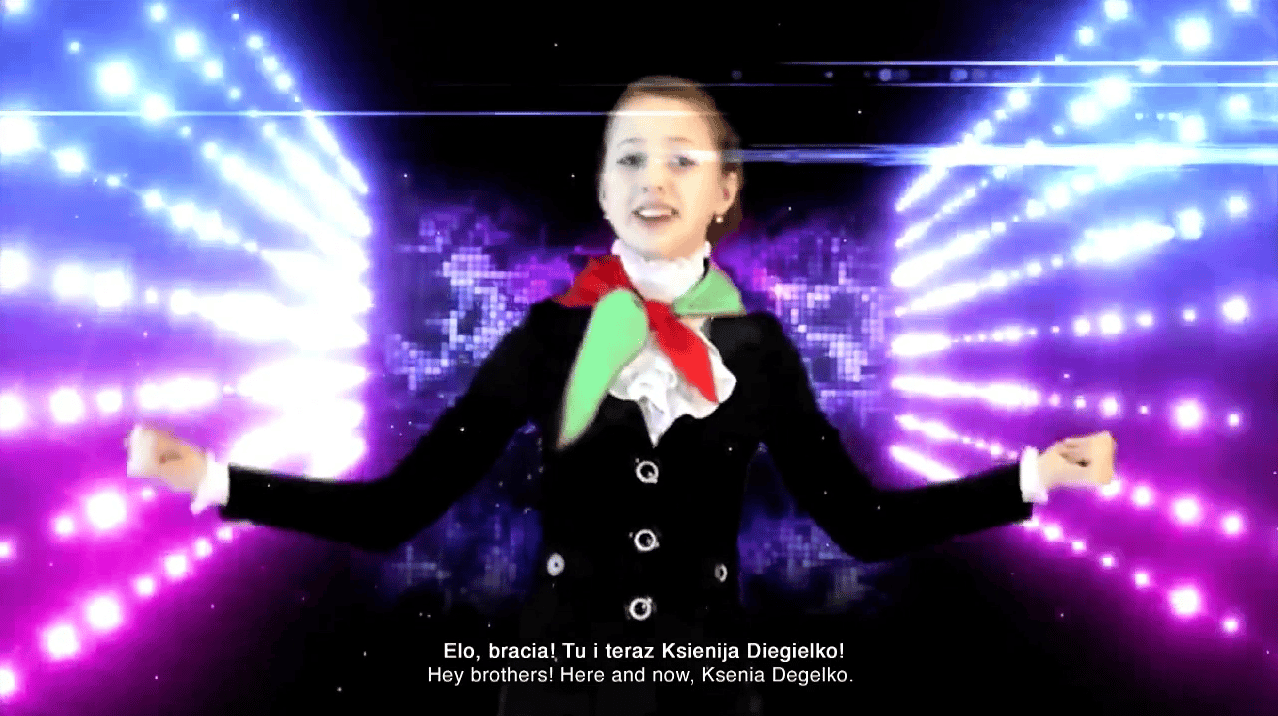
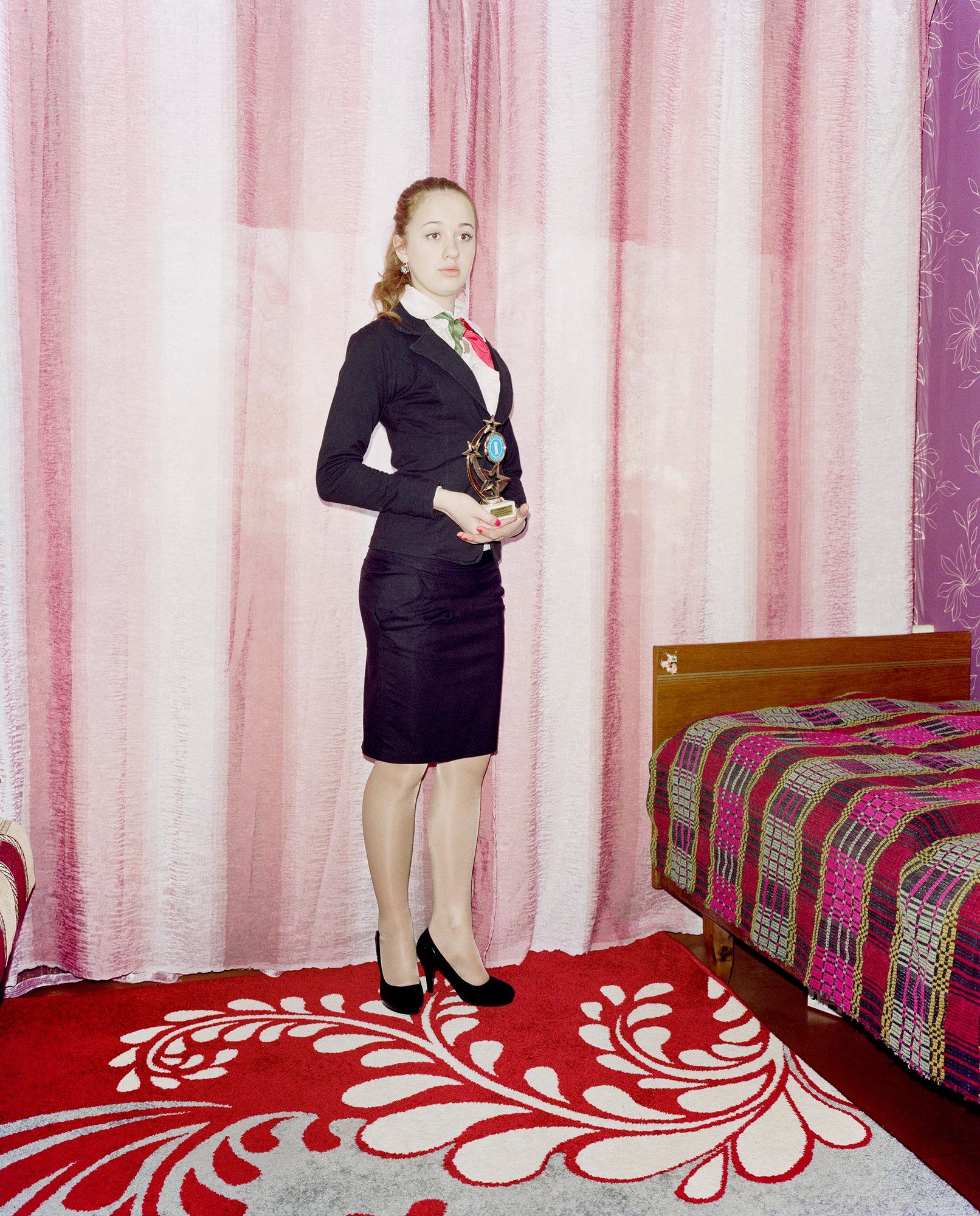
In a video produced in 2012, a then 13-year-old Belarusian from the town of Oktyabrsky named Xenia Degelko created a patriotic rap song promoting the Belarusian regime. Hip hop, commonly serving an anti-establishment narrative to empower marginalized minorities, is culturally appropriated here: “I’m an activist of the BRPO (Belarusian Republican Pioneer Organisation), I care about my motherland, I’m ready to support her and to glorify my native land with labor [yeah yeah, yo yo].” From a Western perspective, the song may come across as a ridiculous parody of the genre—Xenia performs all the hand gestures of US-rappers while wearing a traditional school uniform, against the backdrop of a Eurovision-ish decor with folkloristic dancers and flashing neon-lights hyping her message. Nonetheless, the video went viral in Belarus at the time.
Flash forward to 2020. The Polish photographer Rafał Milach is informed that Xenia Degalko, who he had once photographed for his series The Winners, has decided to join the anti-regime rallies in Belarus, following the rigged elections that kept Alexander Lukashenko, ‘the last dictator of Europe,’ in power. Milach, who meanwhile found himself immersed in the anti-establishment activism of his own country, was puzzled and started to rethink his long-term interest in propaganda and protest.
Xenia’s story reveals the fragile mechanisms of political repression: even in a forceful authoritarian machinery, one can detect under-the-radar individualism. This notion became the starting point of Refusal. Second Fracture—currently on view at the Circulo de Bellas Artes in Madrid—in which Milach bridges the fundamentals of his artistic endeavors for the first time. In this interview for LensCulture, Milach speaks to Erik Vroons about the potential of collective practices to challenge existing political structures.
Erik Vroons: This PHotoESPAÑA-show echoes themes presented back in 2018, when your exhibition Refusal was nominated for the Deutsche Borse Prize. How does your current exhibition relate to its earlier iteration?
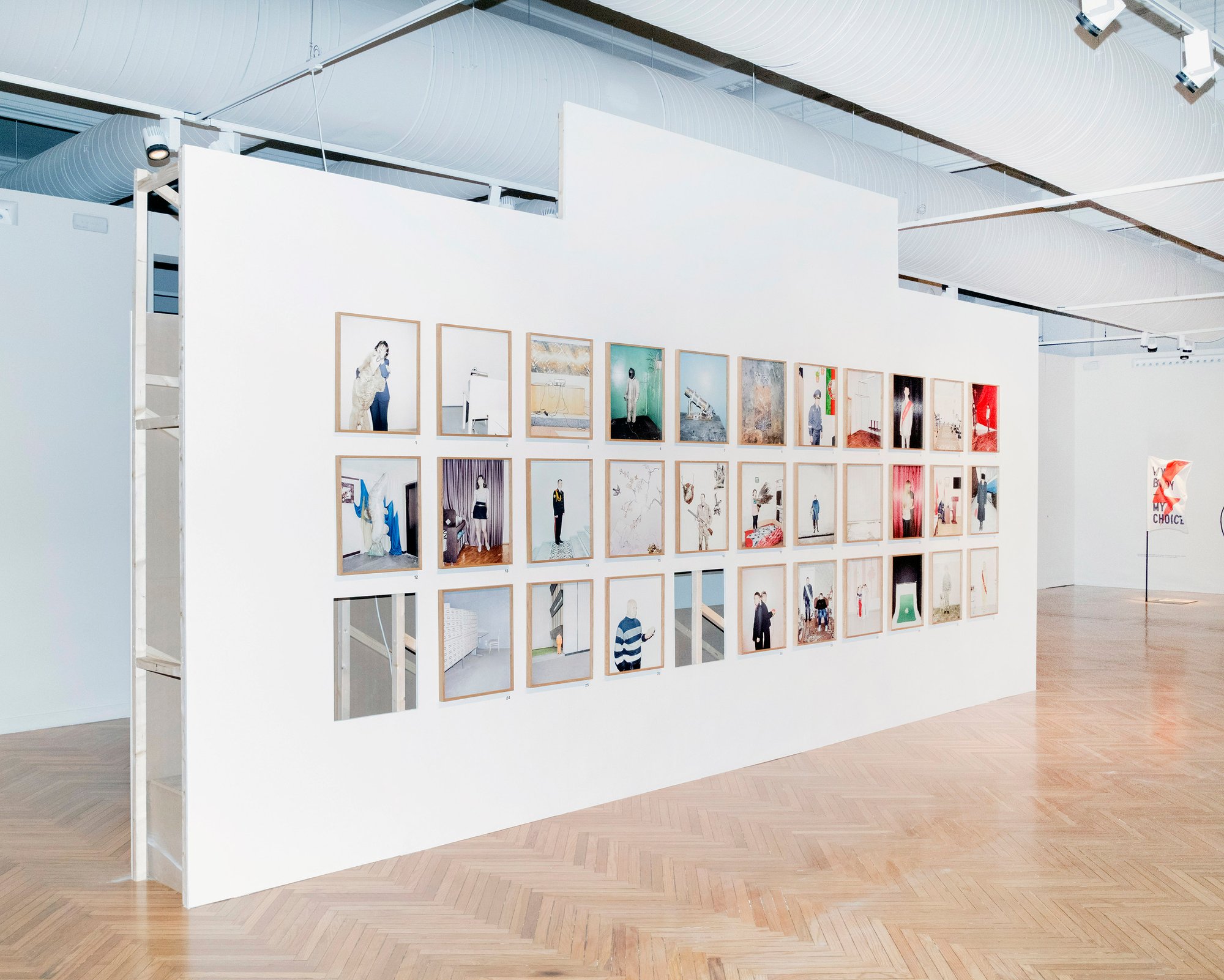
Rafał Milach: Refusal, as I presented it in 2017/18, contained a collection of elements that reflected the affirmation of certain autocratic behaviors as performed in Eastern Europe and post-Soviet states. Thinking back to that set up, there is a junction with what I am now showing in Madrid: The Winners (2010- 2013). The title, Refusal, came from a situation I had with Yuri, a Belarusian ploughman of a collective farm that I wanted to portray in The Winners: a collection of state-organized contest winners, together representing carefully constructed propaganda machinery.
My strategy then was to disguise my real intentions by acting as a ‘propaganda photographer.’ My true purpose was to mirror systemic behaviors that perceive the citizens as instrumental. However, while everything was arranged with his superiors, he simply refused to be photographed. To me, even though this rejection was a small gesture—he was not protesting openly against the system—it was an act of resistance; a fracture in the authoritarian system as I had witnessed it until that moment. This ‘no’ would become a pretext for the whole project.
EV: In Madrid, The Winners gets a central position again, but with two pictures missing this time, which are then presented on the other side of a constructed wall that you created for this exhibition. Can you explain how this introduces the second fracture?
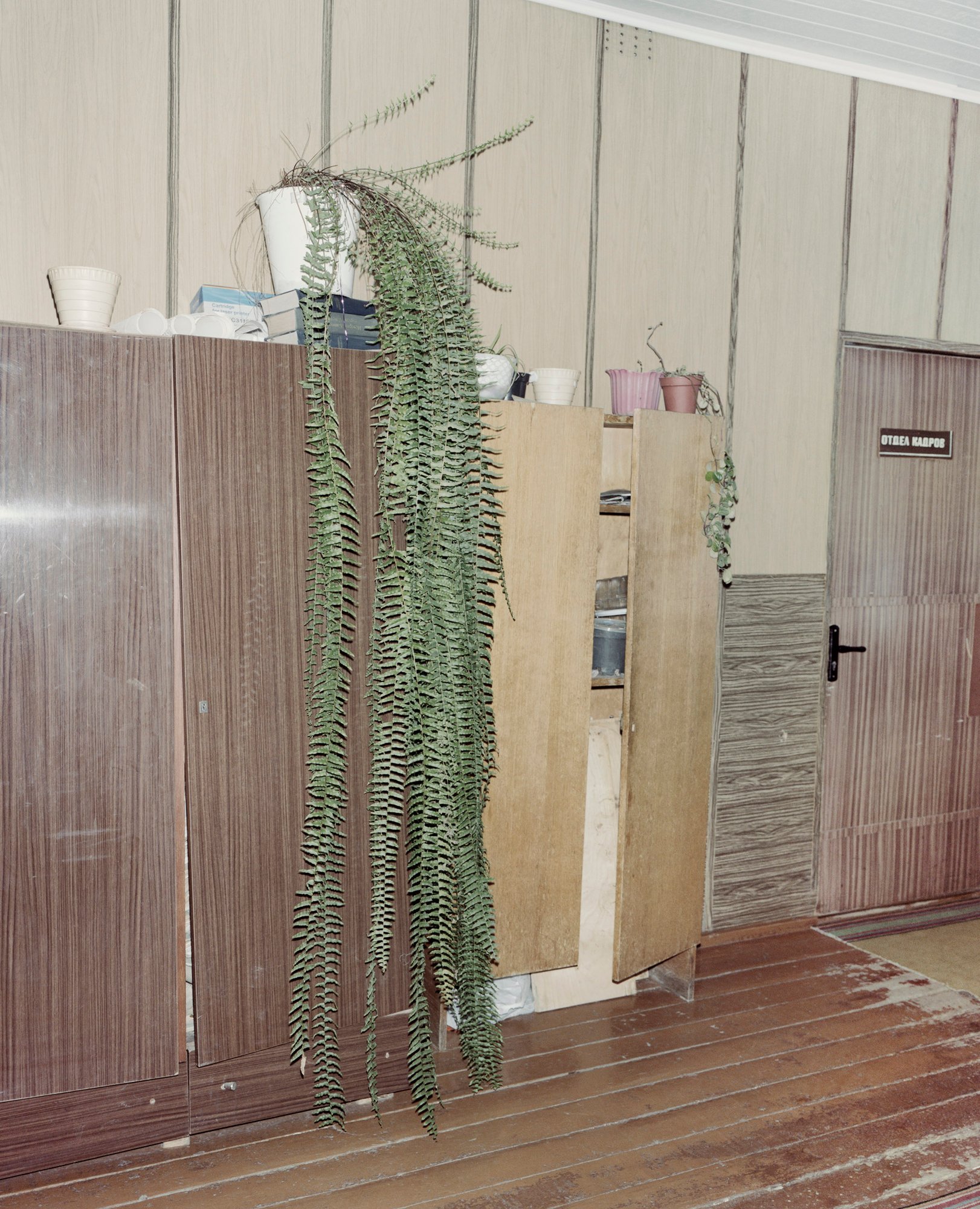
RM: In 2018, one frame in the grid of winners was left empty—a void representing Yuri’s portrait that I never got to make. Then, a few years later, I found out that around 2020-21, Xenia Degelko, who I also photographed for The Winners, had flipped from being a pro-regime activist to an anti-governmental protester. That was remarkable news to me at the time but it is only now, with an open invitation to propose an exhibition concept for PhotoEspaňa—that Xenia’s repositioning came back into my mind.
Eventually, this led to the idea of juxtaposing two major themes that have been seeping through my work for the past 15 years: systemic propaganda and the gestures of protest. In my understanding, two major themes collide: Xenia switching her ideological position encapsulates the notion of a second fracture in a seemingly continuous and hermetic authoritarian regime, while also serving as a departure point to connect it with my personal involvement in grassroots protest movements in Poland.
EV: Speaking of that, can you talk about the contents of the Archive of Public Protest (A-P-P), of which you are a co-initiator?
RM: At its core, the A-P-P is a collective of photographers who aim to create and collect imagery as coming from the various massive street protests that have been organized in Poland since late 2015. We were, until two years ago, ruled by the PiS Party that aggressively defined the political spectrum with their right-wing nationalism and conservatism. Their policies triggered a cycle of street rallies, all with their own specific demands and cries for justice but sharing an overarching concern for violation of democracy and human rights.
Circling back to this exhibition in Madrid, making a connection between the A-P-P and The Winners was honestly never in the orbit of my interest. However, the last year or so—with the PiS Party being outvoted and no longer ruling over Poland from the parliament—allowed for some headspace to reflect on how propaganda and protest, the two main threads in my works, are deeply interwoven. It did not instantly give me a formula for merging these major themes into one presentation but now that this link has been made, it felt inevitable.
EV: So, to sum up: you consider propaganda and protest not only running parallel to each other but actually interrelated?
RM: Yes, exactly, but this realization arrived from an organic process defined by the circumstances. This show here in Madrid is not intended to reflect an overview of all my practices; it is more a first gesture of post-conceptualization. I never intended it to be a sequel to Refusal. But, now that I found a micro connection point in the story of Xenia, I am super inspired. Since the inception of the A-P-P, I have presented elements of the protest archive in so many different venues and have had the opportunity to give talks about our collective all over the world but making such an explicit connection with a project from nearly a decade ago is a new experience.
EV: Looking around, besides your portraits from The Winners, you present mainly non-photographic elements in this exhibition. What do these bring to your photographs?
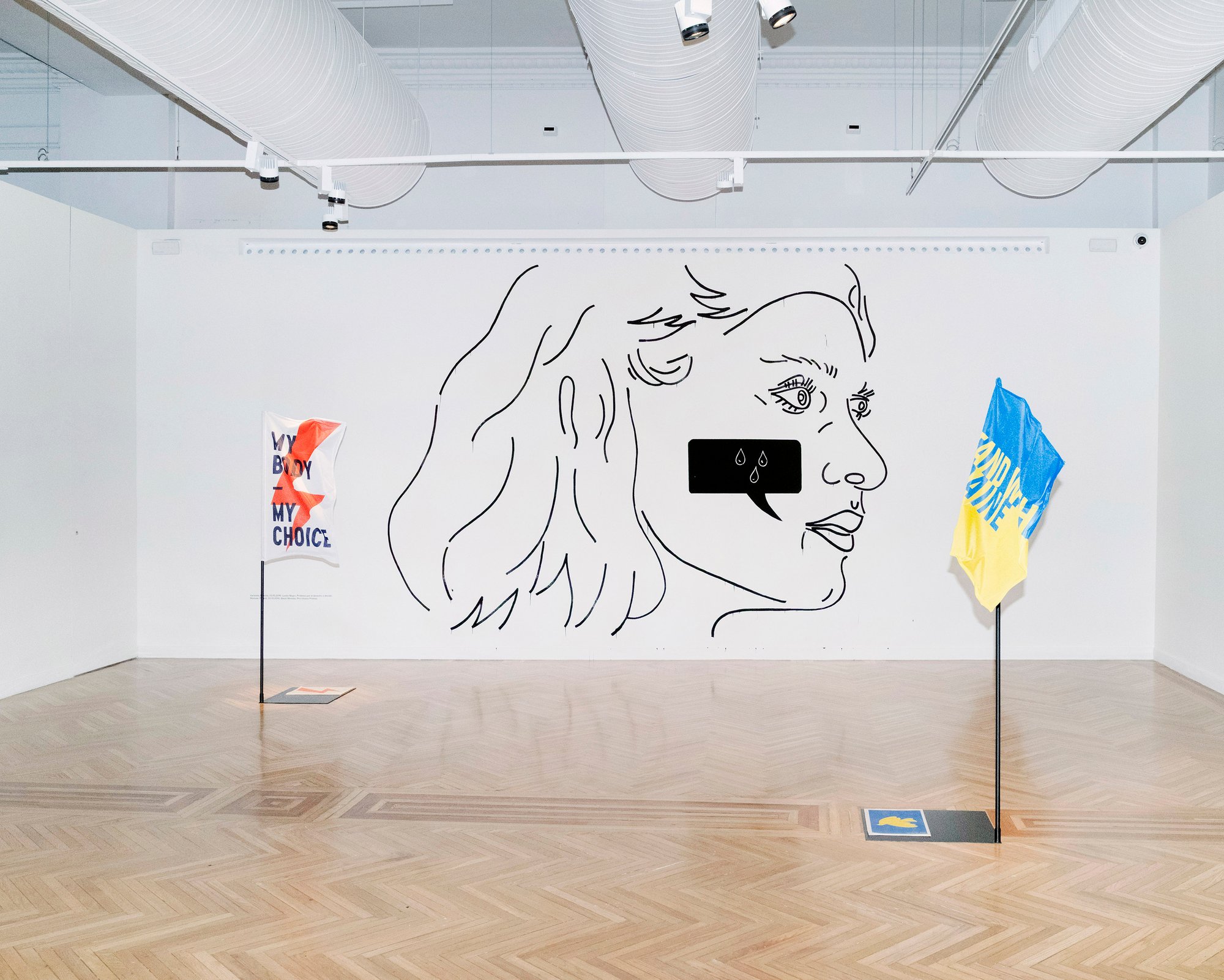
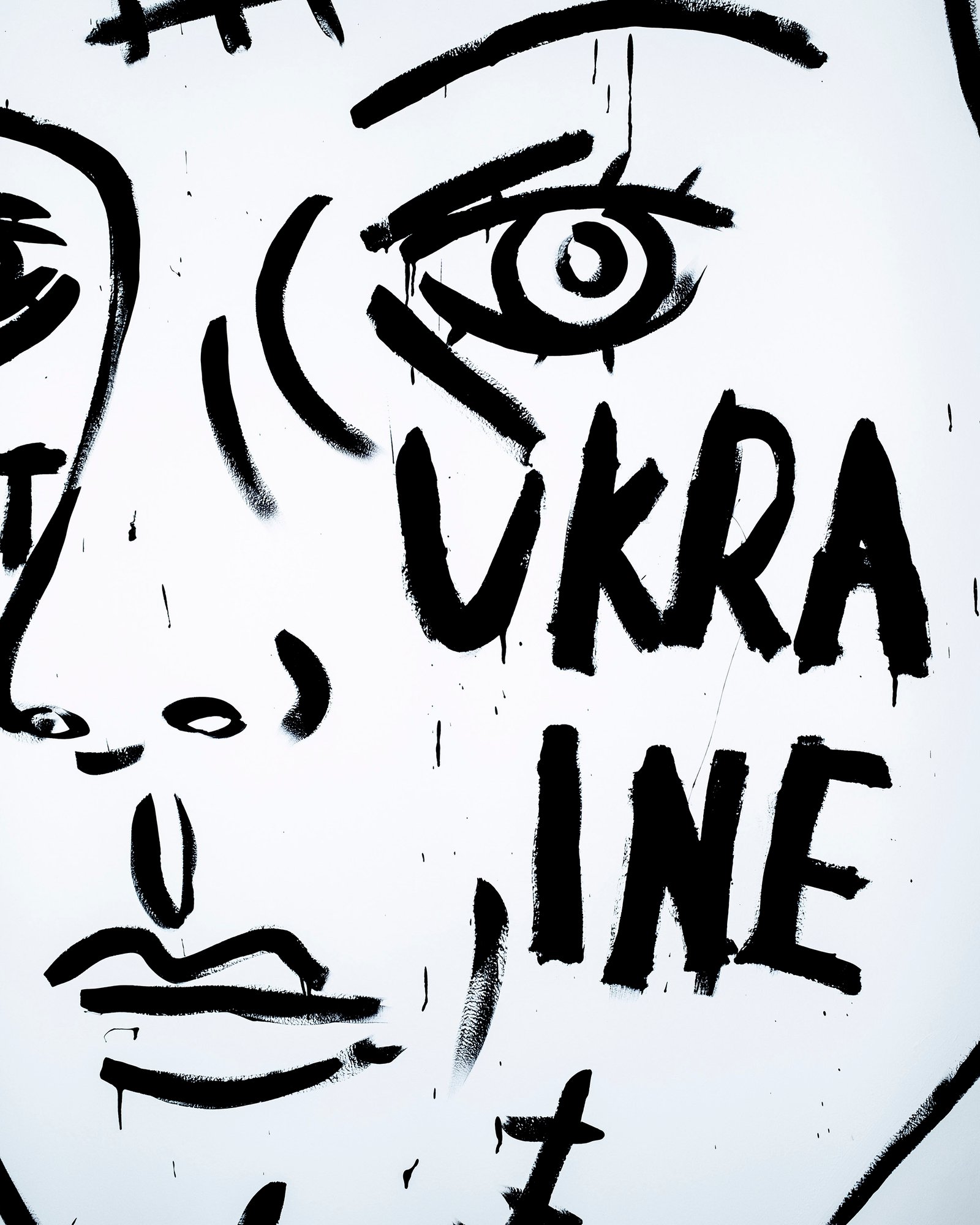
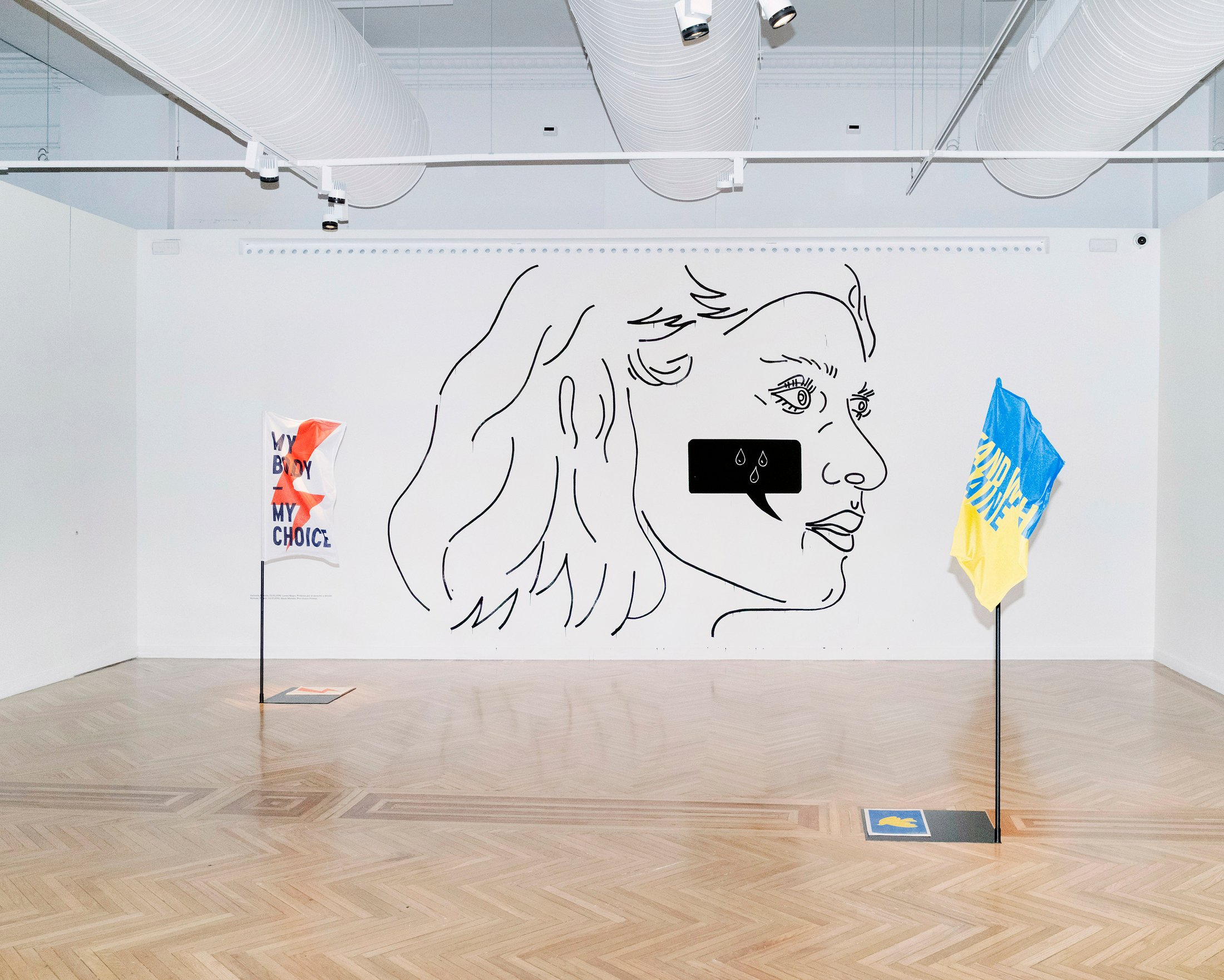
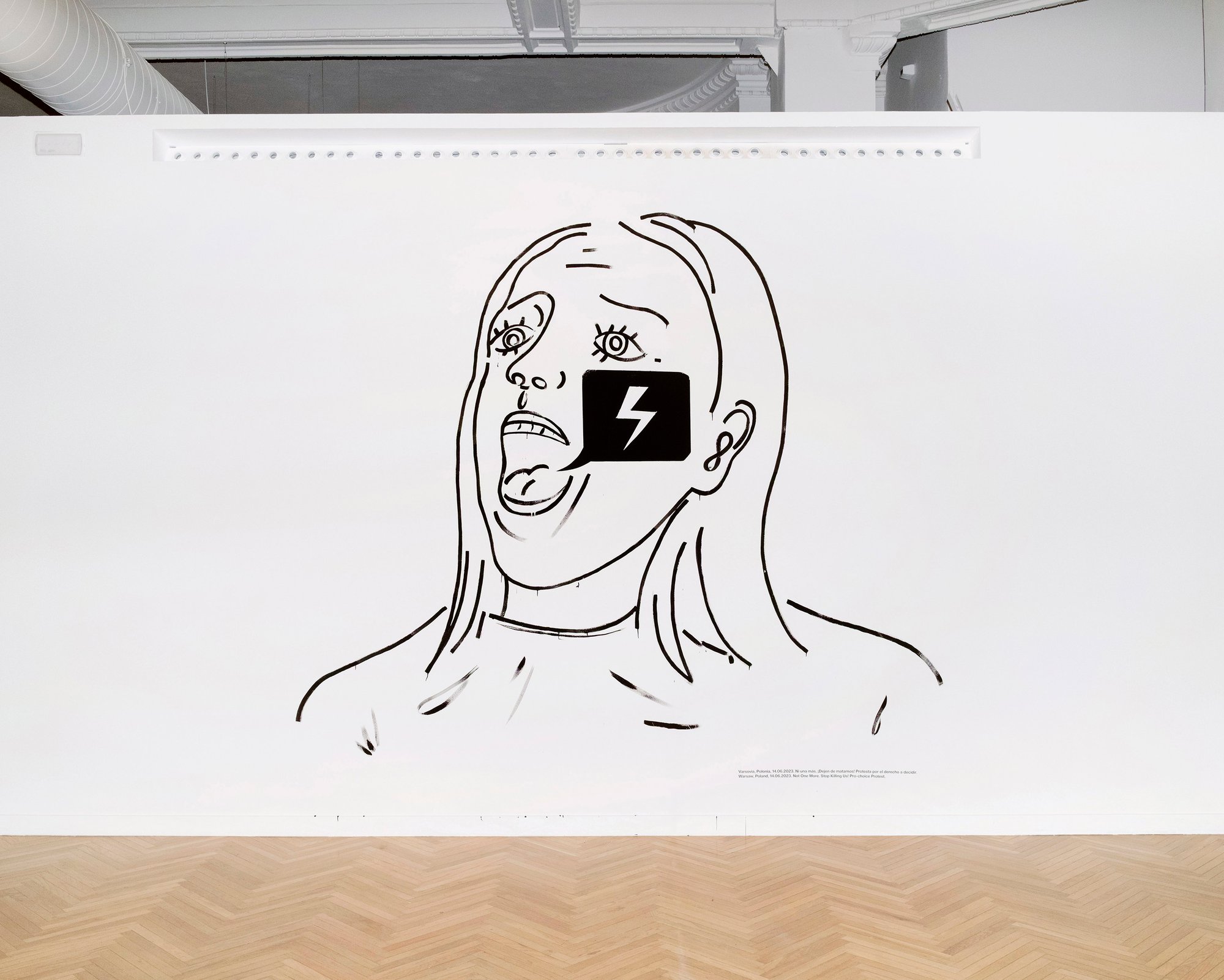
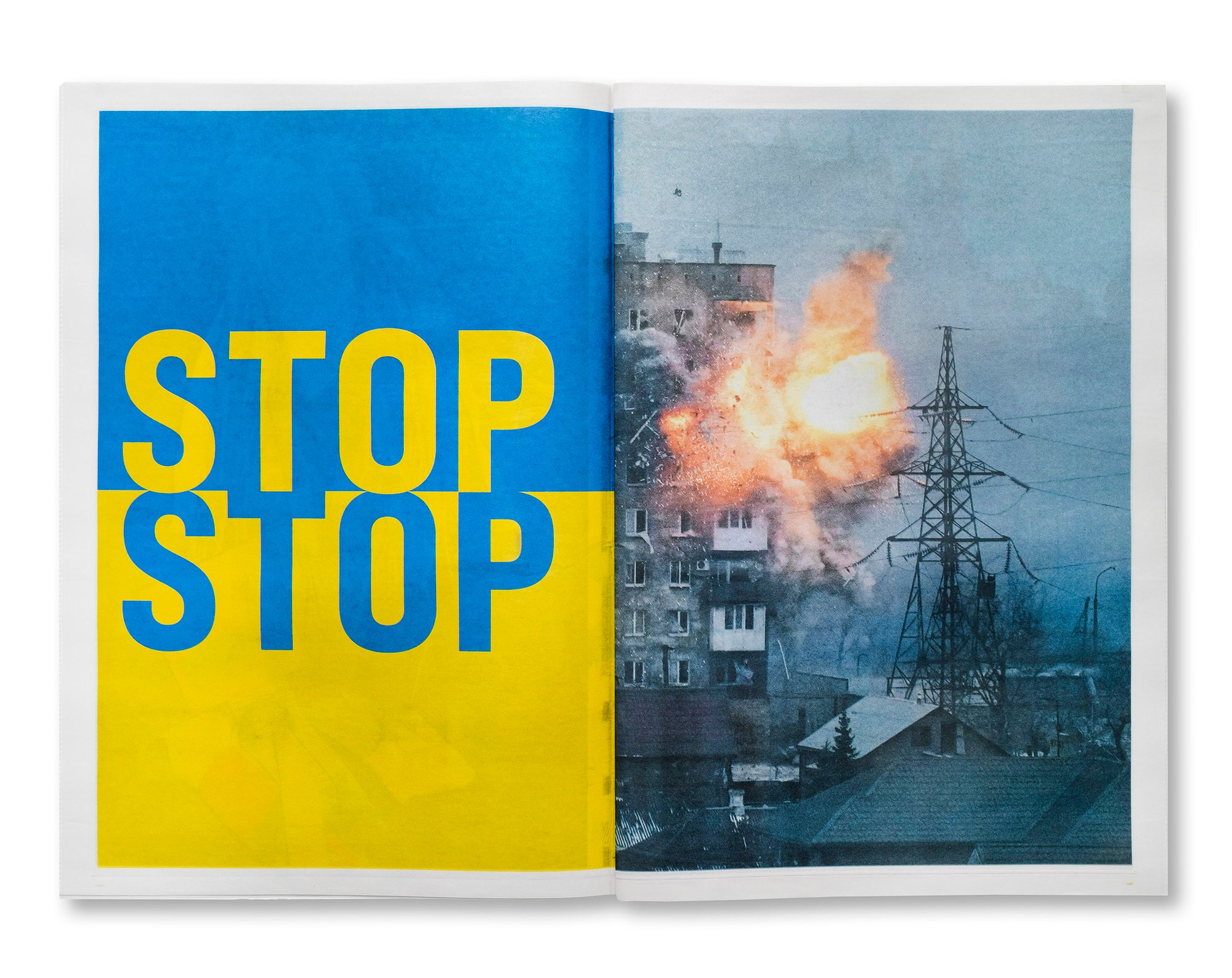
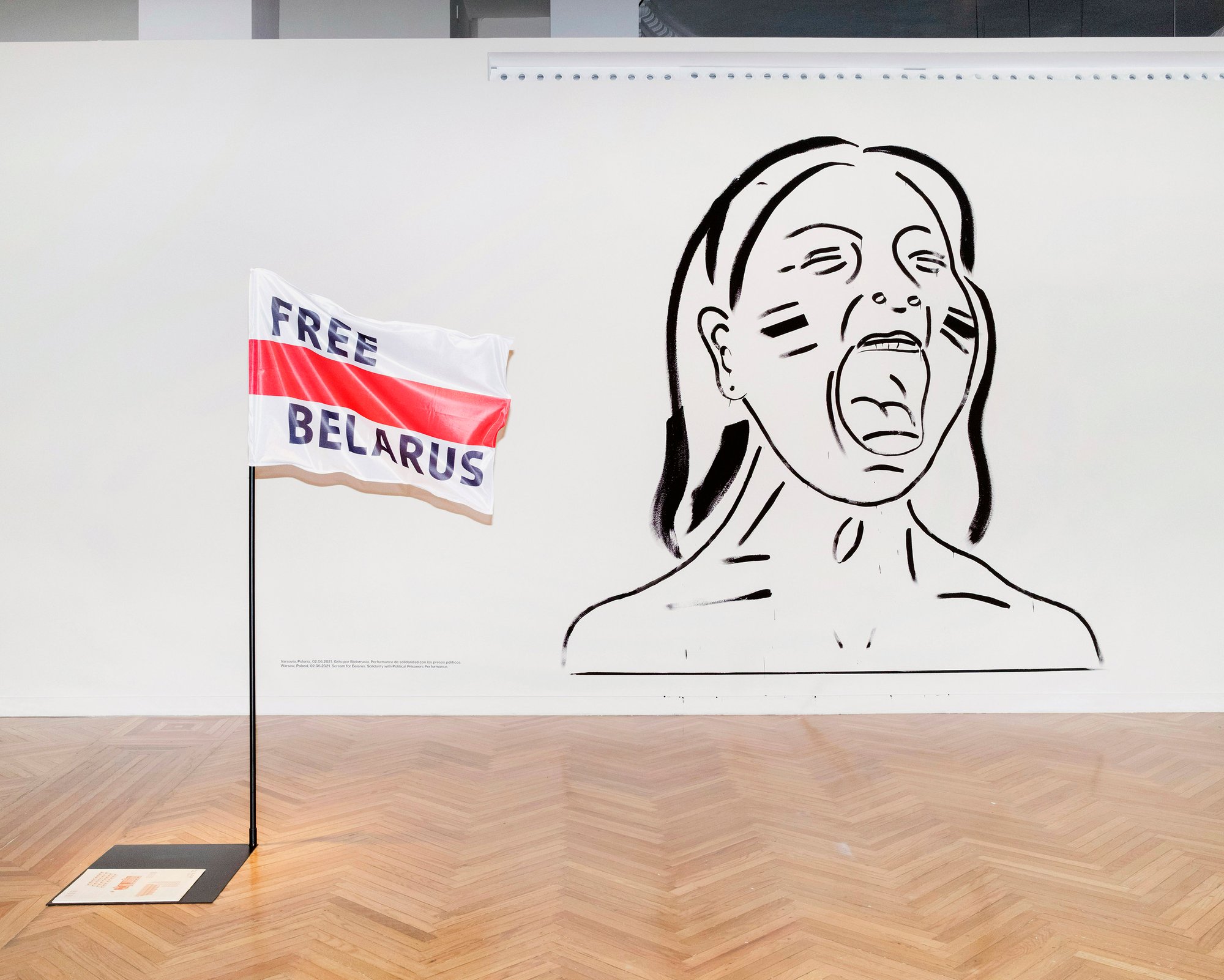
RM: I felt the urge to be simple and communicative, to move away from the more conceptual manner of documentary photography. The core idea here is that Xenia’s story is further echoed in the space around The Winners wall, where I painted murals depicting activists attending protests across Poland and Ukraine—sourced from A-P-P photographic images.
Throughout the exhibition space, I also plant flags related to the pro-choice movement, the humanitarian crisis at the Polish-Belarusian border, the LGBTQ+ community rallies, or the protests led by Ukrainian and Belarusian diasporas. Each flag stand is accompanied by an edition of the A-P-P Strike Newspaper: a series of protest zines that circulated in more than 44,000 copies—featuring slogans, pictures and protesters’ testimonies. So, in that sense, there is quite a lot of photography included in this show, be it secondary perhaps.
Where I am now, with 20 years of experience working on the discourse between visual arts and politics, things are starting to pile up and make some kind of internal loops. Essentially, my works have started to be in dialogue with each other and the situations that initially occurred chronologically and on their own terms are looping back in a more overarching manner.
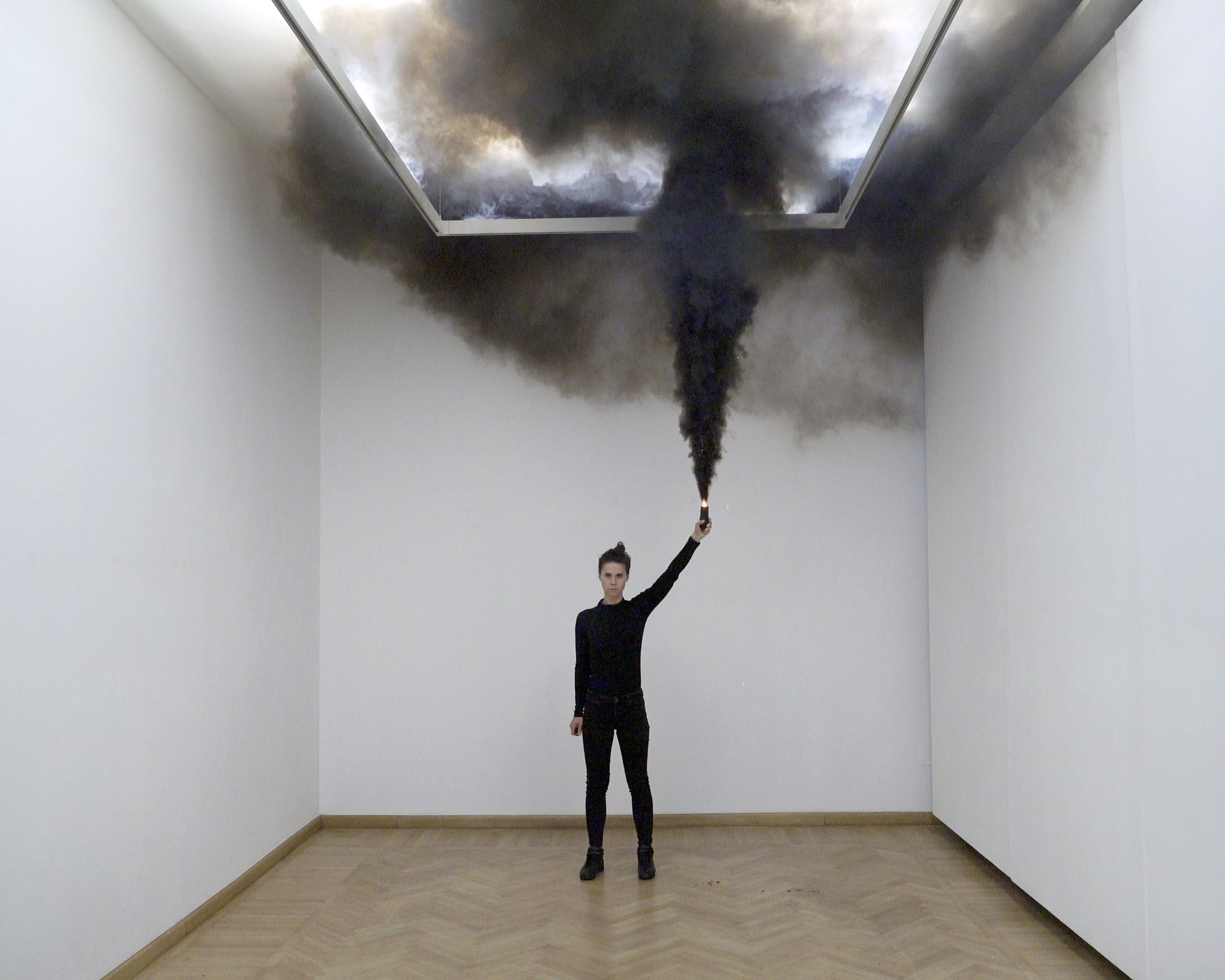
EV: Let’s bring to the fore one specific element of the installation. In collaboration with fellow-artist and activist Karolina Gembara you had a female protagonist set off a black flare in a gallery space, which was then recorded to become Seeding, a video installation which is also presented in Refusal. Second Fracture. How can we understand this performative act? As an appropriation of what is commonly associated with hooliganism?
RM: I like to apply a wide range of discursive strategies to convey certain ideas. I think using certain gestures from the opposite side can help in demanding attention for your own concerns—and this was well-understood by the women protesting against the introduction of a near-total abortion ban in Poland [The ‘Black Protests’ were a series of massive, women-led demonstrations first erupting in October 2016. The movement gets its name from protesters dressing in black to mourn the loss of reproductive freedoms. Their use of black umbrellas was a symbol of resistance while they also set off black flares, the kind as being widely used by football hooligans and ‘ultras’ groups in the color red to create intimidating atmospheres].
So, yes, Seeding somehow counteracts what extreme hooligans do when they amass in Warsaw during far-right street marches—similar to what they often do inside the football stadiums, by igniting these iconic red flares. We wanted to mirror that with a female protagonist lighting up a black flare, in reference to the ‘Black Protests.’ The appropriation of these vibrant aesthetics is what we aimed to reenact in a gallery setting and we were very lucky that Claudia Cussel, back then a curator at Mai Mano Haz in Budapest, agreed to have us film the performance in the gallery there. We actually proposed such a performance to other venues too but unfortunately none agreed to follow up.
EV: The works—as objects and what they address—are very forceful, visually, yet also offer spectators to make interconnections on their own terms. Is it fair to say you’re not keen on being overly explanatory, leaning instead on offering strong elements that viewers can draw from?
RM: Everything you see here in Refusal. Second Fracture, is essentially borrowed from various protest strategies with which I became actively engaged for such a long time. I think it all comes down to a desire to find different access paths to a similar subject. Although it is never literally about myself—it is not autobiographical—all these outlets are also very personal. But I also don’t want to lecture anyone or explain the world. My ultimate goal is to use my privileged position as an artist and give a platform to the existence of women’s or LGBTQ+ rights or the aggression against Ukraine and Palestine, among others. However you take it, this is the world we are living in, and that is what I feel I want to bring across. I want it to resonate with everyone with similar concerns.
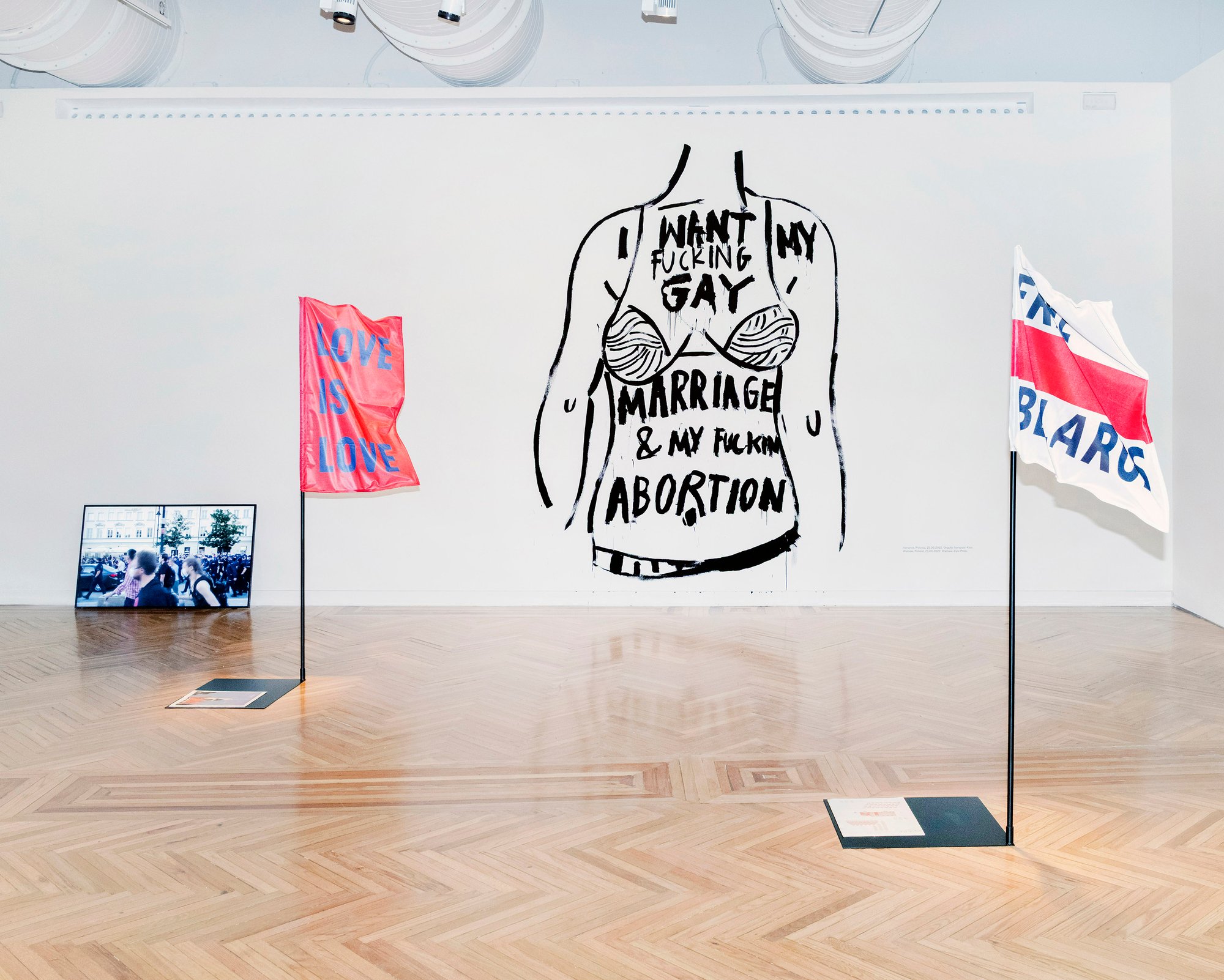
EV: Does showing these murals bring a new dynamic to curating an exhibition?
RM: I’ve actually never exhibited murals on such a scale. With purely photographic presentations, I can prepare my exhibitions in a very detailed way and then it is merely a matter of hanging the works. But when it comes to these large format wall-paintings, I had to set aside a certain amount of time in the days prior to the opening to produce them as large-scale versions of a sketch I made beforehand. So, the process is less controlled than it used to be and that means there is little margin for error. Besides, even though I used to draw before I became a photographer, the mural is not a medium I have become overly familiar with, as I am not really a graffiti artist.
What I have done here in Madrid is both a little bit terrifying and also very exciting as it is a very manual and tactile, or even sensual, process of making. Each mural is also slightly different in the applied technique: the line is different and thus also the gesture varies slightly but you could also say that they developed over time—a photographic depiction made into a drawing, with sampled elements that were in the protests but perhaps not all captured in a single photo, eventually landing here in the exhibition space as a large-scale mural.
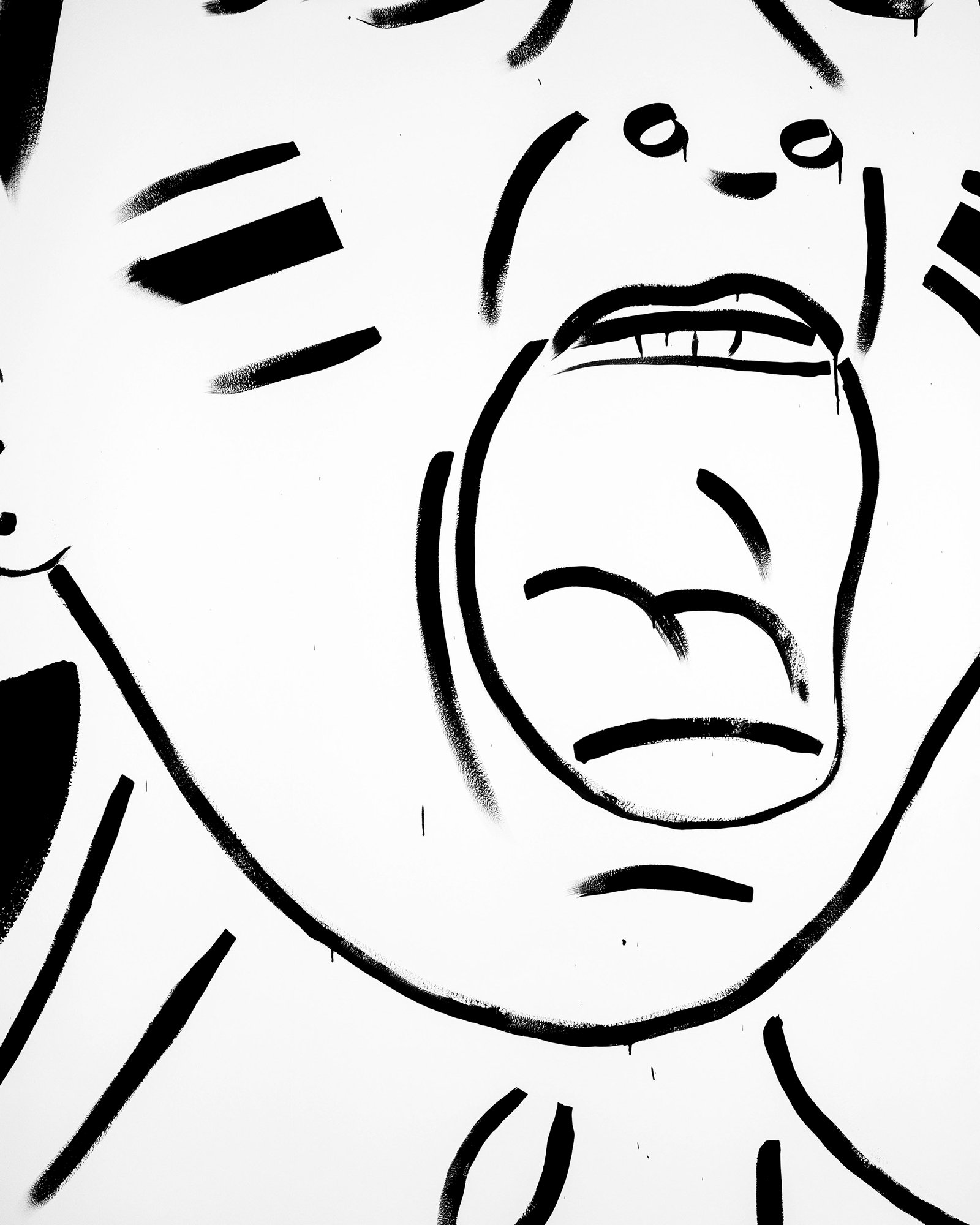
EV: Besides appropriation strategies as already discussed, I also sense a growing urge to visualize processes rather than instant situations. Would you agree?
RM: Yes and no. I still believe in the agency of photography, but I am rather interested in how the various outlets I use, be it the camera or the pencil or whatever is in my toolbox, will help me to articulate the matters close to my heart. Photography is still my main medium of expression, but I’m not married to the form: I am married to the message.
My authorship is chronologically about being formed by the transition from Communism to so-called liberal democracy, then becoming resituated within the European Union and the nationalist-conservative defensive mechanism that bounced off from it. Such landmarks for the region that I grew up in are always overarching within a creative ventilation circuit which means that it allows for reconceptualization—as I attempt to do here, by presenting a work from 15 years ago that turns out to be still valid, on a meta level. It’s how I chose it to be but to always adapt myself to tailor-made outlets per venue instead of being on tour with a traveling set can be exhausting. It requires me to respond with finding a unique curatorial formula each time I exhibit.
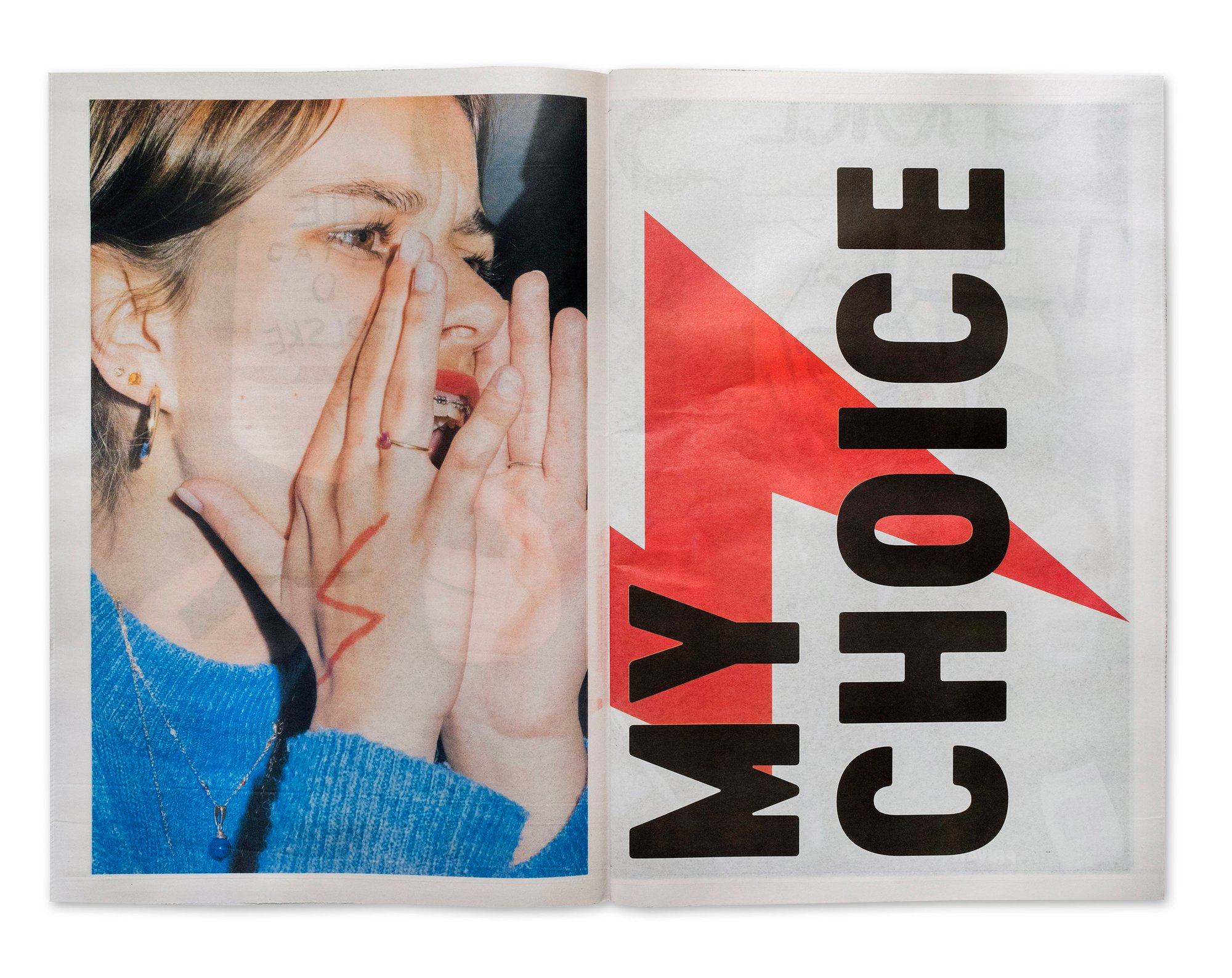
EV: Given that you are both a founding member of the Sputnik Photos collective and the Archive of Public Protest, generally known to be loyal to the people you work with since the start of your career, how important is the collaborative format for you?
RM: It’s fundamental. If I had to do everything alone I likely would not have the stamina for such complex operations such as The Winners, which actually started as becoming a chapter of an overarching Sputnik group project. Of course, the dynamics vary: in the case of the Archive of Public Protest our mission and shared values are very clear from the get-go, while in Sputnik collective initiatives always need to first arrive from creating a common ground, by discussing the matters of concern before we get to work on a project together.
That’s the scheme but let’s also not forget that Sputnik Photos now exists for 20 years and the A-P-P was only founded around six years ago. They arrive from very different socio-political contexts. Even though the situations in which they both came into being are not the same, these kinds of group dynamics really keep me moving and I think it’s been very rewarding too: the like-mindedness, sharing a geopolitical background. Together, we can approach an issue in a more differentiated way, develop a body of work that is more diverse than when acting on it purely by oneself. That we—myself and my peers—manage to do so, beyond any sort of preconceived formats, is priceless for me.
Either way, I see it as a human responsibility to think and act in terms of solidarity. Alterations in civic society never come for an isolated single action; they arrive from building coalitions, from a combined effort of different entities, and from some kind of endurance within the alliance. That altogether will somehow provoke a message and even though I am very well aware that my artistic involvement is just one of many elements that contributes to it all, I will just keep on offering my share to the demanded shifts in our society.
Editor’s note: Refusal. Second Fracture is on view at PHotoESPAÑA in Madrid until 27 September 2026.