
Polaroid Now: The History and Future of Polaroid Photography
by Steve Crist, Oskar Smolokowski, John Reuter
Polaroid Now celebrates new work created by contemporary artists working with Polaroid cameras and film today, and discusses the history, and evolution of the first instant imaging camera system that became a household name.
This curated selection of images is diverse aesthetically and geographically, and embraces the world-wide community of Polaroid artists. The book celebrates the unique, one-of-a-kind, and instantly gratifying qualities of Polaroid imagery. Additionally, Polaroid photographs by renowned luminaries such as Andy Warhol, David Hockney, and Chuck Close are included, as well a section on the 20x24 Polaroid camera by John Reuter, 20 X 24 Director (www.20X24Studio.com), who highlights this "game changer" in our medium plus its 'camera operators'.
Ellen Carey writes/adds for LensCulture:
One of its 'camera operators' is the well-known pioneer of abstraction and minimalism, color partnered with process, in her unique Polaroid and photogram images, experimental lens-based artist and photographer, Ellen Carey from her twin practices as "Photography Degree Zero" (1996-2021) and "Struck by Light" (1988-2021) (www.ellencareyphotography.com).
Her newest series, "Crush & Pull" begins in 2018 (2091,2021) published (pg.60 & 61) as "Crush & Ding" and "Crush & Pull". Both highlights her breakthrough that uses the monumental Polaroid 20 X 24 negative as a conceptual/physical point-of-departure, emphasizing its materiality, its 'light tracings' and light's first face, its 'prima facie'. She underscores all her work from the medium's specific characteristics in: outline, shadow, reflection, seen in the physical photo-object, allowing the picture, in the end result, to "speak back".
Here, Talbot's 19th century paper negative photogram (and later, contact positive print) finds affinities with Polaroid's negative-to-positive instant, one-step, peel away process, founded by that 20th century's "game-changer" in Polaroid's founder, Dr. Edwin Land; one of his inventions, the monumental Polaroid 20 X 24 camera/film (circa 1980s). Both inventions/innovations/processes see the negative-to-positive axis.
This duality is significant as it represents the foundation in our medium of photography and our global picture culture; Carey links these characteristics to other fields -philosophy, literature, music - to name a few, as well as colour/color.
Published on the opposite page (60), is her huge Polaroid "Crush & Pull" (61); it finds Carey's interest in photographic colour theory (RGBYMC). In this artwork, she re-configures this formula of light, across the triptych, partnering its additives with its opposite in the primary subtractives: RC, GM, BY; her off-white "flares" of blended hues, center the middle, connecting the "frames" with irregular topographies while the 'craquelure' - French for cracking - throughout records an different 'after image' in the artist's hand. Here the huge light-sensitive Polaroid negative - crush - in total darkness, touching an emulsion's surface a professional no-no and taboo; Ellen Carey intentional breaks with historical and traditional "picture signs" for "light drawing" anew.
This offers an abstract and minimal "picture sign" that only uses light and all its variations, while her images reference multiple fields, often the history of color photography, starting with Talbot's contemporary, the Victorian, Anna Atkins and her blue cyanotypes, up to Polaroid Now, seen in this book; Edwin Land's contribution to color and photography, instant technology and art is well-known.
This adds context and content to Ellen Carey's work, while the super-crisp picture detail, no-grain contact print of Polaroid parallels that of France's Daguerre, another "game-changer". Light, photography's indexical, is seen throughout all their work, all of their work is one-of-a-kind and unique, all use light-sensitive materials and processes.
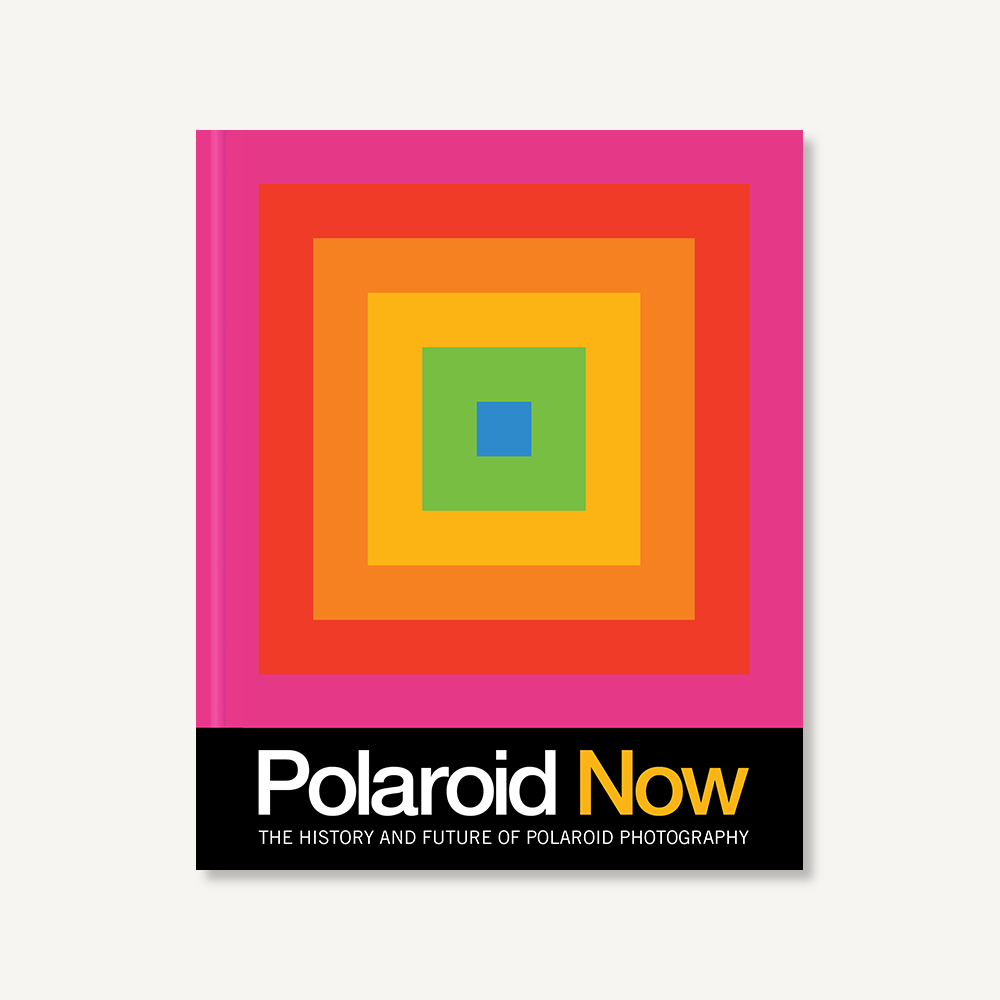
The cover of the book features a design that is reminiscent of the vintage Polaroid Colorpack Film boxes.
The book features over 200 photographic images that explore the inherent beauty and possibilities of Polaroid film, as created by Polaroid artists from around the world. An index features popular Polaroid cameras that are still available and used today.
This officially licensed partnership with this world-renowned brand is the most comprehensive book published on Polaroid, and includes an essay by Polaroid’s CEO Oskar Smolokowski.
This curated selection of images is diverse aesthetically and geographically, and embraces the world-wide community of Polaroid artists. The book celebrates the unique, one-of-a-kind, and instantly gratifying qualities of Polaroid imagery. Additionally, Polaroid photographs by renowned luminaries such as Andy Warhol, David Hockney, and Chuck Close are included, as well a section on the 20x24 Polaroid camera by John Reuter, 20 X 24 Director (www.20X24Studio.com), who highlights this "game changer" in our medium plus its 'camera operators'.
Ellen Carey writes/adds for LensCulture:
One of its 'camera operators' is the well-known pioneer of abstraction and minimalism, color partnered with process, in her unique Polaroid and photogram images, experimental lens-based artist and photographer, Ellen Carey from her twin practices as "Photography Degree Zero" (1996-2021) and "Struck by Light" (1988-2021) (www.ellencareyphotography.com).
Her newest series, "Crush & Pull" begins in 2018 (2091,2021) published (pg.60 & 61) as "Crush & Ding" and "Crush & Pull". Both highlights her breakthrough that uses the monumental Polaroid 20 X 24 negative as a conceptual/physical point-of-departure, emphasizing its materiality, its 'light tracings' and light's first face, its 'prima facie'. She underscores all her work from the medium's specific characteristics in: outline, shadow, reflection, seen in the physical photo-object, allowing the picture, in the end result, to "speak back".
Here, Talbot's 19th century paper negative photogram (and later, contact positive print) finds affinities with Polaroid's negative-to-positive instant, one-step, peel away process, founded by that 20th century's "game-changer" in Polaroid's founder, Dr. Edwin Land; one of his inventions, the monumental Polaroid 20 X 24 camera/film (circa 1980s). Both inventions/innovations/processes see the negative-to-positive axis.
This duality is significant as it represents the foundation in our medium of photography and our global picture culture; Carey links these characteristics to other fields -philosophy, literature, music - to name a few, as well as colour/color.
Published on the opposite page (60), is her huge Polaroid "Crush & Pull" (61); it finds Carey's interest in photographic colour theory (RGBYMC). In this artwork, she re-configures this formula of light, across the triptych, partnering its additives with its opposite in the primary subtractives: RC, GM, BY; her off-white "flares" of blended hues, center the middle, connecting the "frames" with irregular topographies while the 'craquelure' - French for cracking - throughout records an different 'after image' in the artist's hand. Here the huge light-sensitive Polaroid negative - crush - in total darkness, touching an emulsion's surface a professional no-no and taboo; Ellen Carey intentional breaks with historical and traditional "picture signs" for "light drawing" anew.
This offers an abstract and minimal "picture sign" that only uses light and all its variations, while her images reference multiple fields, often the history of color photography, starting with Talbot's contemporary, the Victorian, Anna Atkins and her blue cyanotypes, up to Polaroid Now, seen in this book; Edwin Land's contribution to color and photography, instant technology and art is well-known.
This adds context and content to Ellen Carey's work, while the super-crisp picture detail, no-grain contact print of Polaroid parallels that of France's Daguerre, another "game-changer". Light, photography's indexical, is seen throughout all their work, all of their work is one-of-a-kind and unique, all use light-sensitive materials and processes.
The cover of the book features a design that is reminiscent of the vintage Polaroid Colorpack Film boxes.
The book features over 200 photographic images that explore the inherent beauty and possibilities of Polaroid film, as created by Polaroid artists from around the world. An index features popular Polaroid cameras that are still available and used today.
This officially licensed partnership with this world-renowned brand is the most comprehensive book published on Polaroid, and includes an essay by Polaroid’s CEO Oskar Smolokowski.
Book Information
ISBN:
9781797201375
Publisher:
Chronicle Books