
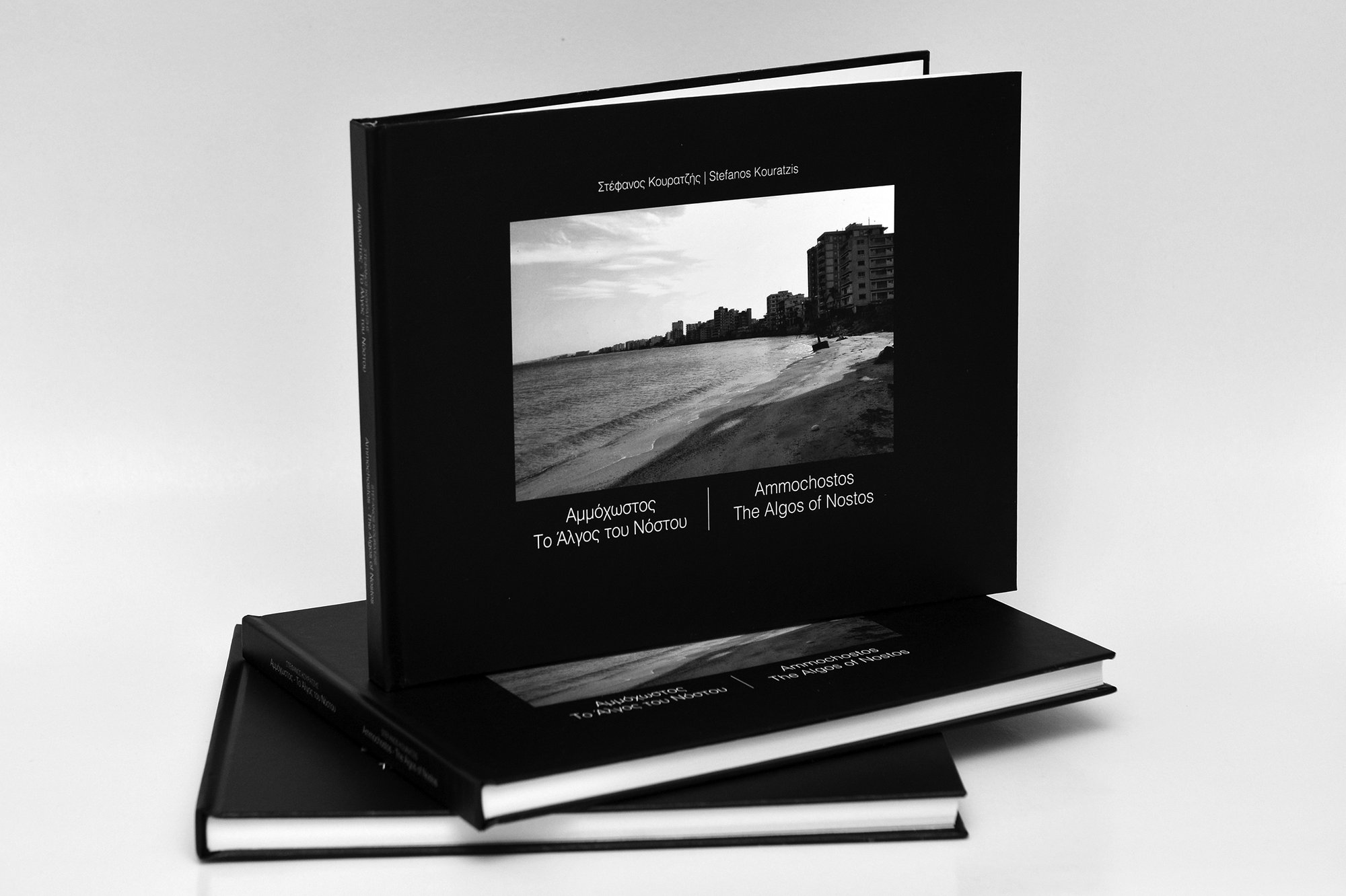
Ammochostos – The Algos of Nostos" (2024)
by Stefanos Kouratzis
Αμμόχωστος - Το Άλγος του Νόστου | Ammochostos – The Algos of Nostos
No one enters Varosha innocently.
To look is already to become witness to a violation that continues.
Αμμόχωστος - Το Άλγος του Νόστου | Ammochostos – The Algos of Nostos is a photobook-monograph by Stefanos Kouratzis, the result of a four-year photographic engagement with the accessible part of the enclosed city of Famagusta, Varosha, in Cyprus, following its illegal partial opening by the Turkish occupying forces in October 2020.
Varosha was not abandoned. It was stopped. Mid-sentence. Mid-life. In 1974.
Fifty years after the Turkish invasion and occupation, the city remains trapped in an unresolved present. Streets, hotels, houses, schools, churches, signs and fragments of everyday life still stand inside a landscape where time appears suspended, but history has not disappeared.
The photobook unfolds across 180 pages and 104 black-and-white photographs. It is structured as a visual journey through the enclosed city, where each image can stand on its own while also leading to the next, forming a continuous narrative of memory, absence and evidence.
The photographs are stripped of colour not as a stylistic gesture, but as a necessity. Colour would distract. Black and white allows the forms, surfaces, volumes and wounds of the city to speak more directly. This is not a walk through ruins.
It is a return through memory.
Each visit to the city was carefully planned in order to hold the present-day image of Varosha in dialogue with its past. What first appears silent or empty is not empty at all. The city's history, topography and details remain present, inscribed into walls, roads, objects and absences.
In the introduction to the book, Stefanos Kouratzis writes that the occupation regime, in October 2020, opened part of the fenced city of Famagusta,
converting the deserted city usurped from its lawful Greek inhabitants into a grotesque thematic park under the misleading guise of a tourist destination. He also writes that, unknowingly and unwillingly, each one of us becomes a witness to continuing violence in a post-conflict era.
Through this photobook, Famagusta appears not only as a Cypriot wound, but as a universal image of loss, displacement, memory and historical rupture. The city resists oblivion. Its images become witnesses.
Not nostalgia as decoration. Not ruins as beauty. But absence as evidence.
Book details
Edition of 500 copies — sold out. Limited edition prints available. Contact for inquiries. Bilingual hardcover edition, Greek and English 180 pages 104 black-and-white photographs Size: 30 × 23 cm, landscape format Printed on Art Matt 150 gsm paper.
No one enters Varosha innocently.
To look is already to become witness to a violation that continues.
Αμμόχωστος - Το Άλγος του Νόστου | Ammochostos – The Algos of Nostos is a photobook-monograph by Stefanos Kouratzis, the result of a four-year photographic engagement with the accessible part of the enclosed city of Famagusta, Varosha, in Cyprus, following its illegal partial opening by the Turkish occupying forces in October 2020.
Varosha was not abandoned. It was stopped. Mid-sentence. Mid-life. In 1974.
Fifty years after the Turkish invasion and occupation, the city remains trapped in an unresolved present. Streets, hotels, houses, schools, churches, signs and fragments of everyday life still stand inside a landscape where time appears suspended, but history has not disappeared.
The photobook unfolds across 180 pages and 104 black-and-white photographs. It is structured as a visual journey through the enclosed city, where each image can stand on its own while also leading to the next, forming a continuous narrative of memory, absence and evidence.
The photographs are stripped of colour not as a stylistic gesture, but as a necessity. Colour would distract. Black and white allows the forms, surfaces, volumes and wounds of the city to speak more directly. This is not a walk through ruins.
It is a return through memory.
Each visit to the city was carefully planned in order to hold the present-day image of Varosha in dialogue with its past. What first appears silent or empty is not empty at all. The city's history, topography and details remain present, inscribed into walls, roads, objects and absences.
In the introduction to the book, Stefanos Kouratzis writes that the occupation regime, in October 2020, opened part of the fenced city of Famagusta,
converting the deserted city usurped from its lawful Greek inhabitants into a grotesque thematic park under the misleading guise of a tourist destination. He also writes that, unknowingly and unwillingly, each one of us becomes a witness to continuing violence in a post-conflict era.
Through this photobook, Famagusta appears not only as a Cypriot wound, but as a universal image of loss, displacement, memory and historical rupture. The city resists oblivion. Its images become witnesses.
Not nostalgia as decoration. Not ruins as beauty. But absence as evidence.
Book details
Edition of 500 copies — sold out. Limited edition prints available. Contact for inquiries. Bilingual hardcover edition, Greek and English 180 pages 104 black-and-white photographs Size: 30 × 23 cm, landscape format Printed on Art Matt 150 gsm paper.
Book Information
ISBN:
978-9925-632-16-9
Publisher:
Stefanos Kouratzis