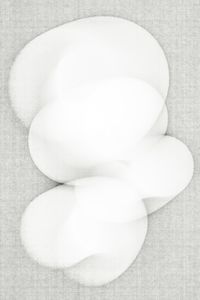
A drawing is created consisting of geometric shapes – in this case circles – with contemporary software. This drawing is then photographed directly from the screen.The single-shot recording of this drawing is for a large part determined by the movement of the camera and the possibilities of a zoom lens.
It’s the exploitation of the sensor’s artifacts that creates the specific structure, colors and their transitions of the photographic work. As with the series 'big nothing', which were photographed by very little light. The sensor translated ’nothing' – that which can not be made permanent – into a grid like structure.
The issue of what, if anything, is represented in an image is alluded in the title of my series 'big nothing' (2013-2019), implying that we might be looking into the void. How can a photograph of nothing exist? Literally of course, it can’t. We are seeing, even in 'big nothing', visual phenomena recorded photographically and perceived optically, even though what we see might not seem to relate to the ‘real’ world around us. Another aspect of abstraction comes into play here, the relationship of form and formlessness. The 'big nothing' series explores the boundaries of form and our capacity to perceive its existence against a background of formlessness. The amorphous shapes in these images exist at the threshold of emergence and disappearance. In terms of the digital construction of the images, intriguingly, the shape itself contains less data than the space surrounding it.