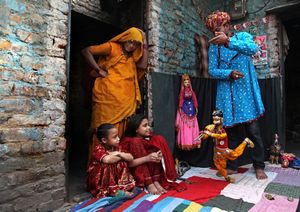
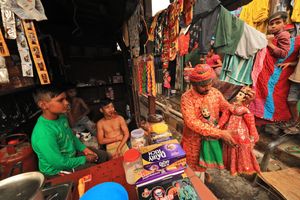
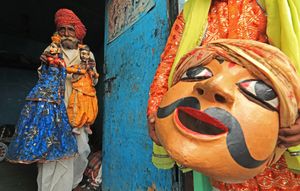
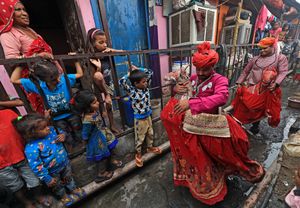
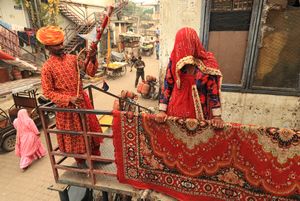
Here is yet another story of politics of development that came out tooth and nail with its brazen face, and threatened the life and occupation of about 2000 families living in a tinsel town in the heart of the city of New Delhi. Once again the politics of development worked without harnessing transparency and citizen engagement in a manner that hardly took care of the sustainable urban growth. The area which is popularly known as Kathputli colony lies in the up-market neighbourhood of the Naraina Industrial Area. For abut fifty years the colony has been serving a phantasmagoric charm to the city dwellers in all kinds of fairs and festivals. The magical art of stringed puppetry, juggling, rope walking, dancing horses and many other art forms have lured the audience on the street side as well in the gala dinners organised in the honour of foreign state officials.
The colony started in the 1950s, as a cluster of makeshift tents in an open field on the outskirts of Delhi, set up by itinerant puppeteers from Rajasthan, which gave the colony its name. In the coming decades street performers of Andhra Pradesh and Maharashtra also moved in. it used to be home to some 2,800 families of magicians, snake charmers, acrobats, singers, dancers, actors, traditional healers and musicians and especially puppeteers from Rajasthan. This makes it world’s largest community of street performers.
It was in 2009 the Government planned to develop residential and commercial complex in this area with the help of a private developer that promised the rehabilitation of these families. However, the residents felt that the development drive would cause damage to their age-old profession as they would be shifted to far-off places with little or no scope of job. In October, 2007 four hundred houses in the colony were bulldozed after several eviction notices though many of the residents of the colony refuse to agree so . The Delhi High Court (HC) had pointed out that the demolition drive at the Kathputli Colony had caused an irreparable loss to the families, who were displaced and moved to transit camps in Anand Parvat.
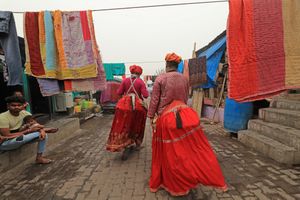
Now, many such artists have shifted to other professions and some are trying hard to keep their art alive. A visit to the transit camp will invariably produce a horror – women cooking on the streetside, daily necessities dumped outside the houses, children criss-crossing over the open sewage oozing out filth at several places or an old snake charmer counting his days sitting idle in front of his shanty.
In my numerous visits to this neighbourhood I have captured a true life story of these people – their daily life stories and their tinsel trivia. The last visit was in November last year in which I took plentiful images of the present location where they have been accommodated in transit camps. This body of work is a part of my ongoing project that will narrate a unversal tale of folk art breathing its last in the jaws of urbanity and consumerism.