Donald John MacLean
John McDougall
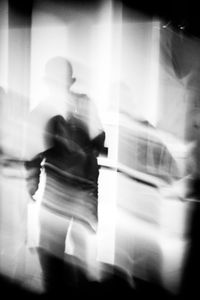
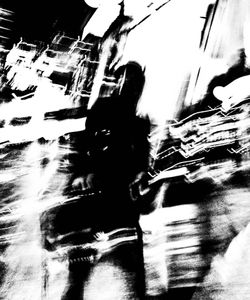
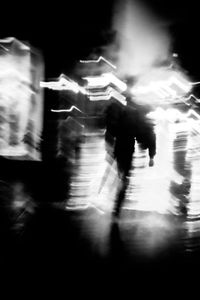
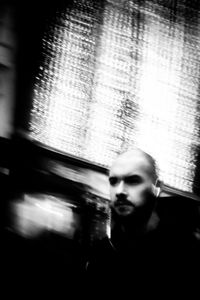
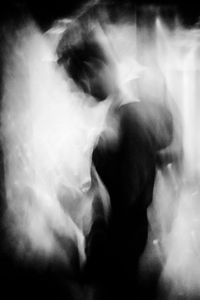
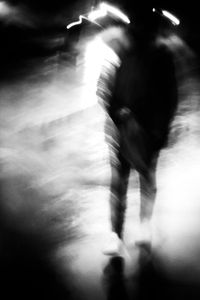
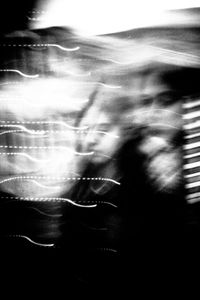
Donald John MacLean isn’t interested in holding your hand and gently persuading you that everything is going to be ok. Subtle isn’t usually the first thing that comes to mind when viewing his work, often presented as a near impenetrable wall of faces, each fighting to avoid your attention, pleading with you to avert your gaze. A barrier which is blurred, grainy and drained of colour, each face melting into the other as it attempts to remain anonymous. Overwhelming by design, Maclean’s imagery compels the viewer towards the impossible task of taking it all in at once.
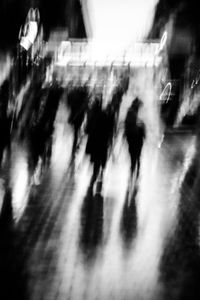
There is a definite rush on first viewing of Donald’s work, one derived from his ability to bring the busy anonymity of the city into the relatively peaceful gallery space. There is a level of showmanship in MacLean’s presentation methods which illustrate those subtleties which are initially missed. The photographer is in control here at all times. It is the audience which, momentarily at least, is not.
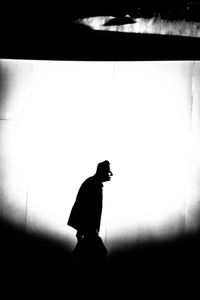
Once the viewer is able to step back and focus on the individual images it becomes clear that MacLean’s message is one of loneliness within the crowded landscape, with hoods, scarves and earphones all symbolic of the barriers we place between ourselves and those around us. His photographs capture those people who share the streets with us, but never enter into our internal narrative. They remain shadowy outlines, barely distinguishable from one another, yet in photographing them Donald has allowed us to stop for a moment and take it all in. He allows us to realise how little we interact with our fellow citizens. Donald’s vision of the city is one which highlights a lack of humanity, but allows the viewer a place to reflect upon that and perhaps find ways to address the issues on a personal level.
Donald’s latest series, Sold (Post Brexit Blues) remains within this stark, almost dystopian style, his approach to individual isolation a fitting commentary on what he views as a nationalistic retreat into ourselves. The awkwardly framed and somewhat disorienting faces represent the sense of uncertainty and distrust which is currently noticeable in society as a whole. It is unimportant which part of the political spectrum that distrust is rooted in, simply that it creates a situation in which people are more afraid of social interaction than ever before.
These images are perhaps even harsher than what has come before: his subjects seem further removed from our idealistic notions of the city. They seem individually more eager to disengage from the view of Donald’s beat-up Russian camera, making the resulting images further illustrative of his wish for us to understand that feeling within ourselves and fight against it. Donald is pleading with us to notice those we share the city with, asking us to take a little more time to rediscover our humanity and to recognise it in others also. In a climate where so called socially-engaged arts often fall into the trap of becoming soft box ticking exercises which present an illusion of social cohesion, Donald John MacLean is asking his audiences to stop and think about the power they hold in effecting real change, through recognising their own retreat from view.