AfrIca, Space ans People
When I traveled to Namibia for the first time, a quotation from Ryszard Kapuściński came to my mind. He once wrote that in a sense we are all provincials —provincials of space and time. “Every globe, every map of the world, shows the former how lost and blind they are in their provincialism; similarly, every history demonstrates to the latter that the present always existed, that history is merely an uninterrupted progression of presents, that what are old events for us, were immediate and present reality for those who lived them out” (Travels with Herodotus). Every subsequent voyage to Africa was not only an expedition to the far end of the Globe for me, but also a journey into time and history. I arrived as a newcomer from our “Western Heartland” to that “Black Province.” However, the longer I was there the clearer I saw how the content of our tranquil and comfortable every-day reality was becoming peripheral when confronted with the essential questions about life raised by the austere existence of bushmen, in harmony with the rhythm and inevitability of nature. I will never forget the placid smile of a disabled woman from Epupa Falls, whose only help while walking were two wooden blocks. I won't forget the angelic singing and hypnotic drums at shamanic rituals, during which the visible world became merely a fragment of a bigger invisible whole. I won't forget the unpretentious acceptance of such austere conditions of survival —as when I took part in a patient hunt for a porcupine.
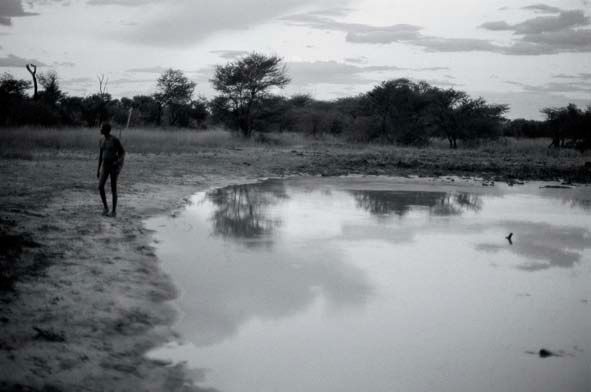
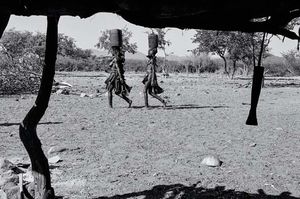
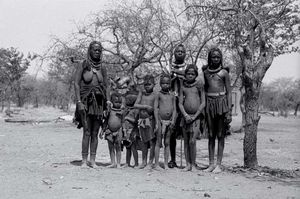
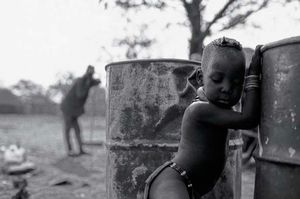
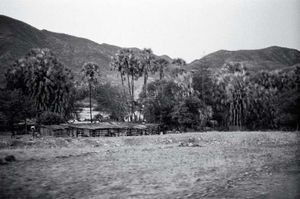
Those journeys also became an artistic challenge for me. The Namibian landscapes, full of light, a spectacle of color, with the wind full of herb fragrance were almost crying out to be immortalized. I decided, however, on black and white plate —not only because of its aesthetic correspondence with the austerity of the bushmen’s life but also because this form allows to enhance the particular, focusing on the details of the life of these people, who are no longer only provincial points on the colorful palette of the landscape, but become the main outline, the center of gravity of my photographs. This reflects my experience: I couldn't take pictures as a tourist —to gain the trust of the hosts of that world I had to live among them, even weeks on end, surrendering to their customs and rhythm. This way their present became a part of my story, a story I wish to share with you now.
The photographs published in the album were taken in the years 2007-2012 during my stay among the Namibian tribes of Owambos, Ovaherero,Kavangos,Bushmen,Namas,Damaras, Rehoboth Basters, Whites and Caprivians: Mbukushu, Tortela, Subia, Yeji.