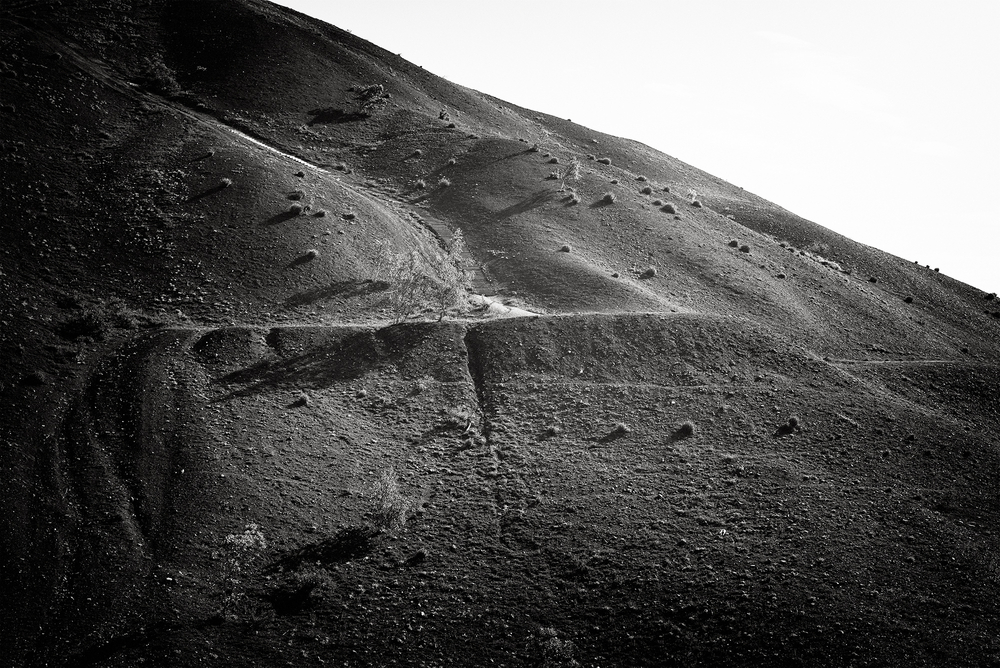
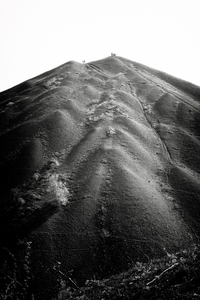
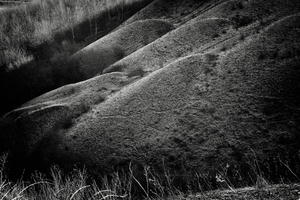
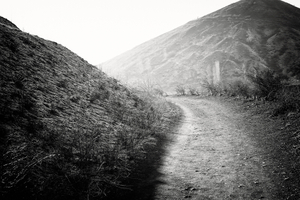
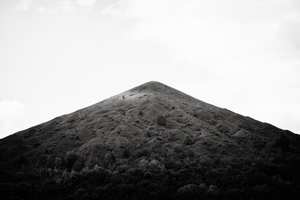
Once symbols of mining and industrial revolution, slag heaps, those black mountains grown from the depths, are revealing today a totally different face.
The face of an essential element of french heritage, with no less than 51 heaps classified as UNESCO World Heritage, but also 353 classified entities such as architectural landmarks, monuments and mining housings.
As a native of Pas-de-Calais and grandson of a collier, the mining region always played a particular part in my life.
Between my grandfather's captivating stories and the typical landscapes of this territory, mixing an undeniable nostalgia and open wounds, geological and social, it always incarnated to me a place of introspection and reflection.
To create this series, I chose to roam 4 sites outstanding by their stories and layouts, within a close geographical area.
The 74/74a slag heaps of the 11/19 pit of Loos-en-Gohelle are Europe's biggest ones, culminating at 188 meters, flanked by a tabular heap (74b) with its settling tank.
The 58 and 58a , other tabular heaps, 100 meters high , stand right across.
The 3 and 6 twin heaps in Ruitz are very similar to those in Loos-en-Gohelle, culminating at 180 meters.
Finally, Pinchonvalles heap 75, sitting astride the towns of Avion, Gyvenchy-en-Gohelle and Liévin, is Europe's longest slag heap with its 3 plateaus totalizing a distance of 1,5 kilometers.
These artificial mountains are composed of mining residue from coal extraction. A majority having been razed after the local coal mines closed down, nothing suggested they would turn into such a flourishing biodiversity reserve.
Nature finally reasserted itself in places where Man had made it disappear. With the help of the last colliers and many of their descendants, elected representatives, volunteers who maintained the memory of these places, inspite of a certain rejection of the past, these stone giants are now an invitation to travel and discover.