
WHITE NOISE
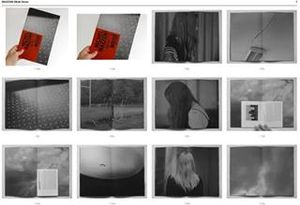
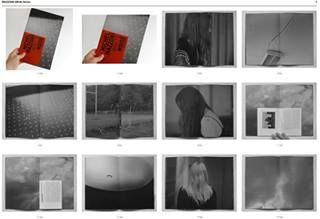
Optical Soliloquy Removed from sight but subjected to the intensity of the visible. This paradox could serve as an introduction into Michel Mazzoni’s world. Everything seems to have disappeared there; beings leave only traces of their passage, or when they do appear, the concealment of the—always female—faces in this feigned indifference provides the screen onto which desire can be projected. This is as much a journey of initiation as it is an escape into memory, with its images of transcursion and what is traversed: a path, corridor, footpath, an opening, stairs, gaps and roads. They are always mental images, in black and iridescent, sometimes even blinding white—images which come to us after an effort, such as a race or the search for oneself. White Noise is a place that has been divided into time sequences, impressions, sensations and blasts of optical heat, as we might imagine in areas where danger remains invisible and is nevertheless present. It is all the more dangerous in that it can only be detected by paranoia. Inspired by cinema of anticipation, postulating the future as run-down, a future contained in memory, the universe of White Noise is a series of imaginary photograms captured in dark rooms. They are also prompted by scenes in which characters try to pronounce words but remain dumbfounded. In White Noise there is a radiant, voiceless cinephilia. From Marker to Antonioni via Tarkovski, we find in Mazzoni’s work a community of thought with filmmakers who have managed to combine fundamental research for forms with sensitive expression. The photographs nevertheless compose their own universe; their optical qualities make them views rather than shots, and what is played out between them, through subtraction, is essential. In this transcursion of the landscape, the close-up and wide angle interact in the same way as nature and constructions, interior and exterior. For everything is governed by the optical subconscious. What is seen on the periphery of the intended focal subject impresses us more than the central aim. When the view point falls backwards and directs the gaze higher, it is most frequently confronted with light sources, where it is burned up. When on the contrary the lens moves downwards, the detail of natural or artificial materials imposes its own optical system, and we drown in it. Meshes, curtains of twigs, thickets and foliage, doors and screens, hair: the frontal views always find an obstacle in their path which constrains our vision from penetrating any deeper and completing the perspective geometry. Sometimes we have to give up. This frustration is in reality an incitement to pursue the journey, to change orientation, to reconsider our course and intellectualise sensations, turning them into milestones in the mental space. We are no longer altogether sure whether we can see without managing to look, or conversely, whether intense observation is suddenly deprived of the very sense of sight, to be reconciled in a purely mental image. The image has long been considered only in terms of a proof of consciousness, like a «renascent sensation» that is to say a reminder, a memory of the perceptive sensation. Going beyond psychologism, phenomenology has incorporated images of «things» to speak like Sartre in The Imaginary. How can these images of things (paintings, photographs and interplay of actors) be reconciled with the image as a proof of consciousness? How can these two image systems be brought together to the point of being mistaken? In its way, White Noise seems to bring about a fusion of these two degrees of the reality of the image, by producing this visible matter. But what is it recounting? White Noise is not a logical sequence of images, but more of a disruptive montage. All naturalistic research is replaced by false alignments, in what Deleuze called the «crystal-image». Clearly White Noise as a unified whole is sewn together between the images—in the «blank spaces» of the visual «noise». These seams are also scars, that is to say marks on the body. This body is feminine and desired, for White Noise is also and above all a work about desire. Sensuality is expressed here optically, through the interplay of depths of field—at the junctions between sharp focus and defocalisation—and iconographically, in the symbolic presence of luminous, biomorphic orbs. The feminine busts are expressionless and faceless, yet their refusal nevertheless adds sensual motifs within the frame of the image, in contrast to the inhumanity of the region that is traversed. White Noise is in its own way an epic poem dispersed by a failing memory. It is a series of unvoiced, visual impressions, the mental images of desire, solitude and experience. We might even say it is the soundtrack of a mute soliloquy. Michel Poivert / 2013
Photos (2)