Manikarnika
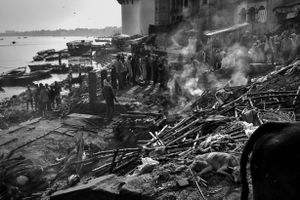
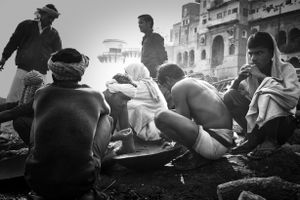
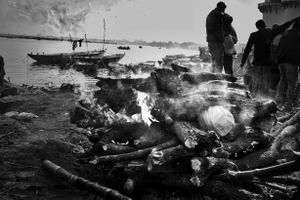
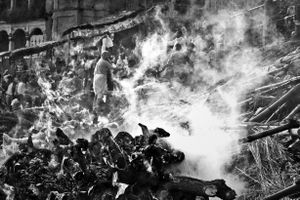
I'm already dead mineral and became plant I’m dead plant and I elevated to animal I’m dead animal and now, here I am human. Why be afraid? Whenever did I become less Dying? Rumi, sufi poet Walking through the narrow, twisted and overcrowded streets of "Godaulia ", the old part of Varanasi (Benares) the Holy City for Hindus, amongst the shops of silk, jewellery,sellers of spices, tea, lassi (yogurt), temples semi-hidden between the houses, betel nut shops, confectioners, cows and motorcycles that honk continuously in order to pass, doing a slalom between pedestrians, occasionally you hear a mantra echoing, liltingly repeated,”RAMA NAMA SATYA HAI”, (the name of Rama is truth) and a chorus responds "SATYA HAI, SATYA HAI” (truth, truth). Nobody moves nor stops his activity or performs any gest, even when, shortly afterwards, you see a short procession of men pass, some of whom carry a stretcher on their shoulders, on which lies a corpse wrapped in colorful and shining silks, yellow, orange, red, gold and silver. Some of the men in the procession are distinguished by being dressed in white tunics, they are male family members of the deceased. There are no women, they are not allowed at the funeral. Children continue to play and adults take care of their affairs. The dead are carried to the cremation ritual at Manikarnika Ghat. Approaching Manikarnika, the atmosphere becomes dense and obscure, it seems to be sealed in a mythological afterlife, reminiscent of the banks of the Styx and the circles of Dante. You meet sellers of wood for the pyres which is sold by the pound and put on large scales to determine the price. To use the correct amount of wood is somewhat of an art and wisdom. The wood used should be sandalwood but it is very expensive, so it's normal to use mango wood with a few handfuls of sandalwood that smells better. The shops near the ghat in the maze of dark and cramped alleys, specialise in the sale of this powder, incense sticks, clarified butter (Ghi), silky funeral shrouds, pottery urns and all it takes for this ceremony. The smell of burned bodies and the black smoke that rises from the pires, burns the eyes and makes you cough. Here life and death are closely intertwined, and dying is part of normal life like living, enjoying and suffering. When you look out on to the Ghat you seem to have been transported to a very ancient time. Life is normal in this hellish place, in the steps leading down to the river it makes an impression the dozens of men who hang out here for their daily chatter, with a chay in their hands or to play cards. The pyres reveal parts of bodies darkened and deformed by fire, while huge black cows walk bogged down in mud and ash. New bodies continually arrive, decorated and glittering, which are waiting for their turn to be cremated. When the body arrives at the Ghat, it will first be washed in the Ganges, immerging it up to its knees. Then it will be laid on a pyre, with the head to the north and the feet to the South. Part of the wood is placed over the body, which is covered with sandalwood powder, clarified butter and a few drops of water from the Ganges. The eldest son (if the deceased is a male) or the youngest male child (if the deceased is a woman) is charged with conducting the rite, he shaves his head and goes to get the sacred fire flame with a bunch of Kusha grass, he makes five turns around the pyre and pours water from the Ganges into the mouth of the deceased and then sets fire to the body starting with the head. As he moves away the “Dom” comes on stage, the people assigned to cremations set out more torches at the base of the pyre which, in the space of a few minutes, will be engulfed by flames. The most important moment is the Kapal Krya, when the skull opens due to the heat and the soul is freed from the body and can rise into the sky towards the Gods. If it doesn’t happen it would be up to a "Dom" to break the skull with a stick on his forehead at the height of the third eye. When the cremation is completed they throw water to put out the fire and the "Dom" separates the lighter human remains from the darker remains of the wood (they take any jewelry or gold teeth present in the remains of the corpse) they deliver the ashes to his son who will return them to the Ganges. Not all people are cremated: gurus and saints who have attained liberation on Earth are thrown directly into the River, with a stone tied to their feet, because their souls were released from the cycle of reincarnation, the same is true for children, pregnant women, dead people who have been poisoned and sacred animals, such as the snake and the cows.
No categories selected
Photos (6)