Uncertain Topographies
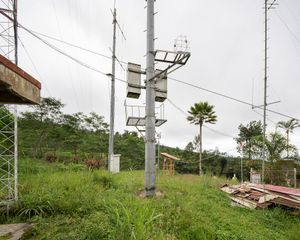
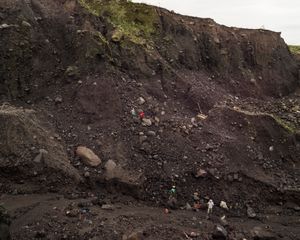
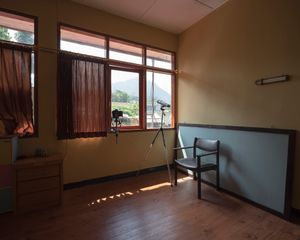
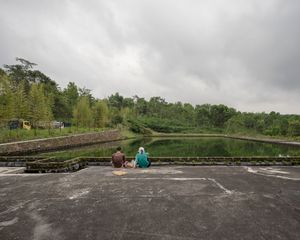
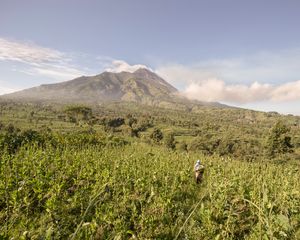
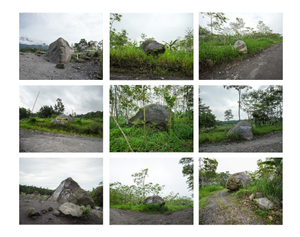
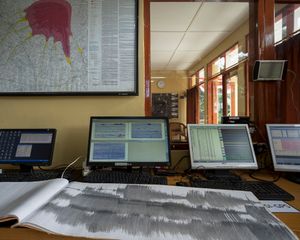
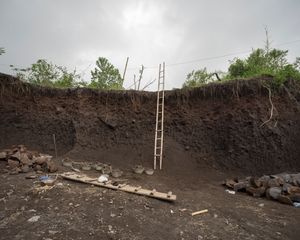
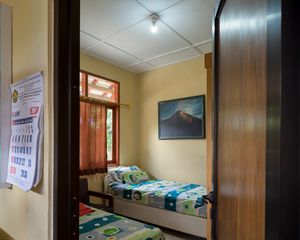
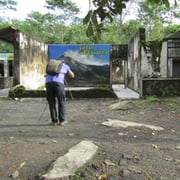
From February 2016 until June 2017, during multiple trips to Yogyakarta, I visited many places around Mount Merapi (Fire Mountain in Javanese). During my explorations I found destroyed villages, obliterated by pyroclastic eruptions in 2010. To my surprise, as close as 2 km away Merapi’s summit were homes, plantations, schools, hotels, quarries, government buildings, tour operators, seismic monitoring stations, and curiously even a Christian church originally modelled in the shape of a dove but actually resembling a chicken. In all my visits to these places, I realised that most of the people I met had something in common. They had a strong connection to Mount Merapi because they had been affected by Merapi's eruptions in some way. Some had lost livestock, houses and land and even the lives of friends and family members. During the completion of this project, I kept thinking what were the reasons that made these people decide to stay so near to a place that is deadly destructive. Merapi is considered to be one of the most active and dangerous volcanoes in the world. It has threatened normal life in communities living around its summit for hundreds of years (Merapi has had 68 historic eruption since 1548). The inhabitants of this uncertain topographies thus have grown accustomed to danger after spending their whole lives in close proximity to latent danger. In a place like this normal life is just a relative term and the balance between danger and benefit is never fixed for them. Their cultural beliefs together with the already mentioned constant exposure to latent danger is counterweighted by the endless benefits this land has to offer to its inhabitants' livelihoods. Merapi has in fact sustained the lives of the inhabitants of Yogyakarta by producing a constant supply of sand and rocks that are mined for the construction industry. Additionally, it produces fertile land that makes agriculture very profitable coupled with a booming tourism industry that profits from Merapi's infamous reputation as an uncontrollable force of nature. This brings about scientific and risk management communities that strive to keep villages and cities around Merapi as humanly safe as possible. Thus, residents have created deep rooted emotional and financial relationships with Mount Merapi. For example, many of the neighbouring villages' main income depends on the above mentioned industries linked to Merapi. Furthermore, Merapi is a constant presence in the normal routine of these villagers, and has over time, become a common topic of informal conversation and even the main subject during community meetings related to the management of resources and the mitigation of risk. This sustainable and economically rewarding ecosystem which Merapi creates, together with the ancestral Javanese beliefs that regard mountains as deities, reinforce the strong attachment between the magnificent volcano and the people living under its influence and therefore, a reluctance to move to safer grounds (Lavigne et al.2008). Perhaps, to further illustrate this relationship, during one of my many trips to Yogyakata, while I was photographing in the sleeping quarters of the men that, round the clock, monitor Merapi's seismic activity, there, surrounded by instruments measuring Merapi's every breath and no more than 4 km from its summit, a painting of Merapi hang on the wall above one of the beds. Later, while talking to the station staff, I found out that it had been painted by Mr. Rasiman, one of the men working at the Plawangan station keeping a watchful eye on Merapi all day long. When I had finished photographing at the station, while I was packing my equipment and getting ready to go, I asked Mr. Rasiman: 'Why, did you choose to paint Merapi, and why did you hang it over your bed?' He simply replied -'because it makes me feel closer to it'. --
No categories selected
Photos (44)