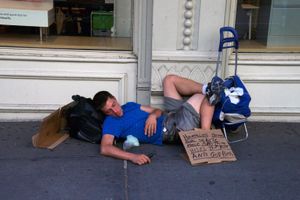
Stolen Portraits
This is my alternate entry to the Emerging Talent Awards 2018. Whenever someone presents his or her work, it is customary to include an exhibition history. However, even though I am entering my 70th year, I am still considered an emerging talent. Beyond the occasional gift to friends, my photographs have never been shown. Yet, despite the lack of provenance, I would like to think that my work holds its own. Even though I was trained as a painter, I was always a latent photographer. I always took photos, but to exhibit my photography was secondary to my work as a painter. Nevertheless, it was clear to me that what I photographed had value. I was never interested in the rare and the extraordinary, the beauty of such imagery was obvious and indisputable. Rather, I found it more challenging discovering what has depth and meaning beneath the experiences of the everyday. I did this by having my camera with me at all times. I shoot with a Nikon 800D, which is a weatherized camera that allows me to take pictures every day, rain or shine. Being every-ready to take pictures gives me the patience to come across imagery that I found meaningful, rather than taking the camera out on the weekends to take “interesting” pictures. Jean Paul Sartre said that meaningful art in some way deals with time. I can understand Sartre making a such statement, however I would like to say that meaningful art has a sense of urgency to it, i.e., things that we should look at. So, I would like to say that these Stolen Portraits of the homeless have a sense of urgency to them. Urgency in the sense that it is important for us to examine what we choose not to see. An urgency to acknowledge that this is of our own making. We disingenuously, ask ourselves, how can this happen, when we know quite well that our society feels that you do not deserve what you cannot pay for, be it healthcare or housing. Furthermore, we distrust social safety nets that could prevent this from happening. Rather, we judge someone’s worth by how they fare in a competitive environment. So, we have to ask ourselves Are these images an inevitable consequence of our society? Will we let this continue, or will we continue to look away. Aesthetically, these images beg the question, “Why do we have to look at this?” These are not beautiful images. Yes, however the role of art has not always been about the creation of beautiful things. The role of art was originally to inspire and foster introspection. Here, the painter Velasquez comes to mind. His many portraits of the midgets and dwarfs cannot be said to be beautiful in the conventional sense, yet those paintings are a source of contemplation and reflection. There was no attempt at creating something beautiful in those portraits. I would like to think that my Stolen Portraits of the homeless perform a similar task. Lastly, I would like to talk about scale. We are a point in time where the scale of photography is now arbitrary and not dictated by the technical limitations of the medium. For generations image quality dictated the size of the handheld photographic print. Today, scale is now a design decision. All of these photographs are 20”x30” (58.8cmx76.2cm). These images should be strident and not visually discreet.
No categories selected
Photos (10)