Dangerous Boredom. A boy sitting inside a run-down public toilet. A group of generic prescription drug addicts uses it as their shelter, both for shooting up and for sleeping. From the series "The Pharmacy of the Third World" © Enrico Fabian. A boy sits inside a run-down public toilet house which a group of generic pharmaceutical drug addicts use as their shelter.
India, also known as the pharmacy of the Third World, is one of the biggest producers of generic drugs worldwide. The vast variety of quality and, most importantly, affordable pharmaceuticals gives millions of people the chance to treat their illnesses. But the lack of monitoring, cover-ups through corruption, and ignorance and greed on the side of the pharmacists have also gotten these medicines - meant to heal, to help people - into the wrong hands.
Jahangirpuri, a colony on the outskirts of New Delhi, has become a disturbing example for the consequences of the loss of the real purpose, of generic pharmaceutical drugs. This new kind of drug abuse is not only widely underreported but even worse, almost unknown to the outside world.
Being Stuck. Fakir prepares one of his daily injections in the public toilet. Fakir and his family live on the outskirts of New Delhi. Much of the family’s misery can be traced back to the father’s heavy addiction to prescription drugs. From the series "The Pharmacy of the Third World" © Enrico Fabian. Fakir, a father of two and married man, addicted to injecting generic pharmaceutical drugs is preparing one of his daily injections while standing on top of a run-down public toilet house that many of the homeless addicts of the area use as a place for injecting or as a shelter for the night.
Fakir and his family are living in an impoverished neighbourhood on the outskirts of New Delhi, India. The reason for the family’s misery and the struggle for a normal life is the father’s heavy addiction to strong generic pharmaceutical drugs influencing almost every aspect of the small family’s life.
India, also known as the pharmacy of the Third World, is one of the biggest producers of generic drugs worldwide. The vast variety of quality and, most importantly, affordable pharmaceuticals gives millions of people the chance to treat their illnesses. But the lack of monitoring, cover-ups through corruption, and ignorance and greed on the side of the pharmacists have also gotten these medicines - meant to heal, to help people - into the wrong hands.
Stifling Memories. Fakir, just before injection. "Since my mother died, everything changed. If not for my two small children, I would have committed suicide a long time ago. This damn medicine…" Fakir said, while crying. From the series "The Pharmacy of the Third World" © Enrico Fabian. Fakir prepares for one of his daily injections. “Since my mother died everything has changed to the worse. If it wasn't for my two small children, I would have committed suicide a long time ago. This damn medicine…”, told me Fakir, crying about his loss and life, sitting lonely in his small room of the family’s house.
He and his family are living in an impoverished neighbourhood on the outskirts of New Delhi, India. The reason for the family’s misery and the struggle for a normal life is the father’s heavy addiction to strong generic pharmaceutical drugs influencing almost every aspect of the small family’s life.
India, also known as the pharmacy of the Third World, is one of the biggest producers of generic drugs worldwide. The vast variety of quality and, most importantly, affordable pharmaceuticals gives millions of people the chance to treat their illnesses. But the lack of monitoring, cover-ups through corruption, and ignorance and greed on the side of the pharmacists have also gotten these medicines - meant to heal, to help people - into the wrong hands.
Left on his own. After injecting, Fakir watches television while smoking a local Indian cigarette. He is a married man, father of two, and has been addicted to generic prescription drugs for many years. From the series "The Pharmacy of the Third World" © Enrico Fabian. After injecting, Fakir watches television while smoking a local Indian cigarette. He is a married man, father of two, and addicted to injecting generic pharmaceutical prescription drugs since many years.
He and his family are living in an impoverished neighborhood on the outskirts of New Delhi, India. The reason for the family’s misery and the struggle for a normal life is the father’s heavy addiction to strong generic pharmaceutical drugs influencing almost every aspect of the small family’s life.
India, also known as the pharmacy of the Third World, is one of the biggest producers of generic drugs worldwide. The vast variety of quality and, most importantly, affordable pharmaceuticals gives millions of people the chance to treat their illnesses. But the lack of monitoring, cover-ups through corruption, and ignorance and greed on the side of the pharmacists have also gotten these medicines - meant to heal, to help people - into the wrong hands.
After Injecting. Vicky, 20, a few seconds after his daily injection. Vicky has been injecting prescription drugs since he was 5 years old. He still lives with his family, though they don’t know about his addiction. His daily need for money has lead to him occasional stealing from his family. From the series "The Pharmacy of the Third World" © Enrico Fabian. The 20 year old Vicky takes a deep drag from his cigarette, a few seconds after he injected himself one his daily needed generic pharmaceutical prescription drug cocktails. Vicky injects since around 5 years and still lives with his family. They don’t know about his addiction. The daily needed money he receives or sometimes steals from his family.
India, also known as the pharmacy of the Third World, is one of the biggest producers of generic drugs worldwide. The vast variety of quality and, most importantly, affordable pharmaceuticals gives millions of people the chance to treat their illnesses. But the lack of monitoring, cover-ups through corruption, and ignorance and greed on the side of the pharmacists have also gotten these medicines - meant to heal, to help people - into the wrong hands.
Jahangirpuri, a colony on the outskirts of New Delhi, has become a disturbing example for the consequences of the loss of the real purpose, of generic pharmaceutical drugs. This new kind of drug abuse is not only widely underreported but even worse, almost unknown to the outside world.
Uncertainty. The three year old Paras is lying in the arms of his father. His father has been addicted to injecting generic prescription drugs for many years. From the series "The Pharmacy of the Third World" © Enrico Fabian. The three year old Paras is lying in the arms of his father who is addicted ti injecting generic pharmaceutical prescription drugs since many years.
Everyone’s childhood should be idyllic, light-hearted and free of worries and sorrows of whatever kind. Yet the reality for most children growing up on our planet is a stark contrast to that ideal.
So also for the three year old Paras and his four year old sister Mania who are living with their parents in an impoverished neighbourhood on the outskirts of New Delhi, India. The reason for their misery and the family’s struggle for a normal life is the father’s heavy addiction to strong generic pharmaceutical drugs.
The children can’t yet fully comprehend the dangerously fragile environment they are living in, but they are old enough to feel that there is something seriously wrong.
India, also known as the pharmacy of the Third World, is one of the biggest producers of generic drugs worldwide. The vast variety of quality and, most importantly, affordable pharmaceuticals gives millions of people the chance to treat their illnesses. But the lack of monitoring, cover-ups through corruption, and ignorance and greed on the side of the pharmacists have also gotten these medicines - meant to heal, to help people - into the wrong hands.
Vicious Circle. A homeless Indian man addicted to injecting generic prescription drugs is holding a used needle in his mouth after injecting himself. From the series "The Pharmacy of the Third World" © Enrico Fabian. A homeless Indian man addicted to injecting generic pharmaceutical prescription drugs is holding a used needle in his mouth after he injected himself.
India, also known as the pharmacy of the Third World, is one of the biggest producers of generic drugs worldwide. The vast variety of quality and, most importantly, affordable pharmaceuticals gives millions of people the chance to treat their illnesses. But the lack of monitoring, cover-ups through corruption, and ignorance and greed on the side of the pharmacists have also gotten these medicines - meant to heal, to help people - into the wrong hands.
Jahangirpuri, a colony on the outskirts of New Delhi, has become a disturbing example for the consequences of the loss of the real purpose, of generic pharmaceutical drugs. This new kind of drug abuse is not only widely underreported but even worse, almost unknown to the outside world.
Day in, Day out. This woman is married to a man addicted to generic prescription drugs. With her daughter, she is cleaning the room of her father in law. Due to her husband’s addiction, her life alternates from on top of the world to the depths of despair. From the series "The Pharmacy of the Third World" © Enrico Fabian. A woman, her daughter standing next to her, married to a man addicted to injecting generic pharmaceutical drugs is cleaning the room of her father in law. The two pictures on the wall strangely reflect her life which is constantly, because of her husband’s addiction, on top of the world or in the depths of despair.
Her husband and the family are living in an impoverished neighbourhood on the outskirts of New Delhi, India. The reason for the family’s misery and the struggle for a normal life is the husband’s heavy addiction to strong generic pharmaceutical drugs influencing almost every aspect of the small family’s life.
India, also known as the pharmacy of the Third World, is one of the biggest producers of generic drugs worldwide. The vast variety of quality and, most importantly, affordable pharmaceuticals gives millions of people the chance to treat their illnesses. But the lack of monitoring, cover-ups through corruption, and ignorance and greed on the side of the pharmacists have also gotten these medicines - meant to heal, to help people - into the wrong hands.
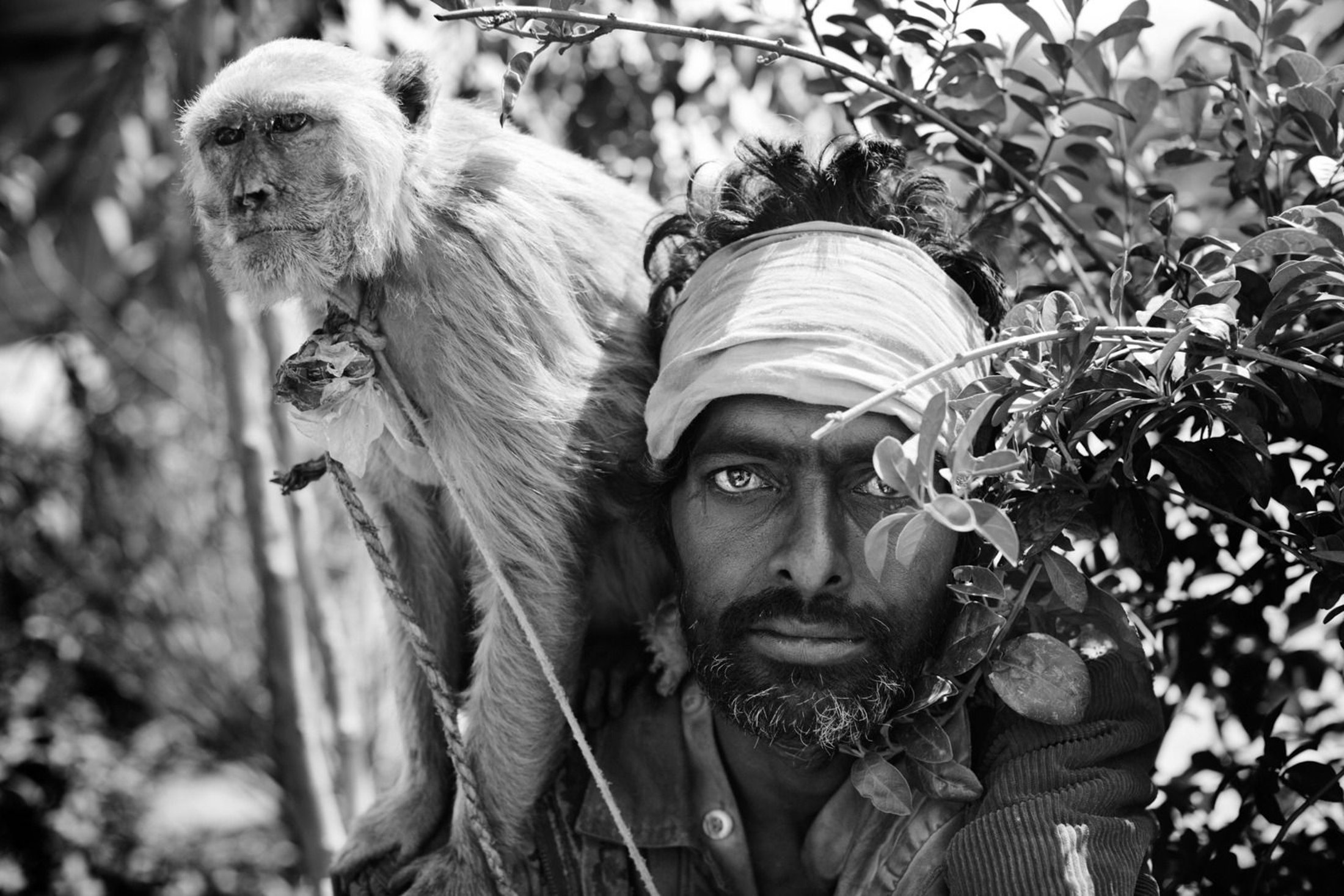
The Monkey on my Back. Vinod is a 40 year old homeless man addicted to generic prescription drugs. The monkey on his shoulder came from a trade with another addict. Vinod hopes the pet will help him to attract more people while begging for money. From the series "The Pharmacy of the Third World" © Enrico Fabian. Vinod, a 40 year old homeless man addicted to injecting generic pharmaceutical prescription drugs is taking shelter from the sun in a bush. The monkey he traded with another addict hoping that it would help him to attract more people while begging for money.
India, also known as the pharmacy of the Third World, is one of the biggest producers of generic drugs worldwide. The vast variety of quality and, most importantly, affordable pharmaceuticals gives millions of people the chance to treat their illnesses. But the lack of monitoring, cover-ups through corruption, and ignorance and greed on the side of the pharmacists have also gotten these medicines - meant to heal, to help people - into the wrong hands.
Jahangirpuri, a colony on the outskirts of New Delhi, has become a disturbing example for the consequences of the loss of the real purpose, of generic pharmaceutical drugs. This new kind of drug abuse is not only widely underreported but even worse, almost unknown to the outside world.