The 15th Noorderlicht Photofestival is presenting two major new exhibits, Behind
Walls and Beyond Walls, which offer a sweeping overview
of Eastern European photography before and after the fall of Communism in 1989. Photography from all the former East Block lands is brought together in
one large-scale presentation.
Much of the work is being shown for the first
time outside its country of origin.
The photos here in Lens Culture represent just a tiny preview of the work being featured at Noorderlicht this year. Behind Walls features 37 photographers from 13 countries, and Beyond Walls presents 35 photographers from 20 countries.
Behind Walls
During Communist rule in Eastern Europe, "official" photography — propaganda — was all that the public usually saw. Personal and honest documentary photography was forbidden. Even brave photographers who dared to take photos unofficially, rarely showed their photos to others, for fear of punishment. But of course, there were lots of brave photographers who documented "real life" in their lands, and privately held onto these photographic memories.
Without exposure to other visual imagery from around the world, photographers in the East Block
(both official and underground) developed their own photographic vocabularies.
They documented a now vanished era, each in their own way.
Censorship and lack of freedom were a self-evident part of life in
the days of the East Block. The totalitarian regimes propagated
an heroic image of socialist society. Photographs of everyday
scenes and personal interests were not appreciated. Only in periods
of relative freedom, such as during the Prague Spring, but
also in the DDR of the late 1970s, did photographers violate the
unwritten rules, and then carefully. At other moments flight into
a self-created reality offered solace, and this became a great
stimulant for photographic experimentation.
Proud portraits of the ‘worker of the month’, clandestine photographs
of staged people’s manifestations, advertising for products
that were not available, forbidden photographs of nude
women: Behind Walls provides a fascinating picture of life and
photography in the Socialist paradise.
Beyond Walls
A new Eastern Europe arose after 1989. The Iron Curtain disappeared, the street scene
changed unrecognizably. Some countries disintegrated, a majority have become members of
the European Union. After four decades of Communism, capitalism is the new ideology.
Individualism
has replaced collectivism, opposition politics is again permitted. The heroic worker
has had to become a critical consumer.
As a mirror held up to Behind Walls, a second exhibition, Beyond Walls, provides a picture of
Eastern Europe after the fall of the Iron Curtain. Left opposes right, nostalgia for the old days
faces off against the blessings of capitalism. Among the remains of the Communist era – from
the gray architecture to the discrimination against ethnic groups – a frantic search for a new
identity is going on.
These changes also leave their mark on photography. What was previously forbidden ground
– literally, in the case of once heavily guarded border areas – or new phenomena such as a
beauty contest in Poland or the rise of a Romanian tourist industry, can now be documented.
Beyond Walls tells the
story of a world full of contradictions in which a dynamic present still bears the traces of a
charged past.
For more details about the festival and exhibitions, check the Noorderlicht website.

Feature
Picturing Eastern Europe: an overview of photography —
before and after Communism
A sweeping overview of photography from Eastern Europe — some old views, and lots of new discoveries. Curated by Noorderlicht
Curated byNoorderlicht Festival
View Images
Feature
Picturing Eastern Europe: an overview of photography —
before and after Communism
A sweeping overview of photography from Eastern Europe — some old views, and lots of new discoveries. Curated by Noorderlicht
Curated byNoorderlicht Festival
Picturing Eastern Europe: an overview of photography — before and after Communism
A sweeping overview of photography from Eastern Europe — some old views, and lots of new discoveries. Curated by Noorderlicht
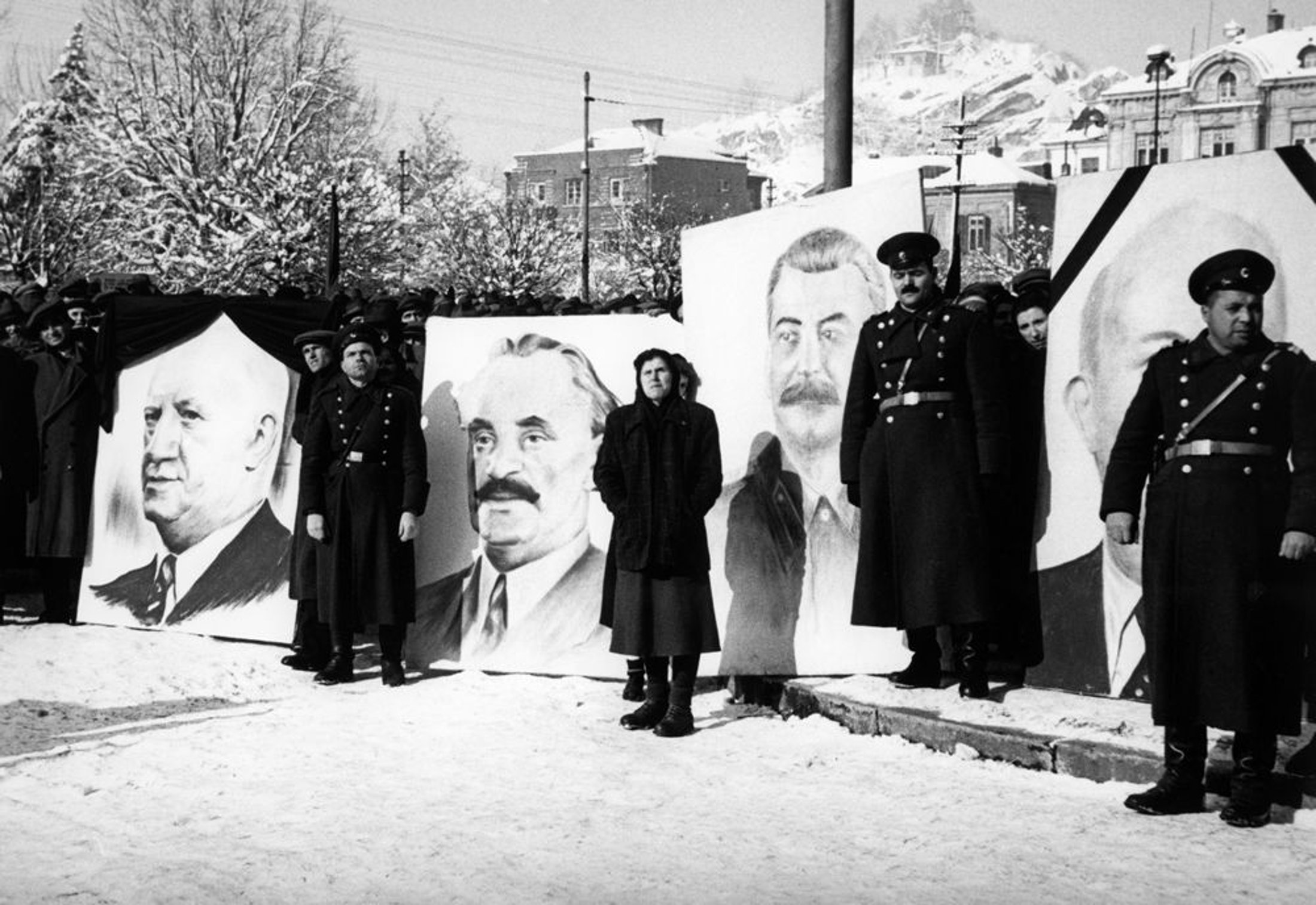
Death of a communist leader, from The Unknown Photographer (1950-1956) © Svetlana Bahchevanova (Bulgaria), from the exhibition Behind Walls: Eastern Europe before 1989. Courtesy of the Noorderlicht Photofestival 2008.
Untitled, from To Become a Soldier (1970-1979) © Andrzej Baturo (Poland), from the exhibition Behind Walls: Eastern Europe before 1989. Courtesy of the Noorderlicht Photofestival 2008.
Dagmar mit geige, dagmar with violin, 1972 from Kratzen am Beton (1970-1978) © Barbara Metselaar-Berthold (Germany), from the exhibition Behind Walls: Eastern Europe before 1989. Courtesy of the Noorderlicht Photofestival 2008.
Tätowierter vor Karussells, Leipzig 1981, from Infrared Night Shots (1980-1982) © Erasmus Schröter (Germany), from the exhibition Behind Walls: Eastern Europe before 1989. Courtesy of the Noorderlicht Photofestival 2008.
Reminiscences of childhood 5, from Reminiscences of Childhood (1989) © Galina Moskaleva (Lithuania), from the exhibition Behind Walls: Eastern Europe before 1989. Courtesy of the Noorderlicht Photofestival 2008.
Melting shop at the Lenin Steelworks, 1963, from 802% above the norm (1940-1960) © Henryk Makarewicz, from the exhibition Behind Walls: Eastern Europe before 1989. Courtesy of Visavis.pl Photographers Collective, Poland/Imago Mundi Foundation, Poland and the Noorderlicht Photofestival 2008.
Ernest Really No Longer Knows What Hell Do, 1982-87, from Ernest Alicia (1982-1988) © Jano Pavlik(Czechoslovakia), from the exhibition Behind Walls: Eastern Europe before 1989. Courtesy of Langhans Gallery, Prague, Czech Republic and the Noorderlicht Photofestival 2008.
1982, from Official (1981-1989) © Juraj Kammer (Czechoslovakia), from the exhibition Behind Walls: Eastern Europe before 1989. Courtesy of Regional Cultural Centre Humenné, Slovakia and the Noorderlicht Photofestival 2008.
Forest near coal heaps, 1979, from Silesia (1978-1979) © Michal Cala (Poland), from the exhibition Behind Walls: Eastern Europe before 1989. Courtesy of the Noorderlicht Photofestival 2008.
Culture, from One Body One Soul (1985-1986) © Miro Svolik (Czechoslovakia), from the exhibition Behind Walls: Eastern Europe before 1989. Courtesy of the Baudelaire Gallery, Antwerpen, Belgium and the Noorderlicht Photofestival 2008.
Videoton TV, 1968, from Advertising Photographs (1962-1970) © Füles (Hungary), from the exhibition Behind Walls: Eastern Europe before 1989. Courtesy of the Noorderlicht Photofestival 2008.
From The Childish Album (1989) © Sergey Kozhemyakin (Belarus), from the exhibition Behind Walls: Eastern Europe before 1989. Courtesy of the Noorderlicht Photofestival 2008.
From Portrait for the Kolkhoz's Board of Honor (1980-1989) © Vladimir Shakhlevich (Belarus), from the exhibition Behind Walls: Eastern Europe before 1989. Courtesy of the Noorderlicht Photofestival 2008.
A School for Blind Children. Chestnuts, 1. Kaunas, 1962 © Antanas Sutkus (Lithuania), from the exhibition Behind Walls: Eastern Europe before 1989. Courtesy of the Noorderlicht Photofestival 2008.
The first public action of the new formed Bulgarian anticommunist political opposition, December 10, 1989 in Sofia in front of the church Alexander Nevskiî. They wanted changes within the ruling Communist Party. © Svetlana Bahchevanova (Bulgaria), from the exhibition Transition. Courtesy of the Noorderlicht Photofestival 2008. 8
From Newborn Democracy © Besim Fushà (Albania), from the exhibition Transition. Courtesy of the Fusha Studio, Tirana, Albania and the Noorderlicht Photofestival 2008.
16.06.1989/7 30 a.m, from 16th of June 1989, 7 30 a.m © István Halas (Hungary), from the exhibition Transition. Courtesy of the Noorderlicht Photofestival 2008.
Medien am Brandenburger Tor, Berlin, November 1989, from Neuland © Claudio Hils (Germany), from the exhibition Transition. Courtesy of the Galerie J.J. Heckenhauer, Berlin, Germany and the Noorderlicht Photofestival 2008.
January 1991. Latvian people on the streets safeguard the new government and make fire near the soviet symbol of Lenins monument. © Janis Knakis (Latvia), from the exhibition Transition. Courtesy of the Noorderlicht Photofestival 2008.
Heavy milicia presence at the Palace of Culture in Warsaw, during the last session of the XI Meeting of the Polish Communist Party (PZPR) which saw the dissolution of the party. 29.01.1990 © Witold Krassowski (Poland), from the exhibition Transition. Courtesy of the Noorderlicht Photofestival 2008.
December 22, 1989, about 15h30. Piata Revolutiei, Bucharest © Andrei Pandele (Romania), from the exhibition Transition. Courtesy of the Noorderlicht Photofestival 2008.
Red demonstrations in November of 1989, from Jump beyond red © Yevgeniy Pavlov (Ukraine), from the exhibition Transition. Courtesy of the Noorderlicht Photofestival 2008.
© Stecha Pavel (Czech Republic), from the exhibition Transition. Courtesy of Langhans Gallery, Prague, Czech Republic and the Noorderlicht Photofestival 2008.
23 September 1991, in Vilnius, Lithuania, during the Putsch in Moscow. © Antanas Sutkus (Lithuania), from the exhibition Transition. Courtesy of the Noorderlicht Photofestival 2008.
23 august 1989. Baltic Chain (Baltic Way) on the Estonian-Latvian border. © Veermäe, Tiit (Estonia), from the exhibition Transition. Courtesy of the Noorderlicht Photofestival 2008.
From Montenegro, the Youngest Old Nation in the World © Alen Aligrudic (Bosnia and Herzegovina), from the exhibition Beyond Walls: Eastern Europe after 1989. Courtesy of the Noorderlicht Photofestival 2008.
From GDR - Museum Views © Anja Bohnhof (Germany), from the exhibition Beyond Walls: Eastern Europe after 1989. Courtesy of the Noorderlicht Photofestival 2008.
Potsdamer Platz, Berlin, November 1989, from Neuland © Claudio Hils (Germany), from the exhibition Beyond Walls: Eastern Europe after 1989. Courtesy of the Galerie J.J. Heckenhauer, Berlin, Germany and the Noorderlicht Photofestival 2008.
February 1998, Brancoveanu canal. Florie's birthday, Mia and Laurentzio having drugs, a little while after Mia felt bad because of all the drugs she had. She lied on the floor calling for help. Most of the children around didn't listen to her, until one of them seemed to care for her, shaking her to wake her up, from Survival Under © Flore-Aël Surun (France), from the exhibition Beyond Walls: Eastern Europe after 1989. Courtesy of Tendance Floue, France and the Noorderlicht Photofestival 2008.
On the cell, from Running through the Wind © Frank Rothe (Germany), from the exhibition Beyond Walls: Eastern Europe after 1989. Courtesy of Camera Work, Berlin, Germany and the Noorderlicht Photofestival 2008.
Bus no 6, Odessa, Ukraine. Odessa, on the Black Sea, is Ukraine's largest Port, with a historically diverse ethnic population, from Transit Ukraine © George Georgiou (United Kingdom), from the exhibition Beyond Walls: Eastern Europe after 1989. Courtesy of Panos Pictures, United Kingdom and the Noorderlicht Photofestival 2008.
Pensiuni Poientina, Ramnicu Sarat from Waiting for Tourism © Irma Bulkens (Netherlands), from the exhibition Beyond Walls: Eastern Europe after 1989. Courtesy of the Noorderlicht Photofestival 2008.
Delegate from Unofficial © Lucia Nimcova (Czech Republic), from the exhibition Beyond Walls: Eastern Europe after 1989. Courtesy of the Noorderlicht Photofestival 2008.
Members of the Hungarian League of National Prosperity, Budapest, City Park, 1 May 1996, from Left-Right © Péter Rákosi (Hungary), from the exhibition Beyond Walls: Eastern Europe after 1989. Courtesy of the Noorderlicht Photofestival 2008.
From Industria © Václav Jirásek (Czech Republic), from the exhibition Beyond Walls: Eastern Europe after 1989. Courtesy of the Galerie Rudolfinum Prague, Czech Republic and the Noorderlicht Photofestival 2008.
From Tracks_01_Sarajevo © Vittorio Mortarotti (Italy), from the exhibition Beyond Walls: Eastern Europe after 1989. Courtesy of the Noorderlicht Photofestival 2008.
The newly recovered freedom of demonstration. A night gathering of WWII veterans that had suffered political prosecution, in front of the gates of the infamous political prison in Rakowiecka Street in Warsaw, a symbol of Communist oppression, 1989, from After-images of Poland © Witold Krassowski (Poland), from the exhibition Beyond Walls: Eastern Europe after 1989. Courtesy of the Noorderlicht Photofestival 2008.

Top Awards include: Full publication with Nazraeli Press, valued at more than $25,000, Los Angeles Exhibition, Cash Prizes, Solo Feature on LensCulture.

© Peyton Fulford
Stay connected to the global photography community
Receive industry news, advice from editors & gallerists, exclusive deadlines, access to the best photography events and more on a weekly basis.
You have been subscribed!