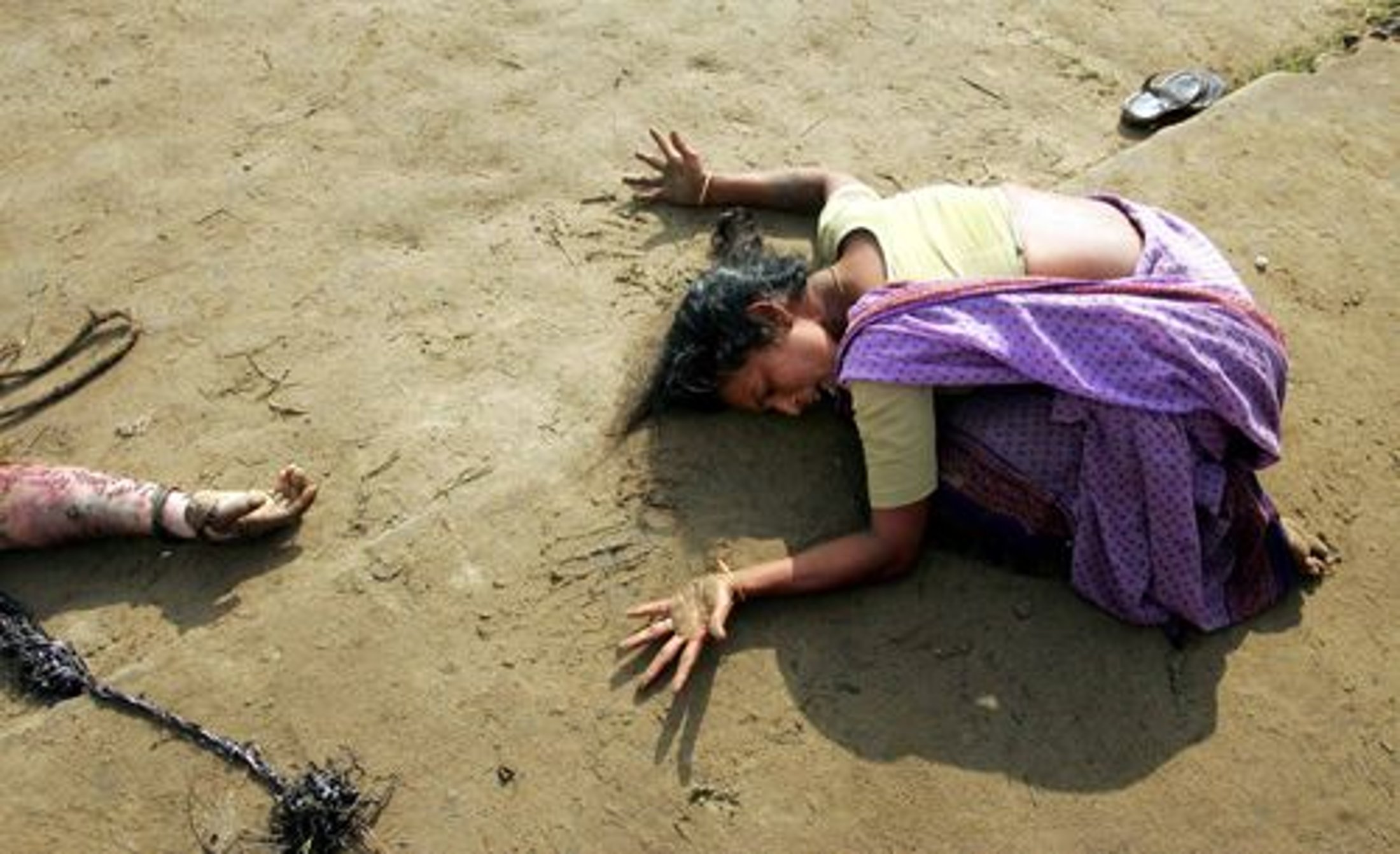
World Press Photo of the Year 2004 © Arko Datta, India, Reuters, Mourning a tsunami victim, Tamil Nadu, India, 28 December. A woman mourns a relative killed in the tsunami, at Cuddalore in Tamil Nadu, India. On December 26 a massive earthquake off the coast of Sumatra, Indonesia, triggered a series of deadly waves that traveled around the Indian Ocean.
2nd prize Spot News Single © Shaul Schwarz, Israel, Corbis. Young boy looting, Port-au-Prince, Haiti, 27 February. An Haitian child loots a piece of meat at the main commercial seaport at Port-au- Prince in February. In the last week of February looters raided aid-agency warehouses, making off with hundreds of tons of food and commodities.
2nd prize Spot News Stories © Yuri Kozyrev, Russia, Time Magazine, Beslan school siege, North Ossetia, Russia. On September 1 a group of Chechen militants occupied School Number One in the town of Beslan, in the neighboring Russian province of North Ossetia.
2nd prize General News Singles © David Robert Swanson, USA, The Philadelphia Inquirer, U.S. marine in ambush, Ar Ramadi, Iraq, 6 April. Private Eric Ayon of Echo Company of the Second Battalion, Fourth Regiment of the US Marines stares through the bullet-riddled windshield of a Humvee ambushed at Ar Ramadi in Iraq on April 6. Eight out of the nine marines on board were killed.
2nd prize General News Stories © Paolo Pellegrin, Italy, Magnum Photos for Vanity Fair, Yasser Arafat’s funeral. Yasser Arafat died in a military hospital in Paris on November 11 at the age of 75, after decades as Palestinian leader. Tens of thousands of Palestinians converged on the Muqata compound in Ramallah for his burial two days later.
2nd prize People in the News Singles © Paul Vreeker, The Netherlands, Reuters, Protest against deportation. Iranian asylum-seeker Mehdy Kavousi sewed up his lips and eyelids and went on hunger strike to protest against his threatened deportation from the Netherlands, in February.
2nd prize People in the News © Ami Vitale, USA, Getty Images, Kashmir. The dispute between India and Pakistan over claims to the mountainous northern region of Kashmir has continued for more than 50 years, and has at least twice led to war between the two nuclear powers. The area is controlled by India, but has a 60 percent Muslim majority.
1st prize Sports Action Singles © Bob Martin, United Kingdom, Sports Illustrated, 200m freestyle heats at Paralympic Games. Spanish swimmer Xavi Torres sets off at the start of the 200m freestyle heats at the Paralympic Games in Athens in September. Torres, all of whose limbs have been amputated, went on to come sixth in the 200m finals.
2nd prize Sports Action Stories © Donald Miralle, Jr, USA, Getty Images,Olympic Games portfolio. Hao Wang of China and Seung Min Ryu of Korea compete for the gold medal in men’s singles table tennis.
1st prize Sports Features Singles © Adam Pretty, Australia, Getty Images, 200m freestyle heats at Olympic Games. Ian Thorpe of Australia starts from lane four and Pieter van den Hoogenband of the Netherlands from lane five, during the heats of the men’s 200m freestyle at the Olympic Games in Athens in August. Both were tipped to win the event.
1st prize Sports Features Stories © Daniel Silva Yoshisato, Peru, Agence France-Presse, Women’s football team, Peru. Churubamba is a farming community 3,850 meters above sea level in the Andahuaylillas district in the region of Cusco, in Peru. Around 60 families farm and graze sheep and llamas.
1st prize Contemporary Issues Singles © James Nachtwey, USA, VII for Time Magazine. Refugee woman and son, Darfur. A woman displaced by conflict in Darfur, Sudan, cares for her son, who is sick with Hepatitis E, in a hospital in West Darfur. The region saw one of the worst humanitarian crises of the year following attacks by Arab militias.
1st prize Contemporary Issues Stories © Michael Wolf, Germany, Laif Photos & Reportagen for Stern Magazine, China: factory for the world. In recent years China has grown to become the world’s fifth largest exporter of merchandise, and has one of the world's fastest growing economies. A huge influx of migrant workers is required to meet demand in city factories.
2nd prize Daily Life Singles © Krisanne Johnson, USA. Brethren girl, Ohio. A young woman of the Old Order German Baptist Brethren plays basketball at her parents’ farm in Ohio, USA, after dinner. Originating in a religious group that came from Schwarzenau in Germany in the early 18th century, the Brethren do not use electricity or cars.
1st prize Daily Life Stories © Jan Grarup, Denmark, Politiken/Rapho for Geo Germany, Roma in Slovakia. The Roma form the second largest minority group in Slovakia, yet as a group tend to suffer disproportionately higher rates of unemployment, poverty and disease. Most live in extremely deprived conditions, often in camps in marginal or devastated zones, with few facilities.
3rd prize Portraits Singles © Brent Stirton, South Africa, Getty Images for Global Business Coalition against Aids. Aids orphan, South Africa. A young Aids orphan stands in a field near Richards Bay, on the South African east coast. Both her parents are dead, and she is being cared for by members of her community.
1st prize Portraits Stories © Adam Nadel, USA, Polaris Images, Darfur portraits. Around two million people fled their homes, and at least 150,000 were thought to have died, as a result of violence that had affected the Darfur region of Sudan since early 2003.
2nd prize Arts and Entertainment Singles © Alfred Seiland, Austria, The New York Times Magazine, Hanging gardens. A Marc Jacobs sundress, an Alexander McQueen chiffon gown, and a Max Mara printed silk dress hang among spring blossoms.
3rd prize Art and Entertainment Stories © Marcello Bonfanti, Italy, Cuban drag queens. Drag queens prepare for, and perform in, an underground show in Havana, Cuba. Similar shows happen in neighborhoods all over the city, but still need to be advertised through select networks of those in the know.
1st prize Nature Stories © Carsten Peter, Germany, National Geographic Magazine, Inside tornadoes. Tornadoes number among the Earth’s most violent natural occurrences, yet no one fully understands how they work. Chasing tornadoes for science requires skilled forecasts, plenty of stamina — and an ability to get out of the way quickly.