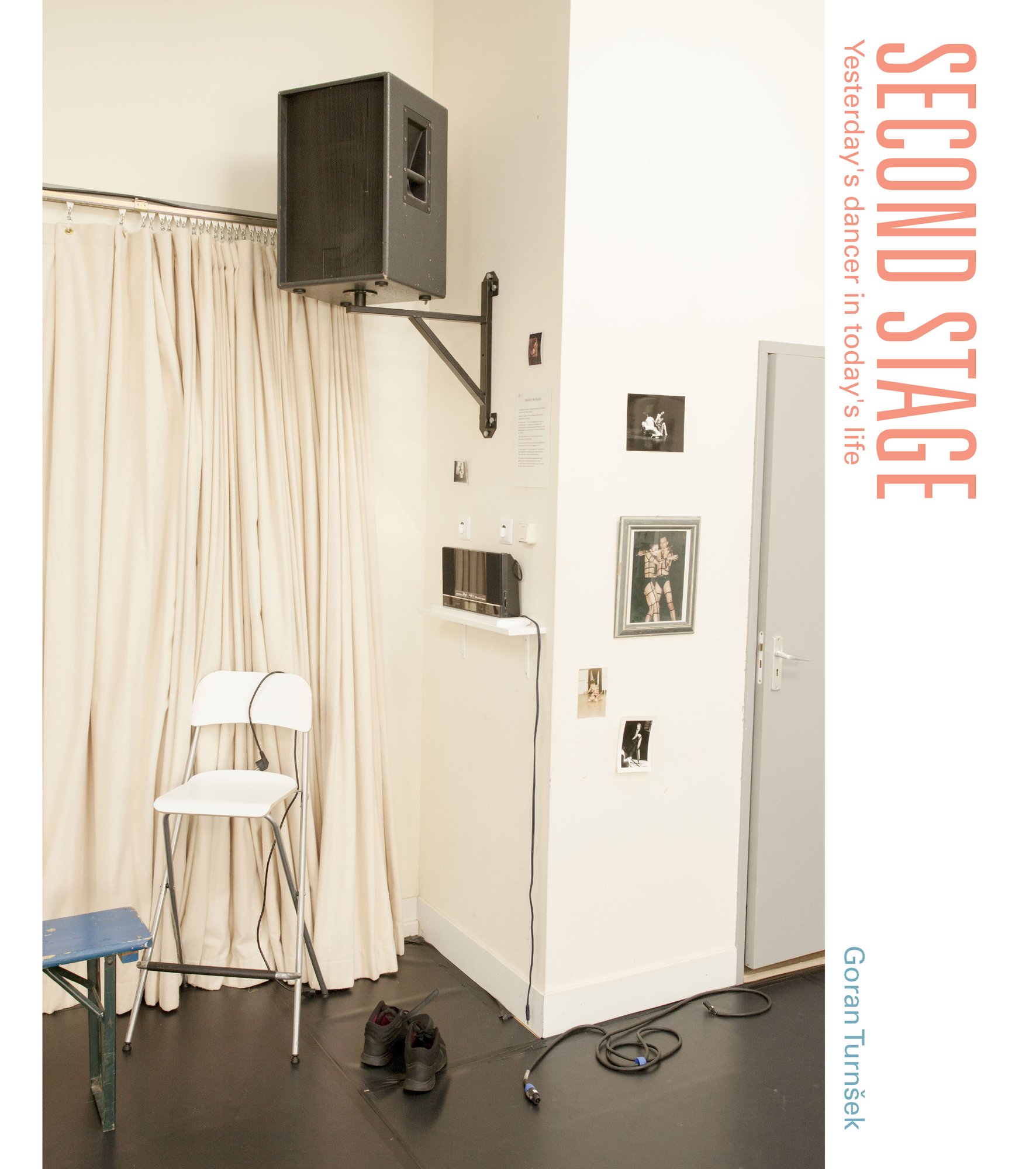
Second Stage
by Goran Turnsek
Most professional sportsmen and women retire before the age of forty. Or if they are not yet ready to rest on their laurels, they retrain for another career that is not so intensively physical. Not only do professional soccer players, gymnasts or cyclists have to start thinking seriously about the next step when they reach the age of about thirty- ve, so do professional dancers. The human body actually starts going down- hill after the age of thirty. No matter how many tricks you might apply to keep up your strength, mobility and stamina, this deterioration cannot be prevented. Many dancers who have made dancing their profession start their intensive training when they are about four years old. And after thirty years of dancing, most dancers have had a professional dancing career of only fifteen years.
The Slovenian-Dutch photographer Goran Turnšek (1978) chose to opt for a new career of photography already during his dancing career. And after a few years of searching, learning and experimenting, Turnšek found a way of working with this medium that was served well by his dancing past. In an almost owing movement from dance (and the memory of dance) to photography, he investigates the space that can be occupied by a dancing body and the movements it can make. For his graduation project Jakob (Fotoacademie Amsterdam, 2015), Turnšek used his own body – still completely steeped in dance memories and suppleness – in a choreographed photo series that focused on visualising and remembering the life of his grandfather Jakob Emeršic, who was unfortunately killed in a hunting accident when Turnšek was still an adolescent.
Dance, movement, rhythm and choreography. At first sight, I wonder what all these have to do with photography. In dance, everything seems the opposite of photography. However, Turnšek makes personal use of his own dancing past to forge exciting links between photography and dance, thus showing that they are actually not so opposed at all. Just as in his Jakob project, in Second Stage he once again bridges the gap between the professional dance world and photography. In Turnšek’s eyes, a new career after dance also offers a sort of stage, on which a role is played, or can be played, through performance. And of course there is no performance without an audience. So for Turnšek the camera has become a new theatre; a stand-in for the audience. And we – a new audience – can now witness how ex-dancers are faring. And see how in their new body they give a performance for Turnšek’s lens; the one ex-dancer's body adapting more easily and quickly to a new life than another.
For Turnšek, the world of photography has become that ‘second stage’, and he has found a way to turn the photobook and the exhibition into choreography and to make photography move. At the same time, it provides insight into and a view of themes that are important to dancers, but do not always get expressed outside physical movement.
Taco Hidde Bakker
Book Information
ISBN:
978-90-9030494-6
Publisher:
self published