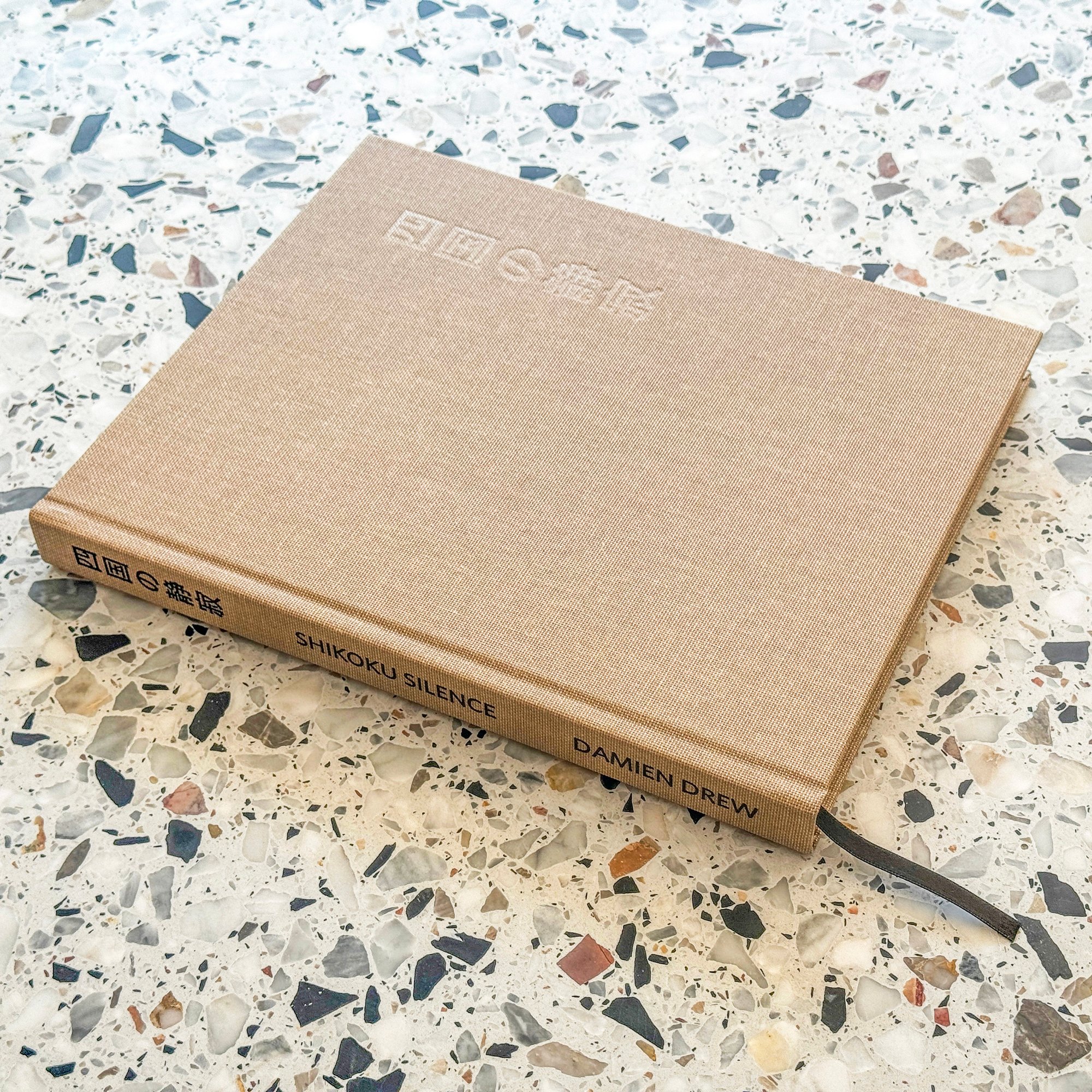
Shikoku Silence
by Damien Drew
Shikoku No Seijaku (Shikoku Silence)
ARTIST PHOTO BOOK
Signed and limited edition photo book. 1 of 200.
26 x 22cm, 62 images, 100 pages, AU$100 + postage.
サイン入り限定版写真集。200部限定。
26 x 22cm, 62枚の写真、102ページ, AU$100+送料
Artist Statement
Shikoku Island is the least populous of Japan’s four major landmasses. The negative effects of Japan’s declining population and the migration of younger people to employment centres on Honshu and Kyushu Islands are starkly evident there.
Many of Shikoku’s elementary schools stand as ‘haikyo’ (ruins), devoid of students due to a lack of local children. Modern yet empty highways cut through the island’s mountainous interior, linking aging ‘shutter towns’ where countless homes and businesses stand deserted. Some consider new large-scale infrastructure to be government vanity projects, executed to project the image of a modern and progressive Japan. These projects fail to connect and inject prosperity into aging communities but instead highlight the increasing decline of Shikoku and the absence of opportunities for young people.
In some regional towns, up to half the residential buildings stand empty and are known colloquially as ‘akiya’ (empty house). The Japanese Government has recently incentivised the purchase of these homes to encourage young people to return to regional areas. In some cases, homes are offered conditionally ‘free’ to young couples if they remain in these towns for a given period.
The population of Nagoro town is now so small that one remaining elderly resident has populated the town with over three hundred ‘scarecrow’ mannequins posed as if undertaking the activities of their former neighbours. These dolls now outnumber residents by ten to one.
While this visual study is geographically focused on the island of Shikoku, it is notable that all forty-seven prefectures in Japan have recorded population declines for the first time. Currently, one in ten people is aged over eighty years old, and hundreds more villages throughout Japan are expected to become economically unviable in the next fifteen years.
This series continues my exploration of the Japanese aesthetic philosophy of ‘wabi-sabi,’ which celebrates the transient beauty found in the impermanence of all things. It is embodied in the modest and imperfect, or in that which carries the patina of years – from a well-loved cooking utensil to the decaying fabric of the built environment.
The Japanese consider ‘wabi-sabi’ to be an aesthetic consciousness that finds value in the imperfect and temporary, transcending the confines of mere appearance. Pertinently, the expression ‘mono no aware’ encapsulates an awareness of the transience of all things, heightening appreciation for their beauty and evoking a gentle sadness at their passing.
This imagery captures the physical decline of the built environment but also celebrates the value of its impermanence and imperfection. Viewers are invited to contemplate the delicate interplay between renewal and decline and to reflect on the quietude and beauty of these vanishing landscapes.
Through ‘Shikoku no Seijaku’ (Shikoku Silence), I aim to capture the melancholic beauty that remains in the wake of the region’s pronounced social change, while documenting the disappearance of vibrant and authentic communities.
The following images form part of a broader series captured in Shikoku, Japan, in 2019. They were shot on a Fuji GFX 50R camera with a GF45mm lens.
ARTIST PHOTO BOOK
Signed and limited edition photo book. 1 of 200.
26 x 22cm, 62 images, 100 pages, AU$100 + postage.
サイン入り限定版写真集。200部限定。
26 x 22cm, 62枚の写真、102ページ, AU$100+送料
Artist Statement
Shikoku Island is the least populous of Japan’s four major landmasses. The negative effects of Japan’s declining population and the migration of younger people to employment centres on Honshu and Kyushu Islands are starkly evident there.
Many of Shikoku’s elementary schools stand as ‘haikyo’ (ruins), devoid of students due to a lack of local children. Modern yet empty highways cut through the island’s mountainous interior, linking aging ‘shutter towns’ where countless homes and businesses stand deserted. Some consider new large-scale infrastructure to be government vanity projects, executed to project the image of a modern and progressive Japan. These projects fail to connect and inject prosperity into aging communities but instead highlight the increasing decline of Shikoku and the absence of opportunities for young people.
In some regional towns, up to half the residential buildings stand empty and are known colloquially as ‘akiya’ (empty house). The Japanese Government has recently incentivised the purchase of these homes to encourage young people to return to regional areas. In some cases, homes are offered conditionally ‘free’ to young couples if they remain in these towns for a given period.
The population of Nagoro town is now so small that one remaining elderly resident has populated the town with over three hundred ‘scarecrow’ mannequins posed as if undertaking the activities of their former neighbours. These dolls now outnumber residents by ten to one.
While this visual study is geographically focused on the island of Shikoku, it is notable that all forty-seven prefectures in Japan have recorded population declines for the first time. Currently, one in ten people is aged over eighty years old, and hundreds more villages throughout Japan are expected to become economically unviable in the next fifteen years.
This series continues my exploration of the Japanese aesthetic philosophy of ‘wabi-sabi,’ which celebrates the transient beauty found in the impermanence of all things. It is embodied in the modest and imperfect, or in that which carries the patina of years – from a well-loved cooking utensil to the decaying fabric of the built environment.
The Japanese consider ‘wabi-sabi’ to be an aesthetic consciousness that finds value in the imperfect and temporary, transcending the confines of mere appearance. Pertinently, the expression ‘mono no aware’ encapsulates an awareness of the transience of all things, heightening appreciation for their beauty and evoking a gentle sadness at their passing.
This imagery captures the physical decline of the built environment but also celebrates the value of its impermanence and imperfection. Viewers are invited to contemplate the delicate interplay between renewal and decline and to reflect on the quietude and beauty of these vanishing landscapes.
Through ‘Shikoku no Seijaku’ (Shikoku Silence), I aim to capture the melancholic beauty that remains in the wake of the region’s pronounced social change, while documenting the disappearance of vibrant and authentic communities.
The following images form part of a broader series captured in Shikoku, Japan, in 2019. They were shot on a Fuji GFX 50R camera with a GF45mm lens.
Book Information
ISBN:
978-0-646-89169-9
Publisher:
self published