Chen Liang 亮 陈's Projects
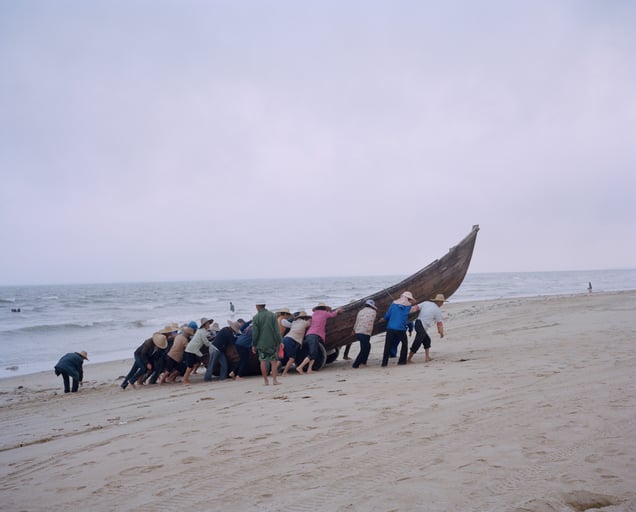
The development and construction of Donghai Island began around 2007. During these ten years, large-scale demolition and construction were carried out in Donghai Island, and some large heavy industry and chemical enterprises built factories here. Dongdao is planned to be transformed into a modern large industrial new city by 2030, and the lifestyle of the fishing and rice town will be replaced by urbanization and industrialization, and the natural island of Xanadu will become an industrial island. In 2013, I returned to my hometown from other provinces and have been working on the hometown project ever since. I have always used medium format film cameras to create. Now I live alone in my childhood village. I want to use images to preserve memories and archives for the hometown that is about to be industrialized or urbanized, and discuss the impact of rural urbanization or industrialization on rural traditional culture and the survival and spirit of farmers, so as to explore where the "hometown" of modern Chinese people belongs. What I have recorded is not only the changing hometown, but also the contradictions and complex changes of human destiny and spirit in the process of China's economic development, urbanization and industrialization in this particular era. In the development of human society, how to deal with things fairly and equally, how to protect traditional culture, and what should be the future of human spiritual beliefs? Talk about what makes a happy, beautiful home. Donghai Island is a typical case of China's development. I will continue to photograph the relationship between farmers and factories who have lost their homes and land, and pay attention to the changes in their identity, mental state and life. I photographed a series of problems caused by urbanization and industrialization in my hometown and responded to them with photography.
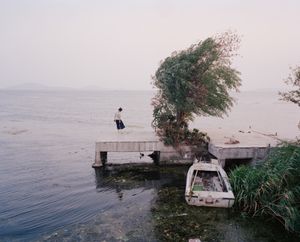
Water is the source of life, most of the ancient Chinese people lived near water, and pay attention to the unity of heaven and man. In recent decades, China has been one of the fastest developing and changing countries in the world. Like all countries, China faces the challenges posed by global warming, air and environmental issues. We live in the same earth and are a community of human destiny. This project started in 2013, mainly around China's lakes, rivers, coasts and other investigation and shooting. I hope to explore the close and complex relationship between human beings and nature in the process of human development, and think about the relationship between human beings and the natural environment in harmony during development. With the continuous emergence of global warming and extreme weather, the living environment of human beings on the earth has been seriously threatened. These images will continue to remind people to take good care of our home and protect our earth.
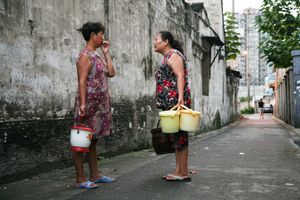
Almost every city in Jiangnan area of China has ancient lanes, most of which are close to the Beijing-Hangzhou Canal, forming the bustling Jiangnan water town ancient town. With the decline of the canal transport and the changes of The Times, these once prosperous ancient towns in the south of the Yangtze River are now surrounded by rising high-rise buildings. The people of Jiangnan who have lived in the old lane for generations still maintain the traditional life style of the original ecology. With the rapid transformation of urbanization, many twists and turns, deep, original flavor of the old lane in the south of the Yangtze River are disappearing in a very rapid way. It is not only the alley that has disappeared, but also the traditional living state and way of life of Jiangnan people, and even the Jiangnan culture. Then the home, then the neighborhood, then the life... Also slowly become our unforgettable memories. From 2007 to now, I have made a large number of records on the water towns in the South of the Yangtze River, taking more than 100,000 photos in more than 10 years to record the life of people in the lanes in the South of the Yangtze River. Now most of the scenes in the pictures have disappeared or changed, and these simple photos record the last life of Jiangnan people.
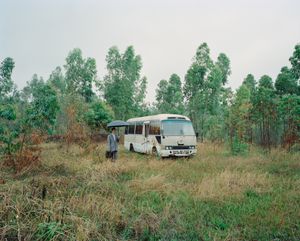
When I was a child, my father went to work abroad and returned home once a year. Every time he came home, he would wear a neat suit, carry a black suitcase and hold a black umbrella, which became my deep memory of my father's image in my childhood and even later. When I grew up, I also drifted away from home, so that I could truly feel what kind of feelings my father was carrying back to his hometown. Nowadays, Donghai Island is undergoing great development, and the hometown is undergoing great changes every day. I want to keep a thought, and through the identity of "father" to express my feelings for my father and hometown. So I wore my father's young suit, carried his suitcase, and once again looked back at this land affectionately as a "father", and took a picture of my hometown one by one.

Water is the source of life, most of the ancient Chinese people lived near water, and pay attention to the unity of heaven and man. In recent decades, China has been one of the fastest developing and changing countries in the world. Like all countries, China faces the challenges posed by global warming, air and environmental issues. We live in the same earth and are a community of human destiny. This project started in 2013, mainly around China's lakes, rivers, coasts and other investigation and shooting. I hope to explore the close and complex relationship between human beings and nature in the process of human development, and think about the relationship between human beings and the natural environment in harmony during development. With the continuous emergence of global warming and extreme weather, the living environment of human beings on the earth has been seriously threatened. These images will continue to remind people to take good care of our home and protect our earth.
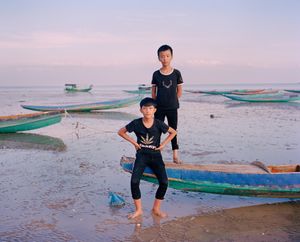
Donghai Island, the fifth largest island in China, has been transformed into a major island of heavy industry in the past decade. Many original residents have been forced to leave their hometown due to requisition of land and other reasons, posing new challenges to the traditional culture and lifestyle of Donghai Island. The air and environment here have also deteriorated. In 2013, I returned to live on the island and used a film camera to document the friendly faces of the people there. I want to remember them through photos and preserve a memory of my hometown. The works I captured in my hometown not only document the love and courage that the people of my hometown display as they face significant changes and new challenges in their environment and air, but also reveal their unyielding dignity and complex inner conflicts. These ordinary faces, simple, kind, resilient, unyielding, optimistic, and brave, are a testament to the resilience of the human spirit. I also hope to explore the multifaceted and complex nature of human beings through portrait photography.

Donghai Island, the fifth largest island in China, has been transformed into a major island of heavy industry in the past decade. Many original residents have been forced to leave their hometown due to requisition of land and other reasons, posing new challenges to the traditional culture and lifestyle of Donghai Island. The air and environment here have also deteriorated. In 2013, I returned to live on the island and used a film camera to document the friendly faces of the people there. I want to remember them through photos and preserve a memory of my hometown. The works I captured in my hometown not only document the love and courage that the people of my hometown display as they face significant changes and new challenges in their environment and air, but also reveal their unyielding dignity and complex inner conflicts. These ordinary faces, simple, kind, resilient, unyielding, optimistic, and brave, are a testament to the resilience of the human spirit. I also hope to explore the multifaceted and complex nature of human beings through portrait photography.