


Announcing 38 Award-Winning Black & White Photographers!




“ The submissions to this year’s LensCulture Black & White Photography Awards proved that black and white photography remains a relevant, potent, and lively medium for expression in 2023. I was incredibly impressed by the high quality overall, the wide variety of subject matter and approaches, and the expressive range conveyed in black, white, and grays. ”


picks

There is a sense of mystery within these images that is created both by the scale and the limited context within the landscape. They are full of texture but devoid of color, leaving a great sense of unknown. The images in Caldera by Andrei Bortnikau pique my curiosity. There is certainly an implied narrative within each image as told by the photographer, and for me, it seems that each narrative takes further shape in what the viewer brings to it. The images might evoke a nostalgic memory or tell a new story to each person who encounters them.

In the realm of contemporary art, Jennifer Baron’s Frozen August stands out as a profound exploration of grief, a theme that is both deeply personal and universally resonant. This project gains its importance from its ability to articulate the ineffable aspects of human experience, notably the complex process of mourning. By channeling her bereavement into a visual form, Baron not only navigates her own path through sorrow but also extends a hand to those grappling with their own losses.
The societal value of such work lies in its capacity to foster empathy and communal healing. Art has long been a medium for processing collective grief—public memorials and war photography are testament to this—and Frozen August contributes to this tradition by providing a space for shared emotional experiences. Baron’s choice of combining various media, such as photography and sketches, allows for a multifaceted dialogue between the work and its audience, enabling a cathartic interaction that transcends the limitations of verbal communication.
Baron’s work captures the beauty inherent in the human condition, even at its most vulnerable. The stark contrasts of light and shadow in her images mirror the oscillating states of hope and despair that characterize mourning. The intimacy of the project is further heightened by its autobiographical nature, as it invites viewers into the artist’s inner sanctum, laying bare the scars of her heartache.
Historically, the project echoes the sentimentality and raw emotion found in the early 20th-century pictorialist photography, where the likes of Julia Margaret Cameron and Edward Steichen used soft focus and creative printing techniques to evoke mood and feeling. Like these pioneers, Baron employs abstraction and intimate detail to convey complex emotional states. While the visual style is distinct, her work also resonates with the contemporary candid and intimate narratives found in the photography of Sally Mann and Nan Goldin, who document their private lives to powerful, sometimes controversial effect.
Frozen August is a testament to the enduring power of art to articulate the depths of human emotion, commemorate our losses, and aid us in a journey towards acceptance and peace. The project is an important cultural artifact, not just because of its aesthetic quality but also because it invites us to connect more deeply to our own humanity.

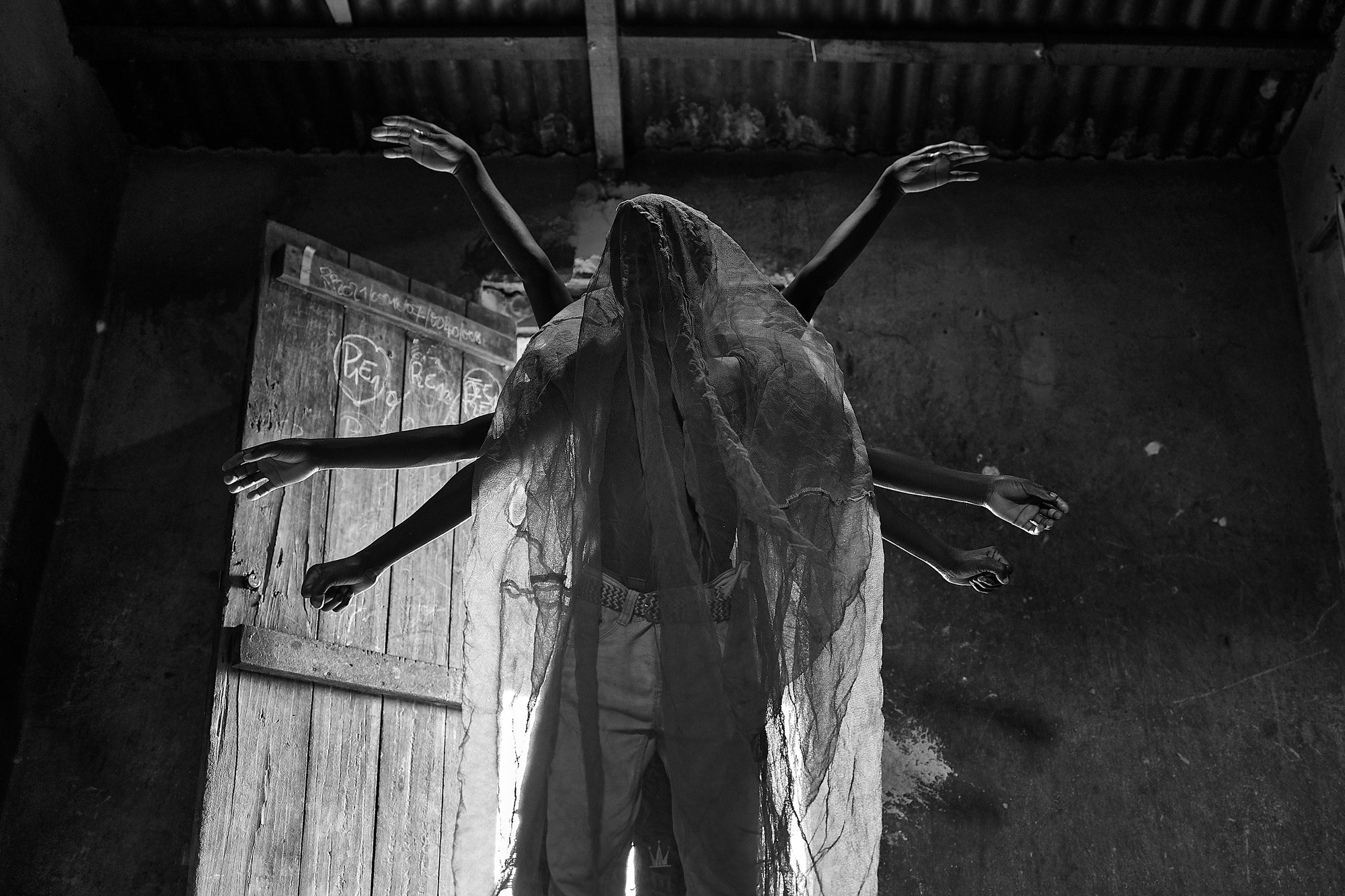
I picked Russell Monk's work as my juror's pick because the images are evocative, mysterious, and surprising. The formality and careful composition in each frame blurs the line between documentary and fine art and makes me think of how many stories and myths are layered into each image.

The photographs of Igor Malijevský give me pause, and makes me stop to look a bit more carefully at how the war in Ukraine is disrupting everyday life for ordinary people in countless ways. It’s not sensational, it’s not shocking, but it’s real. It takes hold of the qualities that only black-and-white can give you, and it presents this view of people who quietly persevere and carry on in the face of adversity. In our age of always-on media, and the immediacy of smartphone reporting, these traditional images break through the clutter and remind us of the continuous, endless sacrifices required to get through day after day in Ukraine.

Serinah Williams’ work is a captivating exercise that seeks to reveals the effects of truth, power and rights. The works raise important questions about the often-silenced histories of communities like Williams’. What histories are lost? What geographies are changed? For me, this series confronts the continued repercussions of the legacies of colonial violences that still prevail and unfold today.

Imagination that springs out of the ordinary and mundane attracts me. In this series The Peak by Jingyu Wu this can be read as a goal. The images explore mankind’s omnipresent challenge to close the gap between man and nature. Aside from my own reading, the formal approach is unassuming, and the black and white images effectively present Jingyu’s ideas and observations about the nature that exists right in front of his eyes.

Form and content are inextricably intertwined in Nicola Ókin Frioli’s powerful photographs of the struggle of indigenous Amazonians in Ecuador to protect their land, water, and way of life from further destruction by extractive industries. Each exquisitely structured composition, each choice of warm or cool black-and-white tonalities, conveys an emotional aspect of the narrative: conflict, curiosity, play, pollution, despair, pride, and tenderness. Frioli’s nuanced telling of this story conveys the complexity of these indigenous cultures, which needed to blend aspects of modernity into their traditional ways of life in order to survive.
“ I enjoyed looking through the array of black and white photographs being made today. Overall, the caliber of photographs submitted were high; they provided moments to focus, pause and reflect on the nuances we are seeing unfold around us everyday. ”


Our International Jury

Bindi Vora is an interdisciplinary photographic artist of Kenyan-Indian heritage, Associate Lecturer at London College of Communication and Curator at Autograph, a London-based non-profit arts charity that explores issues of identity, representation, human rights and social justice through photography. Since joining Autograph, she has curated Hélène Amouzou: Voyages (2023) Eric Gyamfi: Fixing Shadows – Julius and I (2023), Poulomi Basu: Fireflies (2022), co-curated Sasha Huber: You Name It (2022) Care I Contagion I Community – Self & Other (2021-2022); Lola Flash: [sur]passing and Maxine Walker: Untitled (both 2019); published a series artist conversations with Sasha Huber, Mónica Alcázar-Duarte, Maryam Wahid, Tobi Alexandra Falade, David Uzochukwu amongst others. She has independently curated Poulomi Basu: Centralia for Rencontres d’Arles – Louis Roederer Discovery Award (2020); Let’s Go Through This Again (2018); her writing has appeared in publications by Maryam Wahid Zaibuinnisa (MAC, 2022); Another Country: British Documentary Photography Since 1945 (Thames & Hudson); FOAM and British Journal of Photography, participating in public programmes for Tate, GRAIN Photo Hub, The Photographers’ Gallery, The Paul Mellon Centre amongst others. She is currently an artist-in-residence at the National Museums NI (Ulster Museum) as part of the 20/20 project, led by the UAL Decolonising Arts Institute.

Aya Musa is a curator at FOAM, the prominent photography museum in the Netherlands. Musa develops exhibitions at FOAM that provide a deepening and innovative interpretation of the museum’s artistic identity. Prior to this, Musa was a curator and head programmer at the Dutch Photomuseum. In his work, Musa combines social developments with new exhibition forms; where photography is not subordinate to the context from which it arises, but at the same time never loses sight of this context. In this way, he gives photography a stage that goes beyond existing clichés.

Caroline Wall is the director of the Robert Mann Gallery. She graduated from McGill University with a degree in Art History and began her career in the art world at the O’Hara Gallery before joining the team at Robert Mann Gallery in 2006. Robert Mann Gallery features several emerging artists along with an impressive roster of international superstars.
With the gallery, Caroline has participated in many national and international art fairs and works with numerous contemporary photographers and estates organizing both solo and curated group exhibitions. Caroline is a member of the Board of Directors of AIPAD.

Danielle A. Scruggs is a Photo Editor at The Wall Street Journals and a freelance photographer and writer living in Chicago, Illinois. She graduated from Howard University with a degree in journalism and from the Maryland Institute College of Art with a Master’s in Digital Art. Her photography clients include the New York Times, AARP, Buzzfeed News, ESPN, Financial Times, and the New Republic. She has written about art, culture, and film for RogerEbert.com, Ebony, Essence, Teen Vogue, Artsy Magazine, and other publications. Scruggs is also the founder and editor of Black Women Directors, a digital library highlighting the work of Black women and non-binary filmmakers throughout the Diaspora.

Barbara Tannenbaum has organized well over 100 exhibitions during her four-decade career as a curator and academic. From 1985 through 2011, she was chief curator at the Akron Art Museum, where she grew the photography collection from 500 to 2,500 works. She has authored numerous publications including books on TR Ericsson, Ralph Eugene Meatyard, and print-on-demand photobooks, and lectured throughout the U.S. and in Canada, Brazil, and China. As Curator of Photography at The Cleveland Museum of Art, Barbara’s recent and future shows have focused on 19th and 20th century artists including Raja Deen Dayal, American Pictorialist photographers, Ilse Bing, Lois Conner, Aaron Rothman, Tyler Mitchell, Matt Eich, Barbara Bosworth, and Ann Hamilton.

After six years of experience in museum management, Gwen Lee went on to pursue her first love for photography and founded Singapore International Photography Festival (SIPF), the longest running photography festival in Southeast Asia. In 2014, Lee and her team built DECK, an arts centre dedicated to photography arts to provide year-round programming for the community and residency programmes for photographers. Lee has curated over 60 photography exhibitions in Singapore and overseas. In addition to many other awards and honors, in 2022, Lee was a Recipient of Chevalier, Ordre des Arts et des Lettres conferred by Ministry of Culture, France.

Jim Casper is the editor-in-chief of LensCulture, one of the leading online destinations to discover contemporary photography from around the world. As an active member in the contemporary photography world, Casper organizes annual international photography events, travels around the world to meet with photographers and review their portfolios, curates art exhibitions, writes about photography and culture, lectures, conducts workshops, serves as an international juror and nominator for key awards, and is an advisor to arts and education organizations.
