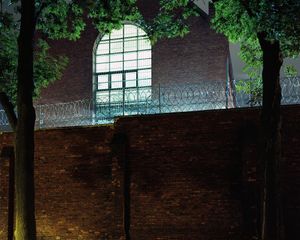
Gemütlichkeit (2015-2022)
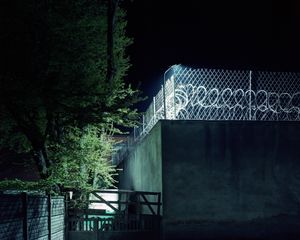
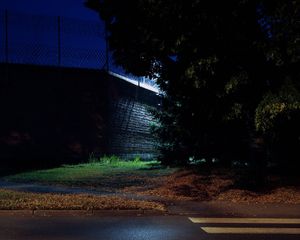
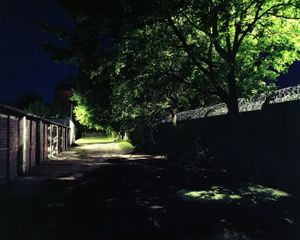
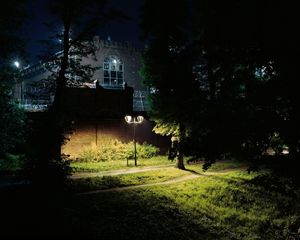
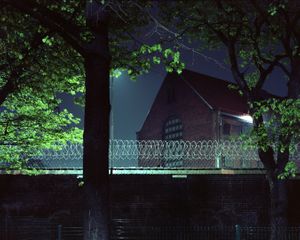
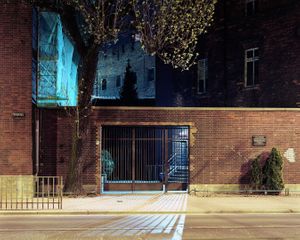
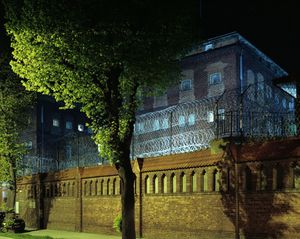
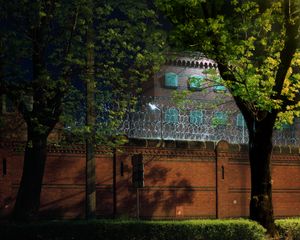
One warm spring night, I saw a soothing, beautiful urban landscape. It was banal, yet I stopped to look at it more closely. I quickly realized that what at first seemed ordinary and pleasant also carried something ominous. Idyll can be the daughter of horror and unease. We see only as much as we know – and as much as we are ready to notice. For years, I have been inspired by Walter Benjamin’s reading of Charles Baudelaire. According to him, the French poet took a critical stance toward the phantasmagorias of modernity, using aesthetic shock to shatter the illusions of totality, beauty, and temporal continuity. He contrasted the idea of progress with a permanent state of catastrophe. Benjamin considered catastrophe an inherent feature of life in large cities: “Hell is not what awaits us, but life here and now.” Catastrophe exists in the present. Benjamin argued that Baudelaire introduced unknown tensions into seemingly tranquil spaces, disrupting the appearance of harmony. He anticipated the aesthetic decay of the artwork and its historical fragility. The way out of catastrophe is not its denial, but its constant anticipation. By breaking the phantasmagoria of urban life, Baudelaire recovered an experience impossible outside the collective. Shock pulled the passerby from the stupor that, in the mechanized crowd, isolated him from others. The poet also employed allegory – a powerless sign with arbitrary qualities, in which everything could mean something else, and nothing exactly what it appeared to be. In this way, he freed us from the illusion of unity between essence and phenomenon, object and representation, dismantling entrenched forms of linguistic imagery. Benjamin called Baudelaire’s expressive means “images of frozen unrest.” Catastrophe, incoherence, and singularity are most fully revealed when illusion disappears – behind closed eyes. Today, the world is even more entangled in phantasmagorias, largely through new ways of experiencing reality via images. Do you see what I see? Gemütlichkeit is an aesthetic concept in the visual arts, emphasizing the cozy, familiar character of pictorial representations. Paintings in this spirit often fell into the convention of kitsch – simple, bourgeoisly soothing, banal, and above all, falsely free of internal tensions and conflicts. It was not only the images themselves – theorists often designed specific ways of seeing and interpreting. I wanted my photographs to break this convention of representation and perception, challenging the habits we have grown accustomed to. Technical info: These photographs of disturbing spaces built on contradictory elements were taken in 2015-2022 in seven cities in Poland. Presented spaces acquire their specific character only at night and at a certain time of the year. I chose spring/early summer when plant leaves were fresh green. I photographed at night, when street lamps illuminated the lush green trees and the lighting behind the walls made the barbed wires shine distinctly. All photographs were taken with a 4x5 inch Tachihara camera with 90 and 150 mm lenses using the Kodak Ektar 100 negative film. The exposure time ranged from 15 to 60 minutes. When cars passed down the street, I covered the lens with a darkslide from a film holder without closing the shutter.
No categories selected
Photos (9)