Red Hook, Brooklyn
Lisa Cutler
Named for both its red clay soil and its land projecting in to New York Bay, Red Hook, Brooklyn is a neighborhood steeped in rich American History.
Red Hook is not the first American neighborhood to be destroyed by shifting industrial trends and powerful urban planners. These planners devastated communities by severing their main streets to create new highways. In 1939, Robert Moses built the Gowanus Expressway, which sliced through Red Hook diagonally. Soon after, in 1940, the Brooklyn Queens Expressway trenched through its working class neighborhoods. In 1959, Lewis Mumford of The New Yorker wrote, “But what is Brooklyn to the highway engineer - except a place to go though rapidly, at whatever necessary sacrifice of peace and amenity to its inhabitants.” Red Hook became physically separated from the rest of Brooklyn.
Red Hook, once the busiest port in the world, a community rich with immigrant workers, became a neighborhood of high crime, abandoned warehouses, vacant industrial lots, wildly overgrown parks, and dilapidated buildings.
It is years later…there is new construction, less crime and the beginning of new a Red Hook. To tourists, the torn down industrial vibe is cool.
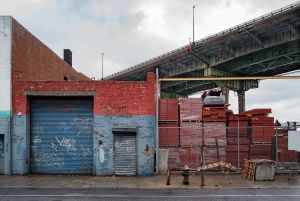
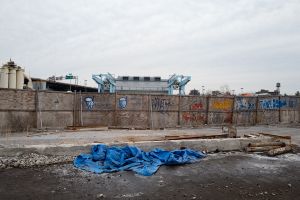
In my recent project on Red Hook, I find a post industrial part of the city where the story is in the quiet details. I see what’s left of its industrial past. I find empty lots and imagine what might have been. I hear the cheers of children behind fenced off, wildly overgrown playing fields. I see the beauty, often delicacy, of strewn trash juxtaposed on modern urban construction,
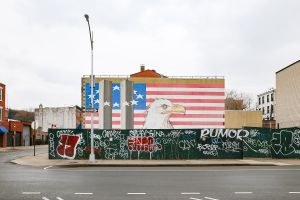
and art on fences beautifying decaying walls and ancient factories. Then, there is the looming Gowanus Expressway. If you look, you can find it almost everywhere.
In my photography, I am interested in discovering beauty away from traditional aesthetics. I try not to embellish or glorify what I see, but rather to keep it free of artifice. The geometry in my visual field guides my eye. I find cubist structures of the industrial revolution. Building and destruction …we are left with the cube, the block, the foundation.
In my pictures the vertical line replaces what is missing in this neighborhood. The tall buildings and the trees have all been stripped from the environment. Where is the strength and dignity in this neighborhood? We see them in gates and lamp posts and the fences.