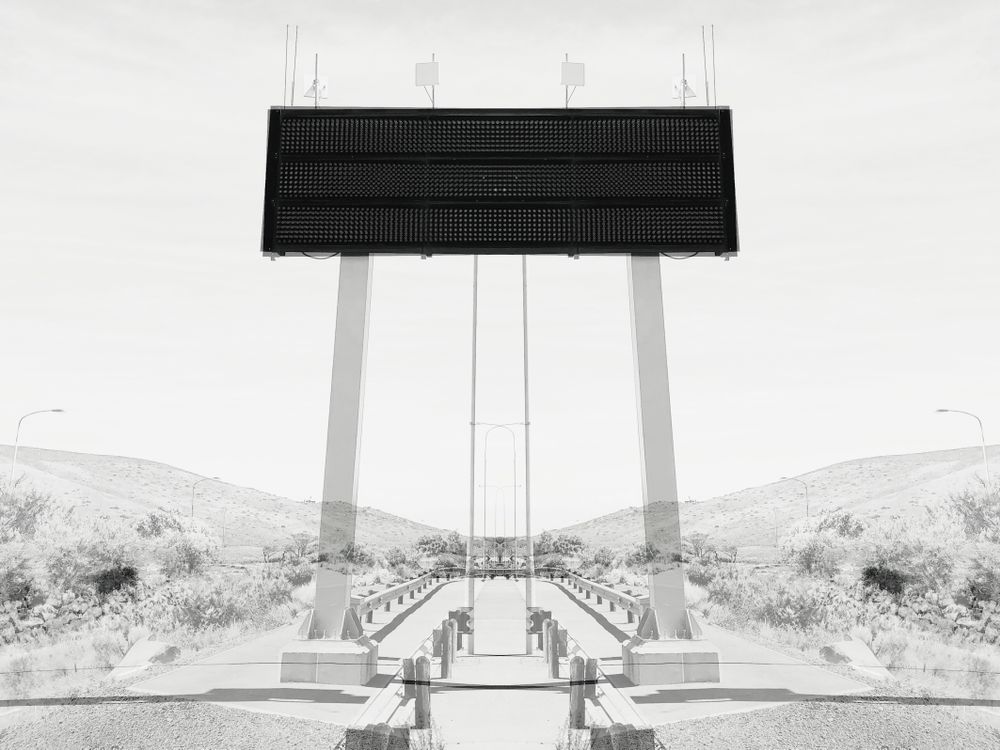
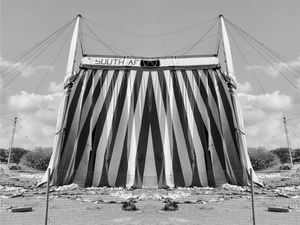
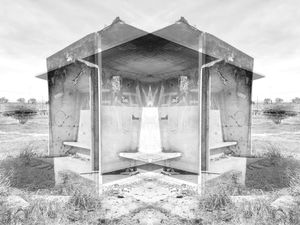
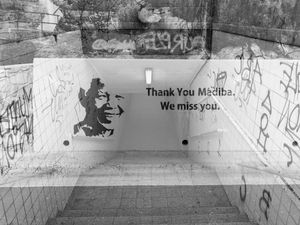
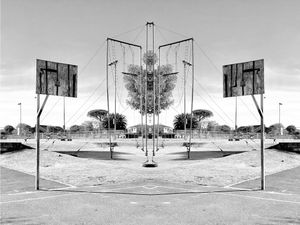
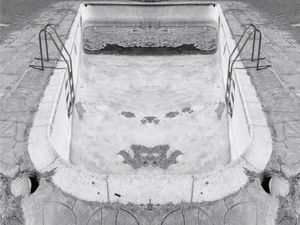
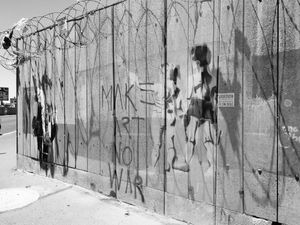
My first reaction to these photographs was to shiver. Two sentences came to mind, by I know not whom – ‘Africa is a cold country where the sun always shines’ and another – ‘The touch of the devil is as cold as ice’. In the Bible of my youth, hell is hot and God can speak through burning bushes. This was the art history book most of us started with. Memory loves associations. Alastair Whitton's photographic Rorschach tests show veiled layers, but have clear titles. We cannot dream without being hurt. We are lead to a place called Cape Town. I was born there in 1953 and grew up in parts around there till 1976 and my mother tongue is still closer to ‘Kaaps’ than any other language. These works carry the sound of dry grass with the wind sweeping across the sands of the Cape Flats smelling of Sunlight soap and as I re-read the of poems of Adam Small (South African 1936 -2016 ) I weep.
Marlene Dumas, Amsterdam, July 2019
*Excerpt from Marlene Dumas' introductory text to 'A Foreign Land' by Alastair Whitton.
When Walter Benjamin described Atget’s photographs as ‘the scene of a crime’, it was the photographer’s ability to conjure portentous meaning within the seemingly nondescript which compelled him. 'Is not every spot of our cities the scene of a crime? Every passerby a perpetrator?' Benjamin asks. 'Does not the photographer – descendent of augurers and haruspices – uncover guilt in his pictures?' Something akin is at work in Whitton’s photographs. But it is not only guilt which informs his photographs, but the realisation of a more complex psychic entanglement of blight and hope. Whitton’s photographs do not declare their intent nor distract us with the gloss of the iconic. Rather, they ask us to linger within the spectre of a charged and fleeting moment that is both personal and impersonal. For if the artist’s quiet biography is implicated in the remaking and suturing of a psychically conflicted moment, this is because Whitton well recognises that he occupies a role in a drama that is never solely of his own making. He is both a perpetrator and a witness of a South African story – indeed the story of the world – in which immunity becomes impossible, and complicity inevitable. His photographs, then, are the enigmatic fragments of a time and place for which no record is ever final.
*Excerpt from Ashraf Jamal's essay - entitled 'A Stranger Cargo' - on the photographs of Alastair Whitton , July 2019.
Ashraf Jamal is a Research Associate at the Visual Identities in Art and Design Research Centre, University of Johannesburg. He is the author of ‘In the World: Essays on Contemporary South African Art’ (Skira, 2017).