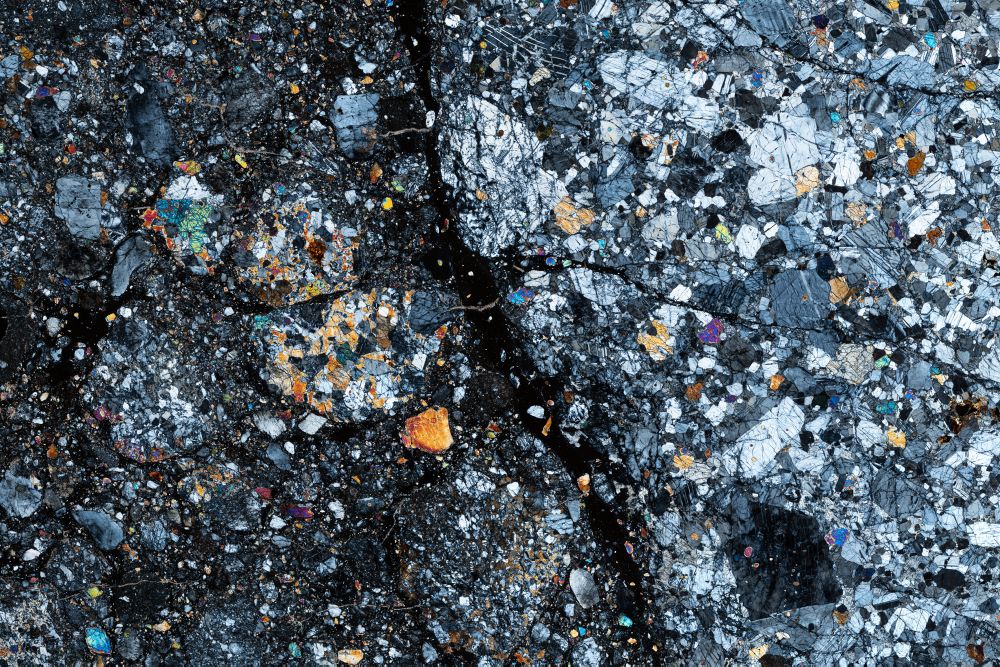
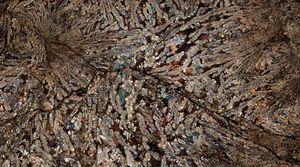
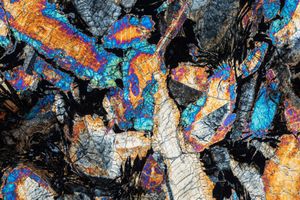
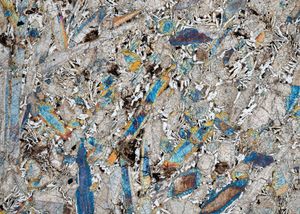
Cosmic Microscapes is a project that marries science and art in a most extreme way. For eons, humans have peered into the cosmos wondering what’s up there. Occasionally, pieces of the Moon, Mars, and asteroids land on Earth and only a fraction of these meteorites are ever recovered. Through a collaboration with Dr. Tony Irving, a geochemical scientist and meteoriticist at the University of Washington, I have photographed some of the world’s rarest meteorite specimens to reveal micro-landscapes from other worlds.
The technical aspects of this project are quite ambitious. Tiny meteorite samples, no larger than 2 cm by 3 cm, are mounted to glass slides and sliced 30 microns thin, 1/3 of the thickness of human hair and nearly transparent. Existing macro photography equipment was not capable of expressing enough detail in such tiny specimens so I designed and built my own micro-panoramic imaging system, which captures just 2 mm of the meteorite at a time. Up to 500 images are combined to produce a staggeringly high resolution image file. In some cases, the resulting image can be printed up to 30 feet wide, 40 thousand times original size, without any pixelation or degradation of quality.
For me, the goal of fine art photography is often to render an interpretive abstraction of reality, rather than merely documenting what is seen. These images of meteorites, however, represent real objects from space, rendered with little interpretation. They are completely natural, documentary in the extreme, yet utterly abstract. When printed very large and viewed at close distance, these enormously detailed images are deeply immersive, evoking a profound state of visual contemplation.