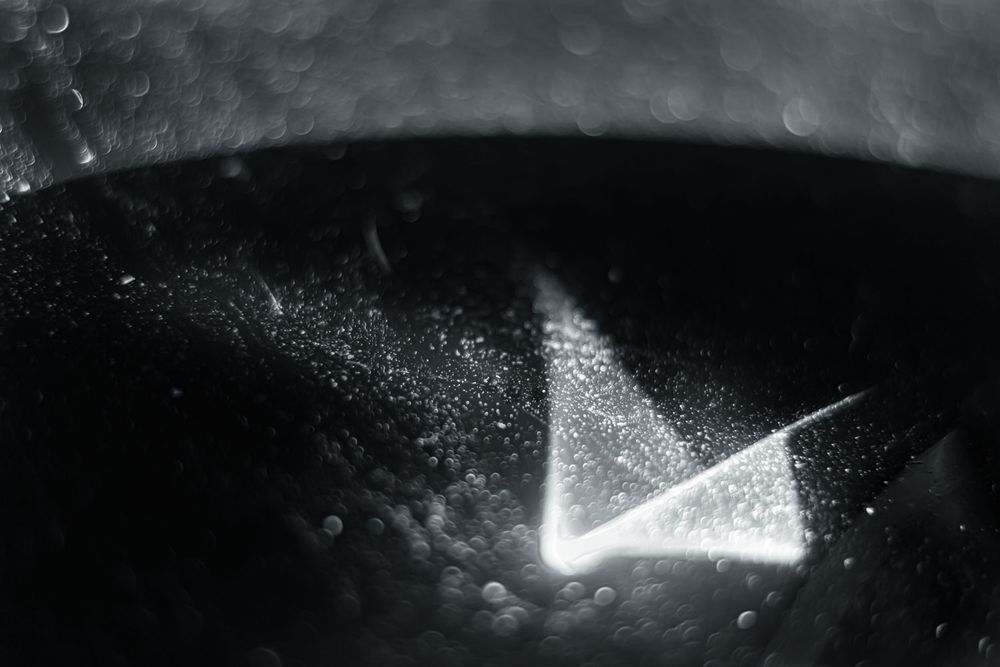
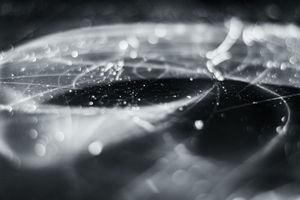
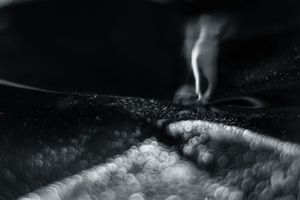
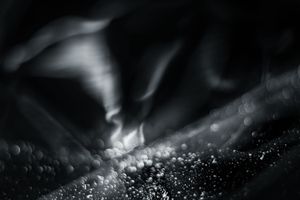
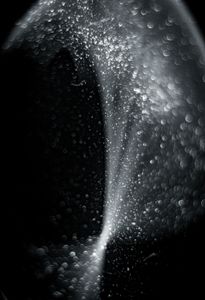
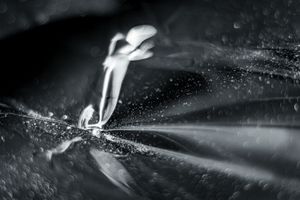
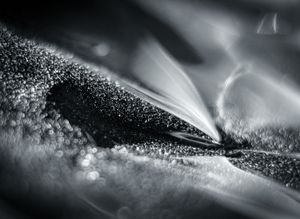
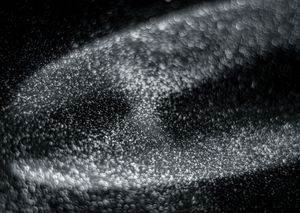
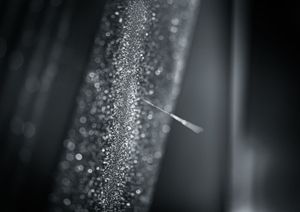
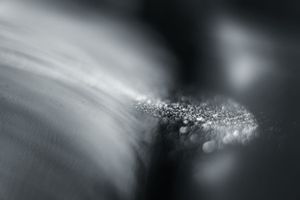
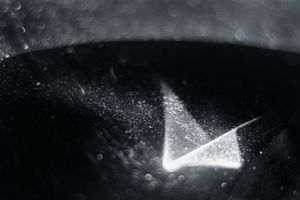
The Nature of Particles series consists of abstract photographs of ordinary particulates that we observe in our everyday surroundings as floating fragments seen in shafts of light.
The genesis of this concept revealed itself earlier this year from a combination of circumstantial and cognitive sources, as precautions and ultimately self-quarantine measures took hold in New York due to the Covid-19 pandemic. With an interest in art and science, I was left to interior observations which felt like harkening back to a time of DaVinci or Thoreau and detached observation of nature. My Nature of Particles series allows a safe distance for one to contemplate both positively and more recently, negatively, what could be happening below the threshold of unaided human sight. I capture the particles in motion. These tiny spheres seem to whirl in unseen eddies, roil in orbits, settle in spots and move on to circulate on invisible flowing currents of air. I use this commonplace occurrence to explore interesting visual possibilities that might remind us of a starry sky, or finely stirred deep ocean sediment or even as a visual immersion within a stream of flowing bubbles. The scale is intentionally left unknown by providing no familiar object for comparison. It is left to the viewers imagination to wonder if the image could be the bright spots in the Milky Way or atoms seen through a high-tech microscope.
To capture the particles in motion and at their scale, I worked with specks of dust about 40 microns wide, at the limit of what we can see without the aid of lenses. (By comparison, a grain of beach sand is about 100 microns and the Coronavirus is .14 microns in size.) Our environment has always been full of floating particles some harmful and others innocuous. Household dust is a combination of materials like hair, skin flakes and dander. The dust particles photographed were sifted so the finest round dust could be grouped and positioned on various custom-made surfaces depending on my photographic intent. Using small air blowers, I controlled and moved particles in short, timed bursts providing the appearance of motion. Lighting was achieved from daylight filtered through large heavy glass optical scraps salvaged from a huge old demolished telescope. The light rays arriving from our sun 90 million miles away, streamed through large 12-inch diameter pieces of old lenses and acting like a warped magnifying glass, provided the light that gave a twisted, structural and unique quality to the particles and image. These well-placed light waves aimed on the surface of particles, combined with modern photographic technology, were used to create images reminiscent of the imaginative worlds these old lenses were originally designed to discover, and then captured with macro lenses on a digital camera. This process takes full advantage of current lens design combined with lighting to narrow the points of focus to the intended particles and then seamlessly transition the viewer to other parts of the images revealing motion and direction.
The “Nature of Particles” Portfolio consists of 30 photographs created in the artist’s studio in New York during the winter/spring of 2020. Captured with digital media, the final photographs are produced by the artist in limited editions on museum-quality archival paper.