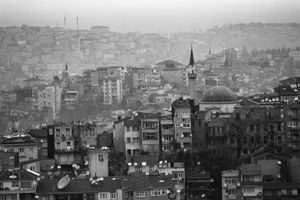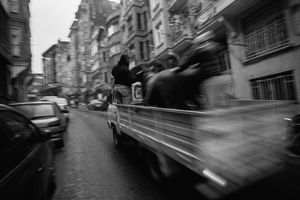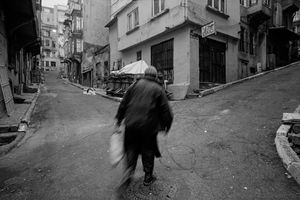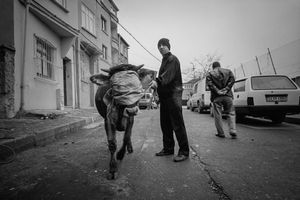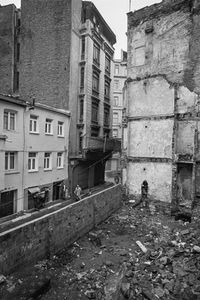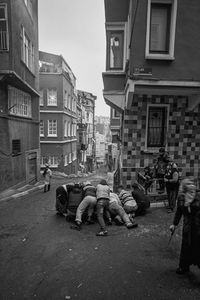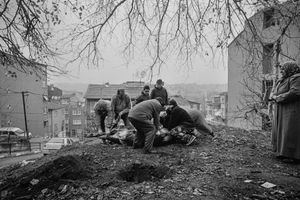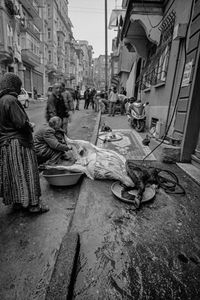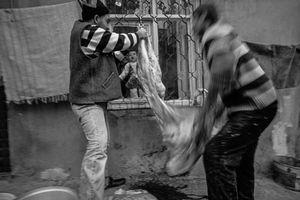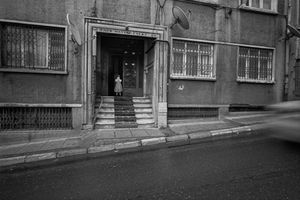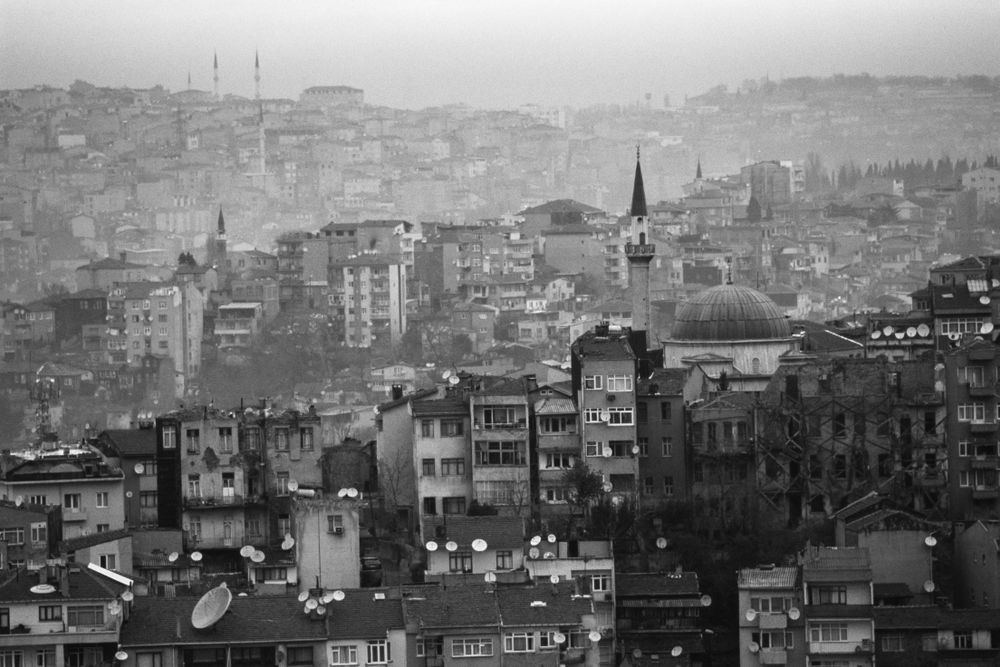

A day, during Eid-al-Adha celebration in Tarlabasi - Istanbul
On the dawn of December 20th 2007, I leave behind me the clamorous, as usual, Tarlabasi Avenue to enter the Tarlabasi district. I cross my path with lonely figures in the narrow winding alleys as I lose myself in the morning mist and fog. The sounds gradually get distant while the fog thickens. Dark streets lie everywhere and the frequently abandoned buildings. Nothing portends what is to follow. It all happens at great speed, rather like a conspiracy and everything is over a few hours later, in this incredible scenery. The streets are cleaned up, the big plastic bags have been removed to their destination… Known as the Fair of Sacrifice or the “big Eid”, it is one of the two great religious fairs of Islam. The other is the Eid al- Fitr. During the celebration of Eid-al- Adha, they buy a cow or a ship depending on their means, they slaughter it ceremoniously and distribute the meat to the poor and to their families. They separate the meat into three parts, one for the family, one for the friends and relatives and one for the poor and needy. This ceremony has officially been banned in the city and in recent years the ceremonious slaughter takes place mainly at the edge of the city, in open spaces. The Eid-al-Adha celebrations in Tarlabasi indicate the religious commitment of those who carry it out under conditions which defy the rules. These pictures are part of a mosaic of the memories of the troubled history of the neighborhood and of the people who have left their imprint there. Tarlabasi is a large district of the 16th century, lying very close to Taksim square, an important commercial and tourist center of the city. Contemporary Tarlabasi was born out of a state of violence. On September 6, 1955, Turkish nationalists, after a planned and successful riot against the Greeks of the city, uprooted violently the citizens who, up to that time, used to be an important part of the urban middle class. After the violent events it was abandoned until the 1980s when Roma, Kurdish population, Africans and recently Syrians, settled in. The area remains a shack town where whoever needs a place to stay finds refuge. For a long time, the captivating Tarlabasi has offered a lively area for minority groups of migrants, Roma, transsexual individuals. The citizens avoid this area. With the project “ Tarlabasi ve Ben” since 2007 the renovation of the area has been planned, foreseeing the relocation of many of the current inhabitants. The reforming scheduled should not turn the area into a sterile tourist destination resulting in the full social change of its population and the demolition or essential alteration of historic structures which define it. There should be some real potential for coexistence and, in my opinion, such a thing will be to everybody’s benefit. These pictures come from a photo project carried out in Istanbul in 1990s, on the life of some historic areas of the city. The whole of the project in BW 135 and 120 negative films, remains unpublished.
No categories selected
Photos (10)