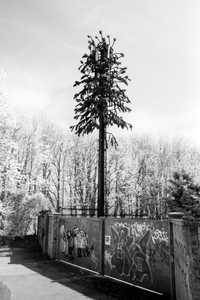
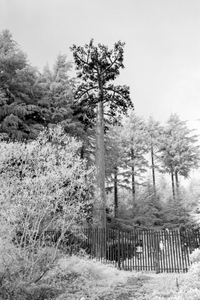
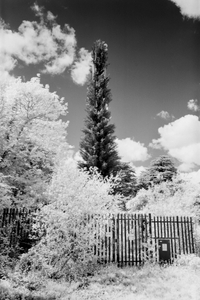
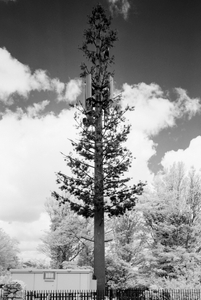
‘Impressions of Nature’ emphasises a characteristic specific to the medium of photography; the capability to draw attention to subjects that may otherwise go unobserved. To illustrate this capability my work takes as its starting point the mundane, in the form of utilitarian structures that we would perhaps prefer not to see. The mobile phone masts which have now become a ubiquitous sight over the past 30 years in the landscape of contemporary Ireland can be considered to be such structures. Reflecting a desire for the mundane not to dominate our surroundings some of these masts have recently been camouflaged with artificial foliage so as to appear as trees. In order to interrogate the relationship of such masts with the surroundings that they inhabit I have deployed the specific medium of black and white infrared film.
Our perception of visible light is limited to a range of wavelengths from 400-700 nanometres (nm), normal analogue film and electronic camera sensors have been designed to operate within this range. Near infrared radiation has a range between 700-1000 nm and can, through the use of filtration and material that is photosensitive to this range, be made visible. Just like with visible light, different materials are more reflective of different wavelengths. The chlorophyll present in plant tissue is particularly reflective of infrared radiation. This can result in a representation of natural foliage in intense whites, in stark contrast to artificial foliage not containing this chemical compound, thereby allowing these masts to be clearly identified. The series of infrared radiation images that have been produced thereby reveal that these camouflaged masts provide a mere simulacrum of nature. In addition, having been produced as a result of photons hitting photosensitive material these images can be considered, in the words of William Henry Fox Talbot, to have been ‘impressed by Nature’s hand’.
By revealing the effects of infrared radiation the images also allude to physical phenomena around us that we cannot observe; such as the presence of lower frequency electromagnetic radiation necessary for the transmission of mobile phone signals via such masts. Thereby emphasising the capability of photography to heighten our perception of not just what is visible but also what is not.