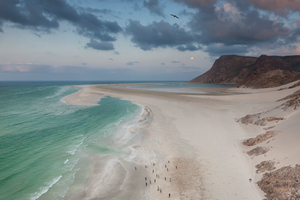
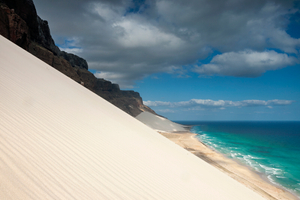
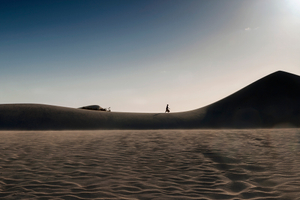
This piece of Yemeni land, located in the Indian Ocean, off the Gulf of Aden, has long remained the secret of merchants and explorers. The "Galapagos of the Indian Ocean" is an exceptional place full of a thousand legends, starting with the one linked to his name: the word Socotra would derive from a Sanskrit expression "dvipa sukhadhara", meaning "the blessed island".
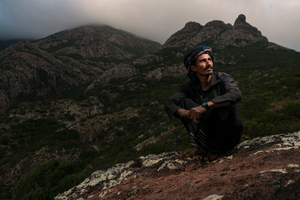
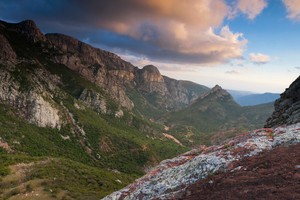
However, at first glance, the land is arid and rocky, the dark cliffs are lost in the clouds, and Egyptian vultures are flying above strange and singular plants. Socotra gives itself a look of inhospitable land as if it wanted to keep its fabulous landscapes hidden or keep the secret of its flora and fauna from another age. This 140 by 40 kilometer piece of land, which broke away from the Horn of Africa thirty million years ago, is considered as "a precious ark of Noah", "A masterpiece work of evolution" by experts that described the archipelago in 2008 when it was registered on the UNESCO World Heritage List.
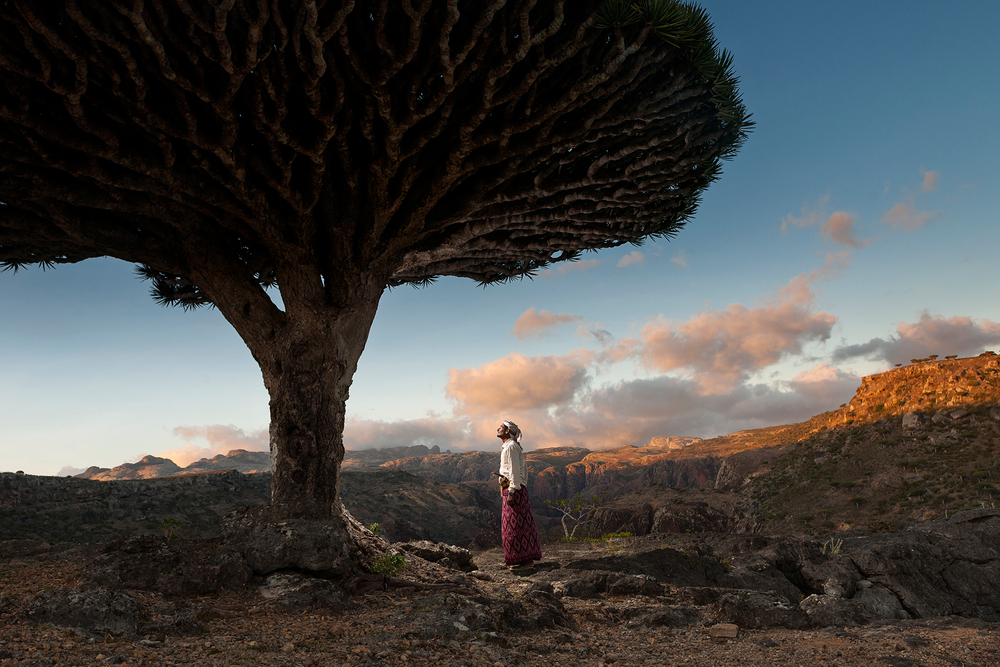
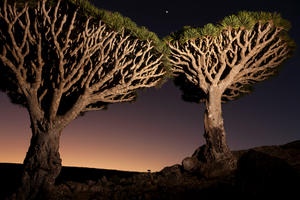
Due to its isolation, Socotra has become a treasure house of biodiversity: on the 825 plant species identified, 307 are endemic, a rarity on a global scale. The most famous gem is called "Draceana cinnabari", aka dragon blood tree.
It is the important variety of resin trees that would have pushed Bedouin tribes of South Arabia to settle on this archipelago lost in the Indian Ocean, a thousand years before our era. Some writings claim that Alexander the Great, in the 4th century BC, wanted to conquer Socotra in order to be able to extract a local myrrh, which would heal the wounds of his soldiers.
The magical virtues of those trees have declined over the centuries, but Socotra has long remained, in the eyes of merchant navigators, a mysterious stopover.
In his travel stories, Marco Polo spoke with fear about the inhabitants of Socotra "Capable of blowing the wind they want and make the sea calm or make great storms...".
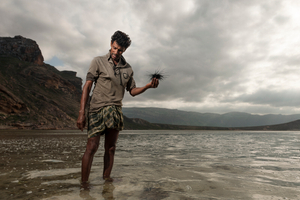
A sign that times are changing, the Socotris, who for a few years have access to the Internet, are expressing themselves on social networks and wondering: "To be part of Yemen or to obtain autonomy?". The idea is not new, but since the beginning of a complex civil war on the mainland involving several regional actors, the question has arisen more and more.
As the economic crisis become worst due to the war on the mainland, and because the Emirati and Saudi investors are more and more numerous, the camp of environmentalists has reduced in favor of supporters of development at any cost.
That is why some families have already sold pieces of their land to Gulf countries’ investors.
For the moment, no construction has emerged, but with time, Socotra the blessed island could become a lost paradise.
Socotra Island - Yemen - February 2020