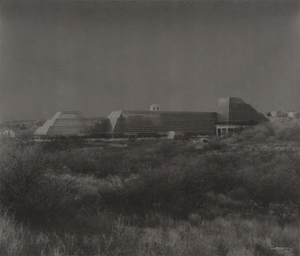
![KÓSMOS - Plurality of worlds as an Aby Warburguian library [2017- 2019]](https://photos.lensculture.com/large/0b504494-cca7-4d00-b07b-dd94cd5eeb06.jpg)

KÓSMOS - Plurality of worlds as an Aby Warburguian library [2017- 2019]
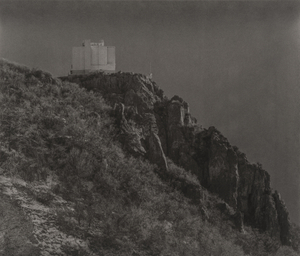
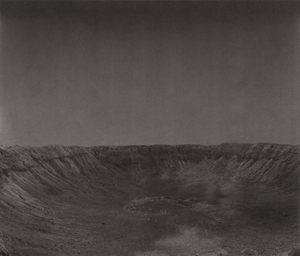
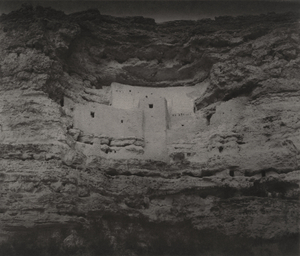
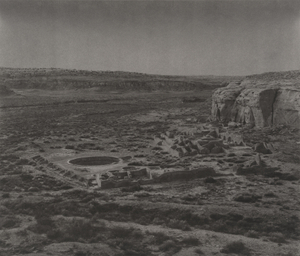
Photographic constellation realized in the American Southwest on a territory that includes the Fours Corners (Arizona, Colorado, New Mexico and Utah) to Southwest Texas. In Greek philosophy, the term KÓSMOS means «the ordered world», the organization of the terrestrial and celestial world. By capturing traces, induces in the landscape, KÓSMOS - Plurality of worlds as an Aby Warburguian library develops a perspectivist reading of this territory by associating an anthropological analysis with a subjective poetics of images. KÓSMOS doesn’t simply seek to reproduce the image of the world externally, to document it, but explores the primordial strangeness of our terrestrial «environment» perceived as an encrypted world, in order to reveal its mesh, its inter-connectivities and interrelationships and attempts to account for the relationship of humans to the terrestrial biosphere and the cosmos. Far from being an immense timeless expanse, this territory is a multi-temporal and multi-memorial space, where different sites reveal themselves as places that bear witness to a profound link between humans and cosmos throughout ages and civilizations. KÓSMOS mirrors the ancestral knowledge of the native populations of the Fours Corners but also contemporary scientific research, such as astronomy or ecology, as well as “Utopian” projections or environmental impacts, manifestations of a modernity crossed by hubris. A cosmovision expresses a world representation, its ordering, its kósmos in the first sense, by the set of perceptive, linguistic, conceptual, symbolic or representational systems of a singular culture. As each culture’s modes of existence and representation are singular, different cosmovisions can result from each of these cultures, even though they live within the same environment. Here in the American Southwest, we find two opposing cosmovisions. The first stems from the naturalistic and scientific approach of modern Western culture, which objectifies and reify «Nature», the other results from representations of the pre-modern world where the relationship between humans and the cosmos appears diametrically different : despite a wide variety of civilizations and cultures, Pueblos (Hopis, Navajos, Zunis, Acoma, Keres, Tewa, Tiwa, Towa) and other Southwest Native Peoples such as Appaches, do not consider space and the beings that live within it as material objects that they can possess, control or vanquish. They have developed knowledge related to astronomy, resulting both in a perception of the cosmos in which all the entities constituting it are interrelated and in a conception of circular time, in which categories of past, present and future do not necessarily follow one another, but intertwine, enlighten one another and coexist. Without the intention of circumscribing the world in a totalizing vision that would inevitably be reductive, this photographic corpus thus invites different cosmovisions and weaves its sense of their articulations and their resonances. KÓSMOS is a constellation in which the world composed of humans and non-humans, animal, vegetable, mineral and celestial worlds, is approached in a web of relationships, where the hierarchy of the subject’s knowledge is abolished in favor of an inclusive analogical synthesis by comparing different cosmovision, different points of view, different time layers, like the art historian Aby Warburg’s library. He had gathered, in his library, an immense fund of cultural memory where knowledge was decompartmentalized, more than sixty thousand books on ancient cults, rituals, myths, magic and art, in a subtle arrangement built piece by piece, according to the principle of «good neighborliness» where one book summons another which in turn is part of a network of horizontal junctions. The library, the art historian’s «space of thought» [Denkraum], refers in its elliptical form to Kivas, «spaces of contemplation» (Andachtsraum) of Pueblos peoples, a pre-modern representation of the cosmos. The prints, made in Piezography (a printing process using carbon pigment inks) on a thin and fragile Japanese paper gives the photographic material a spectral and radiant presence. They are evocative of the experiences of the pioneers of photography, some of whom attempted to record «spectral appearances», invisible remanence. Impregnated with a black light, eclipse light obscure, the images of a carbonaceous chemistry with iridescent shades are imprinted like the reminiscence of a cosmic memory. We are, like these inks, carbon clumps, stardust. The light, black and vibrant, milky and napped, seems to come from the image projected into the inner vault of a skull. Like inner visions, KÓSMOS echoes a latent, ancestral space-time, enclosing a memory of material and immaterial, physical and invisible worlds.
No categories selected
Photos (10)