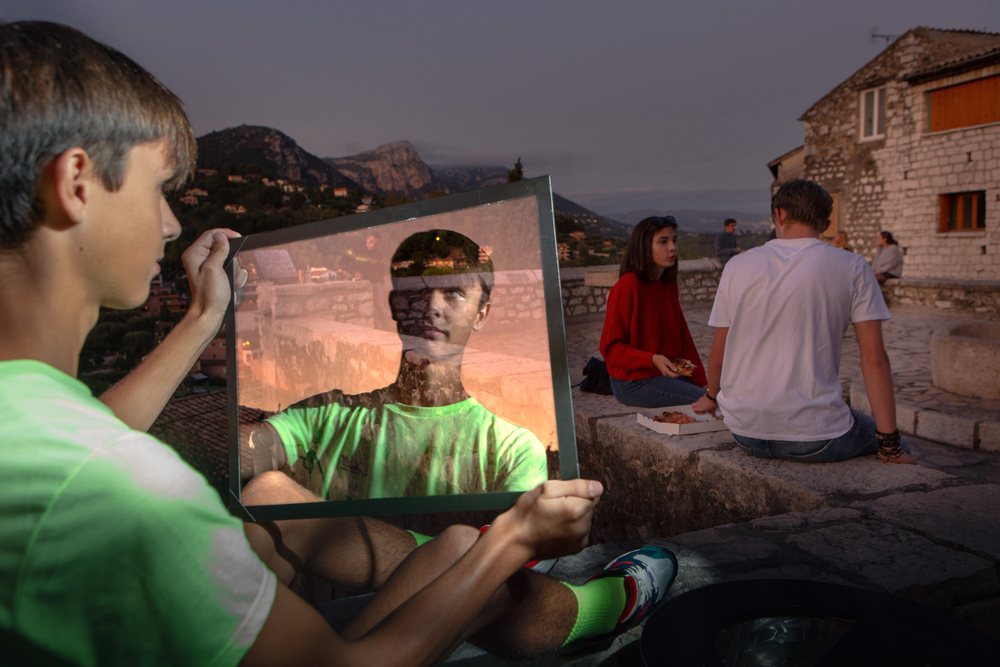
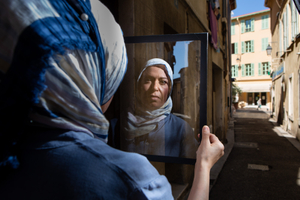
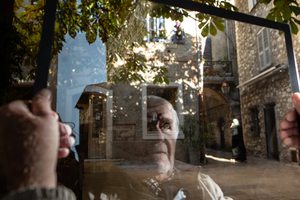
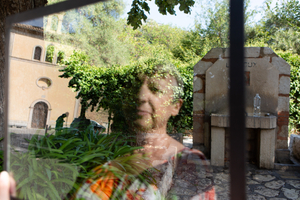
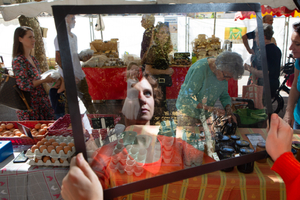
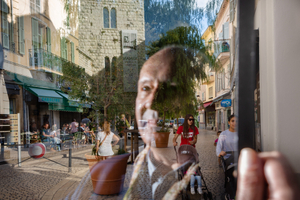
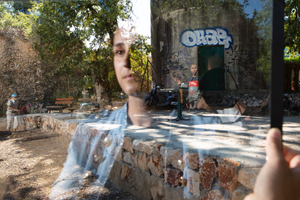
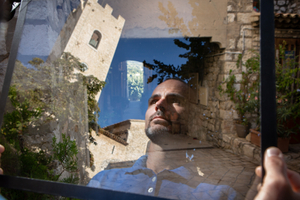
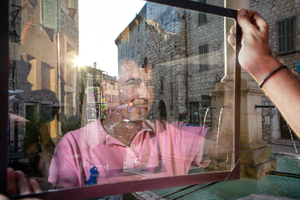
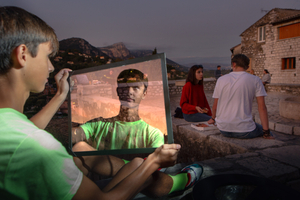
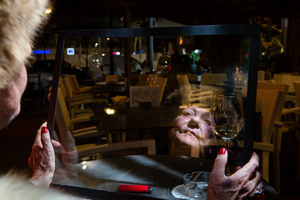
Mi Ieu, Ma Vilo [‘My Eyes, My Town’ in Provençal] is a set of portraits of the inhabitants of Vence, a small town in the South of France. In a reversal of the usual configuration of a portrait (viewer facing the subject), we look over the subject's shoulder to see their image as a reflection in the sheet of glass that they hold - and simultaneously we see the town through their eyes.
This work sets out to explore how our internal narratives, usually unseen, colour the perception we have of our surroundings. The location of each portrait was chosen for its personal meaning for the subject, and the glimpes of the background, behind the viewer but reflected in the glass, symbolise aspects of the subjects' lives that contribute to their understanding of the world.
In the 1960s, French philosopher Maurice Merleau-Ponty asserted that “the body and that which the body perceives cannot be disentangled. Communing with the beings and surroundings it encounters, the body intentionally elaborates them within an ever-present world frame, through use of its pre-conscious, pre-predicative understanding of the world”. It can be said that we each see the world through our own frame.
The intimate portraits, and the interplay of the multilayered reflections visible within them, prompt a consideration of the uniqueness of everyone's point of view. Our individual perception of the world can act as a filter to what we see - and as a barrier between us and others (perhaps especially relevant in the context of social distancing during the COVID pandemic).
Generally, when we view a portrait, we have the impression of looking the person in the eye, face-to-face. It can feel like knowing someone; it can also feel confrontational. Looking at a person’s reflection in glass changes our reactions to their portrait, however. Perhaps we feel that, as we are standing beside rather than opposite them, we are side-by-side with the subject, sharing their view? Or there may be a sense of voyeurism instead, as the photographer looks over the person’s shoulder and we sneak an uninvited look at them, and at their private view of the world?
All reflections and appearance of layering in the portraits were achieved by careful positioning, ambient and flash light, and working with the contrast of the scene at the time - no image processing software was used to manipulate or enhance any of the images.