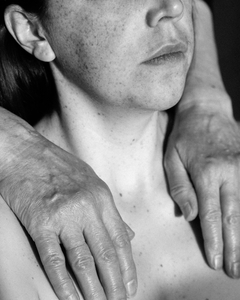
Twenty Seconds To Safety
Whilst I was back at our family home over Christmas last year I made this work with my younger sister, Katie. She had been living with OCD since last March, our mother had a mastectomy and five days later England went into a national lockdown. Katie was deeply fearful that she would pass on the virus to our mother and make her fatally ill, whilst she was isolating in her student halls in preparation for coming home, her OCD began. Before last March I had no experience with OCD, neither did Katie, she told me, ‘a while ago I knew someone with OCD and I thought they quite liked having it, because I thought it was their choice and something to satisfy their needs, I couldn't have been more wrong.’ OCD is not anything like we could have imagined, so often it is misrepresented in the media and trivialised, seen as just a mechanical act. Whilst being at home with my sister I witnessed how OCD affected her, it made me aware of how narrow our understanding of OCD is, and how lazy visual tropes feed this ignorance. What struck me the most about Katie’s experience is how emotional it is, and how these emotions are not linear or operate in binaries. OCD is unrelenting and nuanced. Born out of love, fear and a desire to protect, Katie’s OCD has always been intensely emotional, and continues to be. The aim of the work is to make people aware of the hidden battle that OCD sufferers continuously experience, and to challenge common preconceptions.
No categories selected
Photos (10)