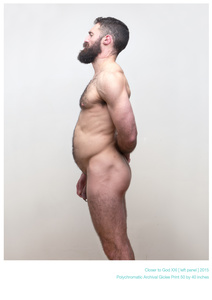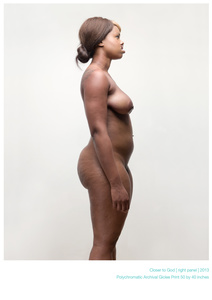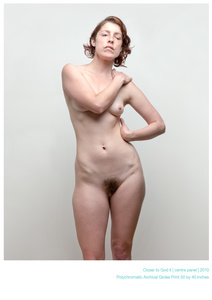
Closer to God
Closer to God is a series of anthropological fictions that seek to question the modern beauty myth while subverting the notion of the photograph as a document of truth. The Modern Beauty Myth: Few photographers today seem to be dealing with the body as “the body itself”. The NUDE seems to have been usurped elsewhere. Certainly the Nude within the canon of photography seems to have become a cliché to say the least. The dubious aesthetic of the Fine Art Nude, with all its seductive lighting, poses from art antiquity, and sensual feminine curves seem to have undermined any serious discussion on the body within photography. The giant naked portraits of Closer to God aim to confront us with our own preconceptions of the human body, an attempt to balance the scales, and to re introduce some discussion on the Body back into an arts arena. Though these images are fictions, they are deliberately confrontational to try and raise awareness of the possibilities of the human firm and to disconnect us from our preconceptions. To remove the veneer of the media idealised form. The human body is capable of all manner of forms, so many of which are judged as undesirable, as are those who inhabit these bodies. I have chosen to make these images as fictions as I did not want to further exploit or further en-freak anyone whose physicality stands them on the fringes of society. Knowing that these images are fictions allows us to more directly scrutinize them without guilt, and this scrutiny is what will result in a questioning of our attitudes to the body and its representation within the arts and broader forums. Photography as Document: Photography is indexically tied to notions of reality. The photographic image is generally always considered to be a sort of realism. The hyper real descriptive photography of the past few decades is driven by impersonal observation and an unsparing factuality. Perhaps the instigators of this unswerving eye could be Bernd and Hilla Becher with their famous and ground breaking Water Towers 1967-83, and their many students at the Kunstakademie in Düsseldorf exemplified by Thomas Ruff in his application of the Becher’s methodology to portraiture. Although this methodology is of some interest, I find the discrepancy between the presumed reality of the photograph and what is increasingly becoming a manipulated approximation of a reality. Digital technologies now allow for the editing of images at an increasing level of sophistication. The hyper reality of the photograph can now be manipulated into strange fictions, reflections of some sort of truth guided by the photographer. Although fully embracing this new plasticity given to photography by the digitization of the medium I have, however, used a sort of model proposed by Thomas Ruff in as much as each portrait I have made for Closer to God could be seen as being non per formative. In as much as I try very hard not to pose the models that are kind and brave enough to collaborate with me on this project. I am downplaying any sense of a performance in making these images, any sense that the images have been directed or staged on an obvious level. I encourage these models to present themselves before the camera to be looked at, scrutinized even. By asking them to adopt poses, much like a life model for a painter, that they are confident they can hold for as long as ten minutes without moving their poses become ciphers echoing the history of figurative art. They pose for themselves, to express themselves and it is my purpose to recognize the emotional vocabulary of their pose/ body. The models have a shared lack of interest in the gaze of the observer, allowing the viewer to intimately look at the details of these fictional physiologies without fear of intrusion.
No categories selected
Photos (15)