CHICAGO
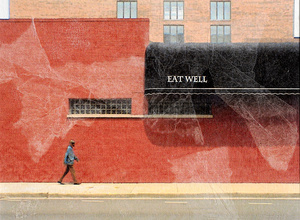
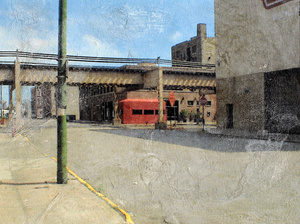
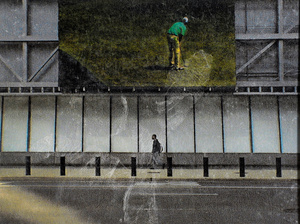
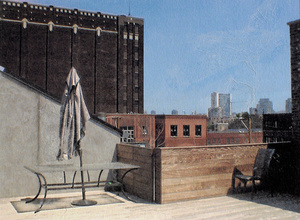
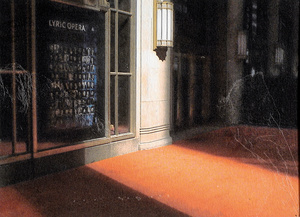
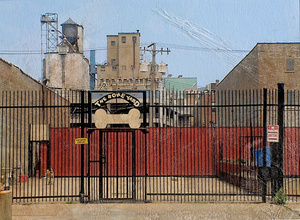
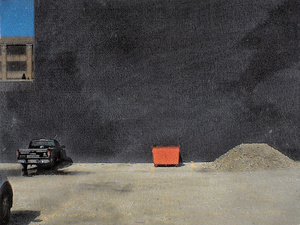
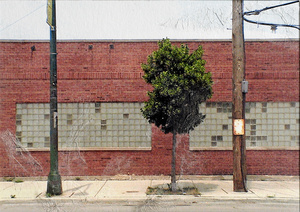
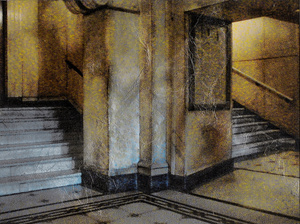
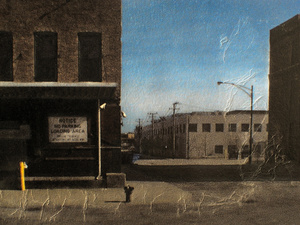
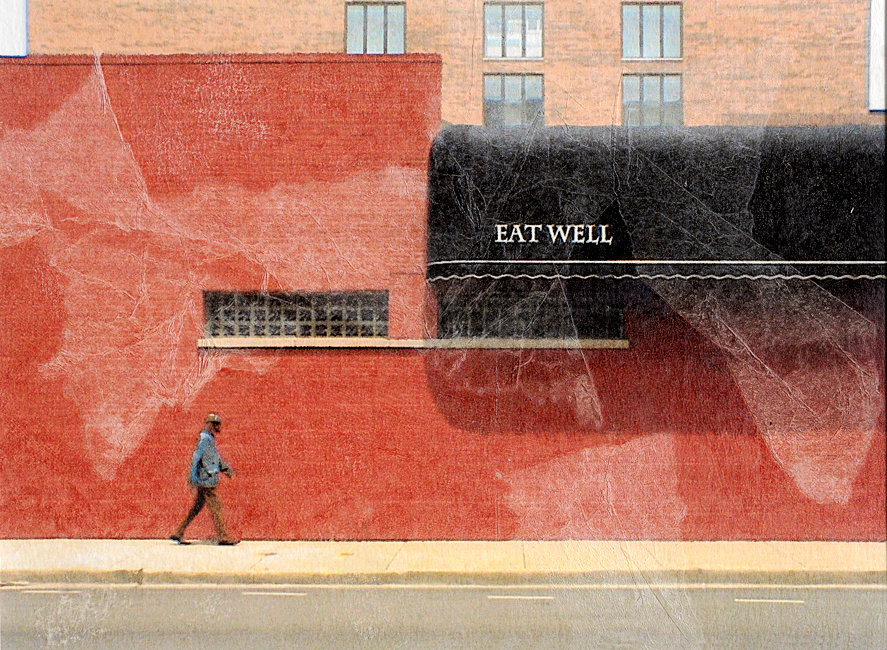
Observing Claude Andreini’s pictures is always a complex sensorial experience since in his case we’re not looking at conventional photographs, which offer different levels of surface with different levels of thickness where the tridimensional effect has to find its path and struggle against the flatness of the surface itself. In this case the glance doesn’t slip away upon the the smoothness of the paper, but it is instead caged inside a stratified paper frame and there it initially stops in order to understand the enigma of how the image has been physically rebuilt after the digital recording. The hands, attracted by the innovation of the medium, struggle to avoid touching its surface: Andreini’s pictures are just apparently mere photographs, and not for the chromatic value only, which is setted between two figurative worlds – photography’s detailed one and the more brushed one of painting – but overall due to the rough corporeality of the paper which becomes one with the picture’s body, with what it is representing. The image is absorbed by the paper’s fiber and lets itself run trough the roughness of the paper, a product of the pixel interfering with the the printer and the paper, which is indeed a paper stratification since on the base many layers of paper are literally displayed as sheets. This technique makes us think about the sprain and brings with itself the act of the author, seldom recalled by conventional photographs. And the act, the powerful expressiveness of the movement, has always been the distinctive way by which Andreini gets his images of reality. I started this text underlining the materic peculiarity of these works simply because it plays an important role in the act of giving itself to the glance of this “Chicago”. Indeed the gaze lives these urban seeings – which are indicators of the multiplicity of existences and structures as it is evident in the very nature of being a metropolis – by an overlapping of sensorial and mental approaches. That is, the merely ocular one (what the photographer sees and frames and for this reason is recognisable), the tactile one ( chromaticity and materiality of buildings, streets, traffic signals, street furniture etc.) and the mental one (the signification element and the symbols evocative one, with memory recalls to the a certain iconographic tradition derived by photography and painting). This last element works by more or less aware quotations- being themselves already part of the contemporary visual culture – which hark back to the American landscapers, such as “the new topographers” and their European epigones. That’s not all. There are evident recalls to the the American cinema as well, contemporary and not, to the works of Wenders, and even to those urban atmospheres which lead us to a classic painter such as Edward Hopper. That’s because I spoke of cultural complexity, fed of these forms of visual contamination related to the overlapping of different aesthetic directions. The resulting “Chicago” is a city recreated by the conceptual and technological versatility of this Italo-Belgian photographer, who is more a world citizen than a person tied to a local reality. His “Chicago” is the result of his own cultural experiences and of his imaginative luggage, but it is somehow that America metropolis which belongs to the collective memory as well, that indeed belongs to our imaginary, built on the roots of media visions which are part of us. This author is deeply eclectic, but what has been swallowed is once again proposed under the clever filter, as we said, of an extremely capable materic and chromatic elaboration which comes after the shot and which absorbs the recorded instant in aesthetic dimension, very transcendent. Nothing is more far from Andreini than the “shot” (a word so very abused by photojournalism to become fashionable), as well as the mimesis of the instant, and the insignificant present drained in itself. Using the wheat of reality Claude makes a dough, ready to be forged by his hands just like it was clay. The result of this operation is put in place of that reality and of that perceived which was existing at the beginning but enriched of those sensorial and plastic values without which there wouldn’t be an artistic work. His expressive field is setted half way by photography, sculpture and painting. His “Chicago” gives us the impression of being sculptured out of time due to andreini’s dedication to the empire of materiality, even if it is caught in the contemporary of light and by the stereotypes of dejà-vu. It is somehow as real as an ancient bas relief. Because of the “sprains” to which relate the paper frames that he uses to to print his seeing of cities, we can see stratifications unthinkable in photography. It look just like inside a mythologic metropolis the cracks may take life, something started moving from the inside and from beneath: the feeling that somewhere someone is operating an archeological digging. It is one of the effects of the destruction that Andreini has provoked. This is where a sort of skidding of perception takes place, that’s because we are used to understand american cities as devoted to present time, without history, monuments of an infinite modernity. I don’t think to be the only one who gets the peculiar resonance of this material effects, that may look like mere style exercises. It’s clear that Andreini’s work compounds form in first instance. His work on “chicago” is not an exception: its richness finds strength in the form and form is itself a part of what Andreini wants to communicate. Roberto Salbitani
No categories selected
Photos (16)